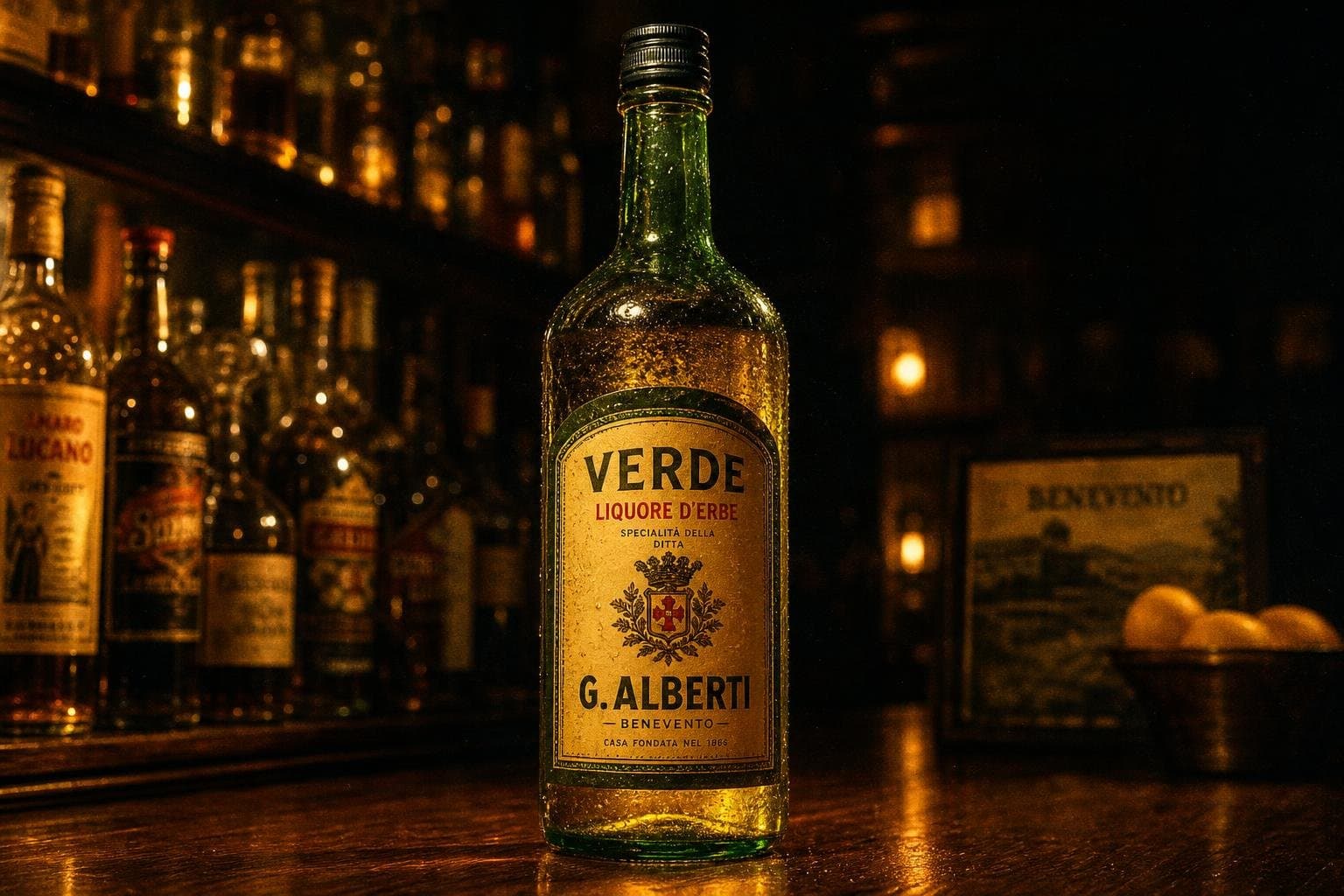

There's a bar in every serious cocktail city that has become, officially or unofficially, a Chartreuse bar. Not because the staff chose it. Because the Carthusian monks who make Chartreuse decided to decrease production, and the liqueur's agents responded by designating certain accounts as preferred distributors — meaning some bars get meaningful allocations while others get nothing. In Milwaukee, that distinction fell to two downtown bars: a high-end hotel bar and a rooftop tiki spot. In other cities, the list reads similarly: the most serious craft cocktail programs, the ones with the relationships and the reputation.
The result is a strange kind of market distortion. Chartreuse becomes simultaneously scarcer and more central — the thing everyone wants, the thing fewer people can get, the thing that defines a bar's seriousness by its mere presence on the shelf. And in the shadow of that dynamic, an entire category of herbal liqueurs has been quietly gathering dust.
This is worth examining. Not because Chartreuse is bad — it isn't, it's extraordinary — but because the cocktail world's fixation on it has functioned less like appreciation and more like a failure of curiosity. The herbal liqueur category is genuinely vast, built on centuries of monastic and apothecary tradition, and it includes dozens of bottles that can do things Chartreuse cannot. The question is whether bartenders have been too busy performing their Chartreuse loyalty to notice.
The Category Is Enormous. The Menu Representation Isn't.
The Oxford Companion to Spirits & Cocktails defines herbal liqueurs as sweetened alcoholic beverages with flavors derived from herbs and spices — typically made by steeping roots, leaves, flowers, citrus peels, and other botanicals in alcohol. The botanical list alone is staggering: angelica, anise, cardamom, cinnamon, clove, coriander, fennel, gentian, hyssop, iris, juniper, lemon balm, marjoram, mint, oregano, peppermint, star anise, thyme, turmeric. Common brands cited in the Companion include Bénédictine, Chartreuse, Jägermeister, Liquore Strega, and Galliano — and that's before the entry even gets to amari and fernets, which it classifies as subcategories of the same family.
That's a lot of territory. And yet walk into most craft cocktail bars and the herbal liqueur section of the back bar tells a much narrower story: Green Chartreuse, Yellow Chartreuse if you're lucky, maybe a bottle of Bénédictine that hasn't moved in three months, and whatever amaro the bar manager is currently obsessed with. The rest of the category — genepi, génépi, Strega, Galliano, Kümmel, the full range of Italian and French herbal digestifs — tends to appear only on menus that have made a deliberate editorial choice to go looking.
Retailer catalogs tell a different story. The herbal liqueur shelf at a well-stocked specialist includes Galliano L'Autentico, Liquore Strega, Amaro Montenegro, Contratto Bitter, Liqueur Génépi d'Armoises, Bigallet Le Grand Tetras Genepi, Tempus Fugit Kina L'Aero D'Or, and Luxardo Del Santo Herbal Liqueur, among others. These bottles exist. They're being made and sold. The gap between what's available and what's being used behind the bar is a choice — and it's a choice that's been heavily shaped by Chartreuse's cultural dominance.
Chartreuse's Monopoly Is Partly Earned, Mostly Constructed
Let's be fair to the monks. Chartreuse — made with 130-plus botanicals by Carthusian monks in France — is a genuinely exceptional product. The green expression has a complexity that rewards attention: herbal, warming, faintly medicinal, with a finish that evolves for minutes. The yellow is softer, honeyed, more approachable. The 1605 expression, first created in 2005 to mark the 400th anniversary of when the monks received the secret recipe, and the MOF cuvée, concocted in 2008 in collaboration with French sommeliers, represent genuine range within a single producer's portfolio. A Chartreuse flight, as offered at Agency in Milwaukee, is a legitimate education in how a single botanical framework can express itself across different production decisions.
None of that is marketing fiction. The product earns its reputation.
What it doesn't earn is the role it's been assigned: default herbal liqueur, irreplaceable ingredient, the thing that proves a bar is serious. That status is constructed — built through decades of cocktail canon-making, reinforced by the Last Word's revival (equal parts gin, Green Chartreuse, maraschino, and lime), and now calcified by the scarcity dynamic the monks themselves created. When a bar can't get Chartreuse, the conversation becomes "how do we substitute Chartreuse" rather than "what else in this category deserves our attention." That's a failure of framing.
The Pago Pago is instructive here. Created by the rum brand Ronrico in the 1940s and appearing in the second edition of Hyman Gale and Gerald F. Marco's The How and When, it's essentially a Daiquiri built with Chartreuse and crème de cacao — a drink that uses Chartreuse not as a starring ingredient but as a modifier, adding herbal depth to a rum-citrus framework. Paul McGee, who revived the drink at Echo Lake, compares its layered approach to Donn the Beachcomber's style. The Pago Pago is a good drink. But it also illustrates the problem: even when Chartreuse plays a supporting role, it tends to become the story. The herbal modifier gets named; the category it represents doesn't.
The Alternatives That Aren't Actually Alternatives
Here's what gets lost when Chartreuse dominates the conversation: the other herbal liqueurs in the category aren't substitutes for Chartreuse. They're different things entirely, with different flavor profiles, different histories, and different cocktail applications. Treating them as Chartreuse alternatives is like treating Campari as a substitute for Aperol because both are red and bitter. Technically adjacent. Functionally distinct.
Genepi — the alpine herbal liqueur made from artemisia plants native to the Alps — occupies a different register than Chartreuse. It's lighter, more floral, with a clean herbal quality that reads as mountain air rather than monastery cellar. Bigallet Le Grand Tetras Genepi is available through specialty retailers; Liqueur Génépi d'Armoises likewise. These aren't hard-to-find bottles in the sense of being out of production — they're hard to find in the sense of being poorly distributed and rarely requested. That's a different problem, and it has a different solution.
Strega — the Italian herbal liqueur that gets its yellow color from saffron and its flavor from mint, juniper, and fennel — has been made in Benevento since the 1860s. The Oxford Companion notes it specifically. It's a bottle with genuine historical depth, a flavor profile that's both distinctive and cocktail-friendly, and essentially zero presence on most American craft cocktail menus. Not because it's unavailable. Because nobody's been asking for it.
Bénédictine is the one herbal liqueur that has maintained some cocktail relevance — it appears in the Bobby Burns, the Vieux Carré, the Singapore Sling — but even its presence tends to be formulaic. It shows up in the drinks where it's always shown up. Bartenders rarely reach for it as a creative tool.
The American Distillers Who Noticed the Gap
The most interesting development in this category isn't happening in France or Italy. It's happening in American distilleries that have looked at the herbal liqueur tradition and decided to build something from local materials.
Haus Alpenz, the importer, brought the Austrian stone pine liqueur Zirbenz to the United States in 2005 — and that single bottle, according to founder Eric Seed, helped establish a foothold for complex herbal and alpine spirits in the American market. By 2011, when Sother Teague and Ravi DeRossi opened Amor y Amargo in New York City's East Village — described as the country's first bar dedicated to bitters, alpine, and herbal spirits — the bottles on offer were still predominantly European. The American production side hadn't caught up yet.
It has since. At Eda Rhyne in Asheville, distillers Rett Murphy and Chris Bower work with Western North Carolina's biodiversity to make an Appalachian Fernet and an Amaro Flora — the former described as evoking "a dark Appalachian cove with hemlock trees and moss dripping and slippery rocks and decaying leaves," the latter as "an Appalachian meadow. Sunshine and grass and insects buzzing around and wildflowers." At Leopold Bros in Denver, master distiller Todd Leopold applies European training to Rocky Mountain herbs and flowers in an alpine herbal liqueur called Three Pins, its name a nod to old-school Telemark ski bindings. At Breckenridge Distillery, master distiller Hans Stafsholt uses gentian and locally harvested genepi in Breckenridge Bitter.
These aren't Chartreuse substitutes. They're expressions of a different terroir, a different tradition, a different set of botanical decisions. The Appalachian Fernet tastes like Appalachia. The Three Pins tastes like the Rockies. That's the point. As Sother Teague notes, "pretty much any distillery that you can think of here in America is adding an aperitif or digestif or amaro to their portfolio" — which means the raw material for a genuinely diverse herbal liqueur program is more


