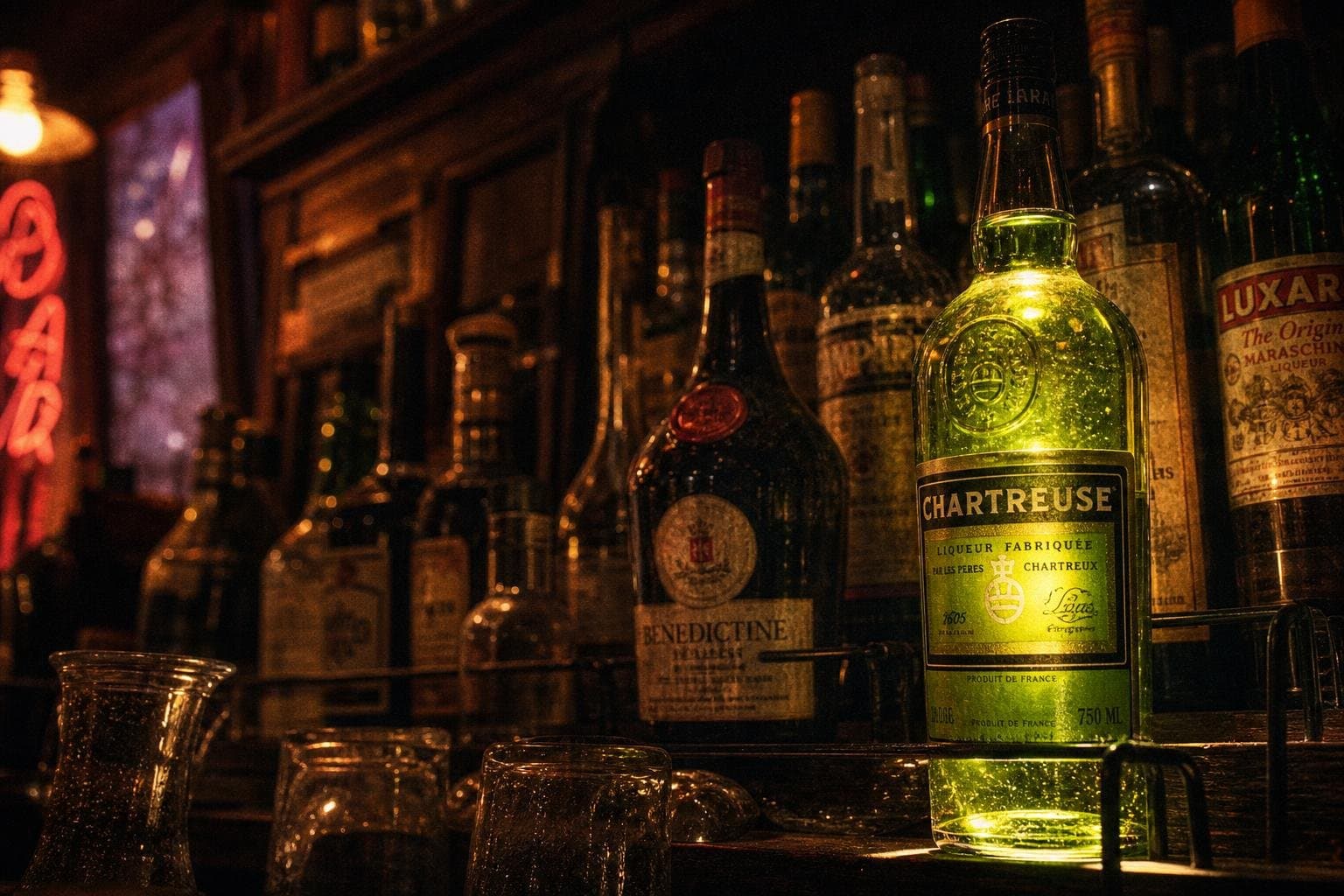

There's a bottle on almost every back bar in America that has been there longer than the bartender, longer than the bar's current concept, probably longer than the building's last renovation. It's amber-colored, vaguely ecclesiastical in its label design, and it gets reached for maybe twice a night — once for a Vieux Carré, once because someone's grandmother asked for it. Meanwhile, three feet away, the Chartreuse is either locked in a speed rail like a precious relic or simply absent, its empty slot a small monument to scarcity and status.
This is the herbal liqueur situation in 2026: one bottle commands reverence, shapes menus, and generates genuine supply anxiety among bartenders, while a category full of its peers — Benedictine, Strega, Génépy, Chartreuse's own yellow sibling — sits largely unexplored. The monks of the Grande Chartreuse didn't engineer this outcome. The bar industry did.
The Monastery Problem Isn't Unique to Chartreuse
Let's establish something the marketing tends to obscure: Chartreuse is not the only spirit with a legitimate monastic origin story. It's just the one with the best PR.
Amaro's origins trace directly to monastery culture — the practice of infusing alcohol with herbs, roots, bark, and botanicals began when religious communities grew medicinal plants and preserved them in spirit. Florence's Santa Maria Novella Pharmacy, founded by Dominican friars who cultivated a botanical garden in the 13th century, still produces herbal liqueurs today. Averna traces its formula to Capuchin friars at the Abbey of Santo Spirito in Sicily, who entrusted their herbal recipe to a local benefactor whose family began producing it commercially in 1868. The monastic origin story is not a differentiator for Chartreuse — it's a genre.
Benedictine is the obvious case. Made in Fécamp, Normandy, it carries the initials D.O.M. on every bottle — Deo Optimo Maximo, "To God, Most Good, Most Great" — and its formula involves dozens of botanicals including angelica, hyssop, and saffron. Whether the recipe genuinely traces to a 16th-century Benedictine monk named Dom Bernardo Vincelli or whether that's a later confection of the brand's 19th-century founder Alexandre Le Grand is, at this point, contested enough that you shouldn't present either version as settled fact. What's not contested: the liquid is complex, it's been continuously produced since the 1860s, and it's widely available at most spirits retailers for roughly $35–45 a bottle. It is not hard to find. It is simply not exciting to talk about.
Strega, the Italian herbal liqueur from Benevento, is another. Made with roughly 70 botanicals including saffron — which gives it that distinctive yellow color — and mint, it's been produced by the Alberti family since 1860. It's a digestif with genuine character, a slightly medicinal edge, and a flavor profile that sits somewhere between Chartreuse and a well-made amaro. It's also, in most American markets, a specialty shop find at around $30–40 a bottle. Not rare. Just overlooked.
The Chartreuse monks did something the others didn't: they capped production in 2021, citing a desire to protect their monastic life and devote time to solitude and prayer. This turned a beloved bar staple into a scarce commodity. Scarcity, in cocktail culture, functions as a kind of retroactive proof of quality. The shortage didn't make Chartreuse better. It made it more desirable, which in bar culture often passes for the same thing.
What Bartenders Actually Reach For, and Why
The honest answer to why Chartreuse dominates the herbal liqueur conversation is that it earned its place in the canon before the shortage made it precious. The Last Word — equal parts gin, green Chartreuse, maraschino, and lime — is one of the great balanced cocktails in the book, and Chartreuse's role in it is genuinely irreplaceable. The Naked and Famous does the same structural work with yellow Chartreuse. These drinks aren't famous because of marketing; they're famous because they're good, and Chartreuse's particular combination of proof and botanical intensity does something in a shaken drink that most other herbal liqueurs don't replicate cleanly.
But here's the problem: bartenders have largely stopped asking what those other liqueurs can do, because the Chartreuse template has become the default frame. If you're thinking about herbal liqueurs as "things that work like Chartreuse," Benedictine and Strega will always disappoint. They're not trying to be Chartreuse. They have different sugar levels, different proof points, different botanical profiles — and those differences suggest different applications, not inferior ones.
Benedictine is lower in proof and sweeter than green Chartreuse, which makes it a modifier rather than a co-equal spirit in most builds. That's not a weakness — it's a different job description. The Vieux Carré uses it as exactly that: a bridge between rye and cognac, adding herbal complexity without overwhelming either base spirit. The B&B — Benedictine and brandy, stirred — is one of the simplest and most underrated digestifs in the book, requiring exactly two bottles and about thirty seconds of effort. None of this is obscure knowledge. It's just knowledge that doesn't get activated because the bottle sits there looking familiar and therefore boring.
Strega has a different problem: it's genuinely strange, and strange requires a bartender willing to explain it. The saffron note is real and slightly medicinal, the mint is assertive, and the overall effect is herbal in a way that reads as slightly witchy rather than alpine-fresh. That's a harder sell at a busy bar than "it's like Chartreuse but yellow." But in a stirred drink with aged rum or a split base of cognac and aged agricole, it does something genuinely interesting — a warmth and complexity that's hard to source from anything else at that price point.
Chartreuse's scarcity has pushed some Philadelphia bartenders to look harder at alternatives, experimenting with Génépy and other alpine herbal liqueurs — discovering that the category has more depth than single-bottle dominance suggested. But this exploration is happening out of necessity, not curiosity, which means it'll stop the moment Chartreuse becomes reliably available again.
The Amaro Moment Didn't Extend Far Enough
The amaro revival of the last decade was supposed to change this. And it did change the conversation around bitter Italian digestifs — Campari, Aperol, Cynar, Fernet, Averna all got their moment of serious bartender attention. The monastic origins of amaro became part of the story bartenders told, connecting the category to something older and more serious than trend-driven drinking. Gentian root, fennel, anise, chamomile, cinchona bark — the botanical vocabulary of amaro entered the bar conversation in a real way.
But the amaro revival was fundamentally about bitterness — about training American palates to accept and enjoy bitter flavors, which they'd been conditioned to avoid. Herbal liqueurs like Benedictine and Strega don't fit neatly into that frame. They're not primarily bitter. They're complex in a different register: sweet-herbal, botanical, sometimes medicinal, occasionally floral. The amaro conversation didn't create a vocabulary for that kind of complexity; it created a vocabulary for bitterness, and everything else got filed under "modifiers" and left there.
Consider what happened with aperitivo culture by comparison. Aperol's formula involves a secret infusion of 16 ingredients, including bitter orange essence, gentian, cinchona bark, and Chinese rhubarb — a botanical complexity that rivals many herbal liqueurs — yet it gets discussed almost exclusively through the lens of the Spritz, as a vehicle for Prosecco and soda rather than as a spirit worth understanding on its own terms. The category flattening runs in every direction.
The cocktail renaissance's other great contribution — the recovery of pre-Prohibition recipes and techniques — also didn't do much for this category. The drinks that came back were largely gin-forward or whiskey-forward, with herbal liqueurs in supporting roles. The Manhattan, the Old Fashioned, the Negroni — these were the flagships of the revival, and they pulled bartender attention toward base spirits and vermouth rather than toward the herbal modifier shelf. One drink came back per cycle; the category stayed narrow.
The Spec Sheet Nobody Is Writing
Here's what a more curious bar culture would be doing with these bottles right now.
Benedictine in a split-base stirred drink with rye and aged rum — a variation on the Vieux Carré structure — is a genuinely excellent drink that requires no invention, just attention. The herbal sweetness bridges the two base spirits in a way that sweet vermouth alone doesn't. At roughly $40 a bottle (widely available at most spirits retailers and large liquor chains), it's not a budget compromise. It's a choice.
Strega with aged agricole rum and a small pour of dry curaçao is a combination that rewards anyone willing to spend twenty minutes with it. The saffron and the grassy funk of agricole create a tension that resolves into something genuinely strange and good. Strega runs around $30–40 at specialty shops and some well-stocked liquor stores — not online-only, not impossible, just requiring slightly more intention than grabbing whatever's at eye level.
Génépy — the alpine herbal liqueur that shares Chartreuse's geographic and botanical neighborhood — is perhaps the most direct substitute for bartenders working around the shortage, and the most interesting in its own right. Several producers are still actively making it; it's not out of production, just unevenly distributed. In the U.S., it's primarily a specialty shop or online purchase, running roughly $30–45 depending on producer. In a Last Word variation, it doesn't replicate Chartreuse exactly — it's lighter, less intense — but it produces a drink that's genuinely worth ordering on its own terms.
The pattern across all of these is the same: available, affordable, underused, and interesting. The bar industry has spent years building the vocabulary to talk about complexity, provenance, and botanical character — Tales of the Cocktail has made consumer education around exactly this kind of depth a central part of its expanding mission — yet that vocabulary gets deployed almost entirely in service of the same handful of reference bottles. It built the vocabulary and then stopped looking.
What the Shortage Should Have Taught Us
[Bartenders stockpiling cases, trading


