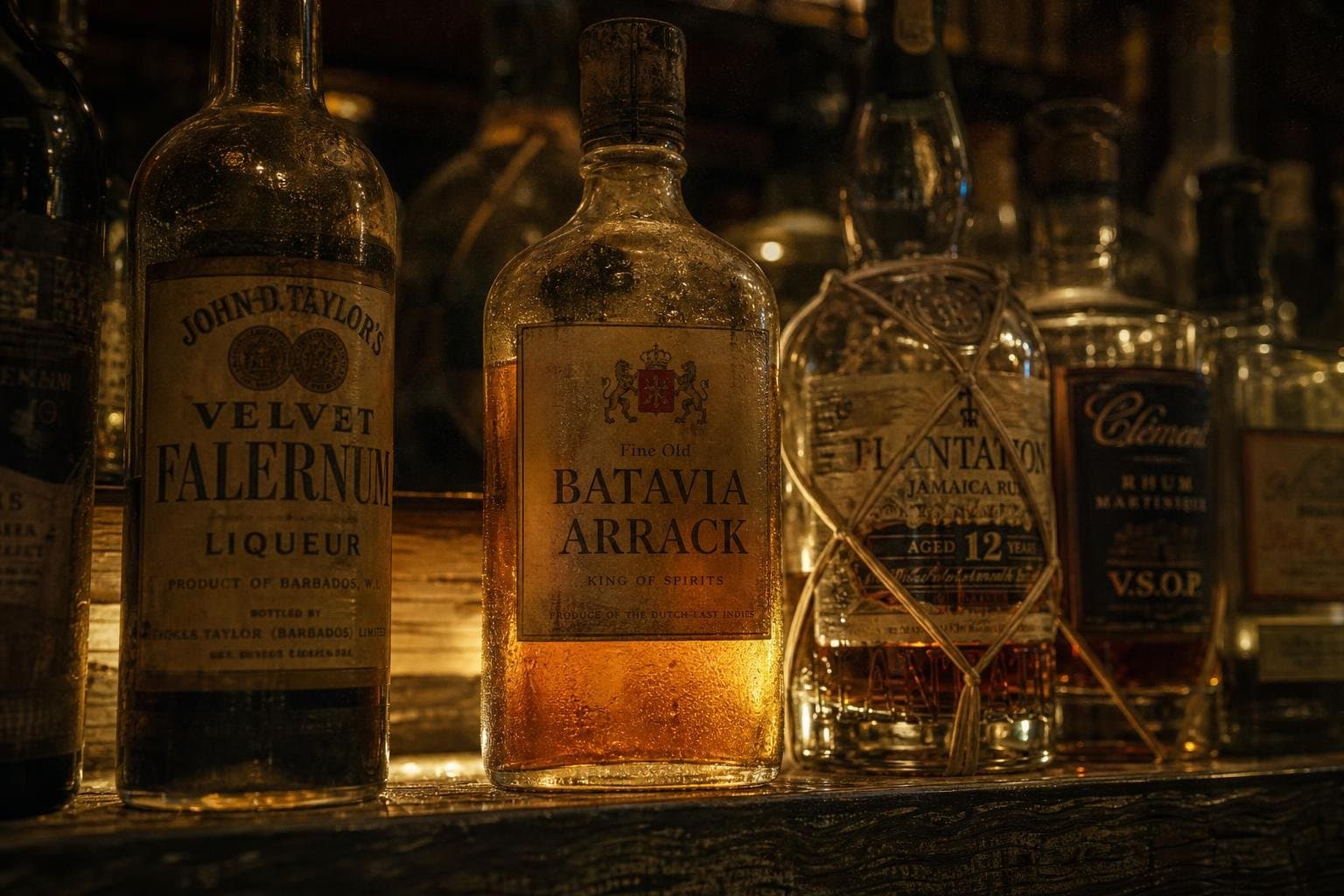

There's a bottle of Batavia arrack behind some bars — usually dusty, usually shelved next to the falernum, usually explained to customers as "kind of like rum." That explanation is doing a lot of heavy lifting. Batavia arrack is not kind of like rum. It is, in one meaningful sense, the spirit that made rum possible as a cocktail category: an older, stranger, more complicated thing that helped wire the Atlantic trade routes and colonized European punch bowls a century before tiki got its hands on the conversation. The fact that it now requires an apology — "think of it as rum, basically" — is not a triumph of simplification. It's a category failure with a long and instructive history.
The Original International Spirit
The case for Batavia arrack's priority in the family of distilled spirits is not a marketing confection. Thuppahi's Blog cites research tracing the arrack trade to around the 9th century AD, with the term in documented use in India before the 13th century — placing it centuries ahead of European brandy or rum in the vocabulary of international spirits commerce. "Long before the rise of the global trade in brandy, whisky, rum and other European spirits," the piece notes, "arrack was the world's first international spirit and Batavia arrack was the world's first luxury spirit."
That claim deserves the usual scrutiny — arrack history is contested, and the sourcing on pre-modern distillation is necessarily speculative. But the general trajectory is well-supported: by the time Dutch traders were running the spice routes through Batavia (present-day Jakarta), they were also exporting an arrack distilled from red rice and Javanese sugarcane that reached London, Amsterdam, and Lisbon well before Caribbean rum had a comparable footprint in European markets.
This matters because cocktail history tends to tell a story with rum at the center and everything else as regional footnote. The actual chronology is more interesting. Batavia arrack was the exotic import, the luxury oddity, the thing wealthy Europeans put in their punch bowls when they wanted to signal that they were connected to global trade routes. Rum was, in important ways, its cheaper, more accessible successor — not the origin point but the adaptation. Understanding that inversion doesn't diminish rum. It just restores arrack to the lineage it actually occupies.
What the Spirit Actually Is
The confusion around Batavia arrack starts with the name. "Arrack" covers a sprawling family of spirits — grape-based Lebanese arak, coconut flower toddy-based Sri Lankan arrack, anise-flavored Mediterranean variations — with the shared etymology tracing back to the Arabic araq (sweat or juice). Batavia arrack is specifically Indonesian, specifically Javanese, and its production method is genuinely distinct from anything else in the category.
The base is Javanese sugarcane, but the fermentation step involves red rice cakes — small fermentation aids that introduce wild yeasts and bacterial cultures contributing funk, earthiness, and an aromatic profile that sits somewhere between aged rum and a molasses-forward agricole. The result is neither clean nor brutal: it has a pronounced fruity ester quality, something faintly floral, a dry finish with real structure. Compared to a column-still light rum, it's a different conversation entirely. Compared to a heavy Jamaican pot still rum, it's a cousin — closer, but still distinct.
This profile made Batavia arrack the preferred base for European punch in the 18th and early 19th centuries. The spirit's complexity gave punch a backbone that simple sugar syrup, citrus, and spice could build on without overpowering. It was arrack punch — not gin punch, not rum punch — that dominated the cellars of London clubs, Amsterdam merchant houses, and colonial officers' messes across the British Empire. David Wondrich's work on punch history has documented this in detail; the spirit's European prestige was not incidental to its production character but inseparable from it.
How Tiki Made and Then Ignored This History
Which brings us to the central irony: when Donn Beach assembled his foundational tiki cocktail program in the 1930s, he wasn't just inventing drinks. He was raiding history. Pachitanglang notes that Beach "blended multiple rums of varying ages and distillation methods, combining light Cuban styles with heavy Jamaican variants" — an approach that consciously exploited the spectrum of rum character to create layered, complex drinks. This was sophisticated source material work. Beach understood that rum was a category wide enough to generate contrast, and that contrast was what gave his drinks their texture.
What the same history almost never acknowledges is that Batavia arrack was part of the pre-tiki lexicon that Beach and his contemporaries were, knowingly or not, inheriting. The punch tradition that informed classic mixed-drink culture — the tradition Wondrich traces directly through American cocktail history — ran through arrack before it ran through rum. When the tiki movement chose rum as its canonical base, it was making an understandable commercial decision (Caribbean rum was accessible; Batavia arrack was not), but it was also simplifying a more complicated lineage.
The simplification had consequences. By the mid-20th century, Batavia arrack had essentially disappeared from American bar culture. It was not, strictly speaking, out of production — the spirit continued to be distilled in Indonesia and used heavily in the Dutch market, where it has never lost its foothold in punch and bitters production. E&A Scheer, the Amsterdam-based blending house, has traded in Batavia arrack for generations and supplies it to European liqueur manufacturers who use it as a flavoring component. The spirit's absence from American cocktail culture was a distribution failure, not an extinction event. That distinction matters, and it's one the industry has been consistently sloppy about.
The Fernet Problem, Restated
The pattern here is familiar enough to be worth naming. When a spirit is obscure in a specific market, the story told about it tends to merge "hard to find here" with "basically gone." Crème Yvette, Batavia arrack, genever — all spirits with continuous production histories that got retroactively treated as lost relics when they were simply poorly distributed. (I've written about this dynamic in some depth with crème Yvette and with genever, and the mechanism is remarkably consistent: American market invisibility gets mistranslated into historical obscurity, which then frames the "rediscovery" narrative as more dramatic than it actually is.)
With Batavia arrack, the rediscovery narrative has been building slowly in craft cocktail circles since roughly the 2000s revival period, and it's followed the expected arc: a few high-profile bartenders started using it, a couple of spirits importers brought it into the American market, and now bottles are available — not widely, but genuinely. The Dutch-produced Naga Batavia Arrack Java Reserve is one expression reaching specialist retailers. Availability is specialty-shop to online-only depending on your market, and pricing varies by retailer. This is not a widely available spirit by any reasonable measure. But it is a findable one.
The question is what bars and home bartenders are actually doing with it when they find it.
What It Belongs In
The most honest argument for Batavia arrack as a cocktail ingredient is also the simplest: punch. Not tiki punch, which is a specific modern construction with specific modern expectations. Classic European punch — five-component, spirit-forward, citrus-balanced, built to serve a table. The spirit's complexity is designed for that application; it fills a large format the way a great Jamaican rum fills a single glass, with room to expand. The funk doesn't overwhelm; it anchors.
In single-serving format, the strongest applications lean into that ester character rather than smoothing it over. Subbing Batavia arrack for rum in a Daiquiri is instructive — the balance holds, but the result tastes earthier and drier, with a finish that lingers differently. Whether you prefer it is a matter of palate. But the drink reveals something. You learn more about what rum is by tasting what arrack is than you do from any number of side-by-side rum comparisons, because arrack clarifies which of rum's characteristics are shared across sugarcane distillates and which are specifically Caribbean — specific to the yeast strains, the barrel programs, the terroir decisions that define the post-tiki rum category.
That's the educational case for using it. The sensory case is simpler: it's good. The funk is interesting. The dryness is real. A well-made punch built on Batavia arrack doesn't taste like a rum punch with a substitution; it tastes like the form the drink was always supposed to take before rum achieved category dominance and retrospectively claimed the format.
The Longer Correction
Tiki's relationship with rum is so deeply embedded in popular imagination that renegotiating it feels almost pedantic. Rum is tiki; tiki is rum. Donn Beach understood rum; his successor Trader Vic understood rum; the whole revival movement that followed understood rum. Why introduce friction around a category relationship that works?
Because the friction is where the interesting history lives. The Barlist piece on rum's maritime history makes the point well: rum's dominance was infrastructural before it was aesthetic. It moved because of sugar trade economics, naval supply chains, and plantation-era production scale. Batavia arrack's European dominance preceded rum's and ended not because the spirit got worse but because the Dutch trading empire contracted while British Caribbean production scaled. These are geopolitical facts that got translated into cocktail history, and then, gradually, into cocktail mythology — the mythology being that rum was always the default, always the right choice, always what the tropics tasted like.
Batavia arrack pushes back on that story. It says: the tropics have a longer memory than tiki does. The punch tradition that tiki drew from, however loosely, ran through Batavia before it ran through Barbados. That's not a reason to abandon rum or to treat arrack as a corrective. It's a reason to use it with the understanding it deserves — as a spirit with genuine historical weight, specific production character, and a claim on the form's ancestry that got quietly erased when the category stopped being commercially convenient.
The bottle's still dusty. That's on us.


