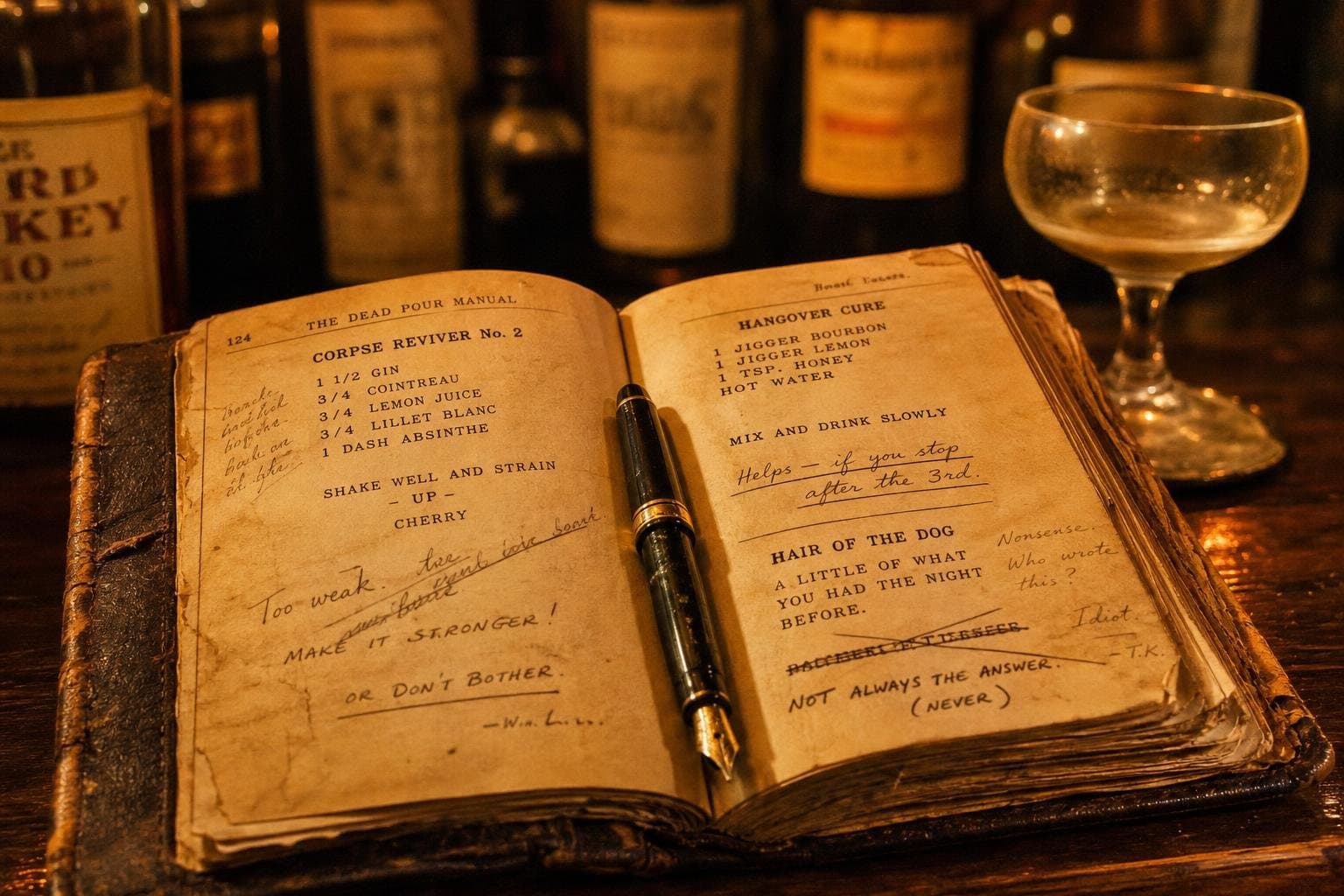

Ask a bartender where the Manhattan came from and you'll likely hear about Winston Churchill's mother hosting a party at the Manhattan Club in 1874. It's a good story. It is also almost certainly wrong. Jennie Jerome was in England recovering from childbirth that year, and the Manhattan Club didn't even occupy the building where the party supposedly happened until 1899 — a gap the Oxford Companion to Spirits & Cocktails traces back only as far as a 1945 telling (fooddrinklife.com). The club may well have invented the drink. Jerome almost certainly didn't hand it to them.
That's one entry on a growing pile of cocktail origin myths the historical record won't support, and the pattern across them is consistent: a glamorous founding scene gets repeated until it calcifies into fact, while the actual paper trail — menus, newspaper columns, bar manuals — tells a messier, less photogenic story. Compare that to how a BBC feature on New Orleans' Obituary Cocktail handles its own murky backstory: the drink's historian is quoted saying it was "likely invented" at a specific French Quarter bar, with the earliest documented reference dated to a 1942 guidebook — hedged language, honestly attributed (bbc.com). That's what responsible provenance sounds like. It's rare.
The Martini Was Thirsty Miners. The Bloody Mary Was Two Guys Arguing. Neither Claim Holds.
Take the Martinez, California story — a bartender supposedly mixing a proto-Martini for a miner headed to San Francisco. The person who passed that story down was an infant when it allegedly happened, and nobody has ever located a record of the miner in question. Meanwhile gin-and-vermouth drinks were already showing up in print by 1883, well before the legend's timeline would allow (fooddrinklife.com).
The Bloody Mary fares no better. Fernand Petiot gets credited for inventing it at Harry's New York Bar in Paris in 1921; George Jessel claims he beat him to it in 1927. The Oxford Companion's researchers found no contemporary evidence for either man's story — the first time vodka, tomato juice, and the drink's name actually appear together in print is a November 1939 newspaper column (fooddrinklife.com). Two egos, one drink, zero proof.
This is exactly the terrain where vintage-themed bars thrive on unverifiable color — a Juneau saloon that displays "a pistol owned by Wyatt Earp himself" as part of its Gold Rush-era pitch, no documentation required, because the point of the prop is atmosphere, not accuracy (thetakeout.com). Nobody expects a barback to produce a chain of custody for a pistol. We hold cocktail origin stories to roughly the same standard, which is the problem.
I'd argue American bars have a particular weakness for single-inventor myths because they're easier to print on a menu than "nobody really knows, but here's what we can document." A name and a date fit on a laminated card. "Disputed, probably mid-1880s, several competing claims" does not. So the simpler story wins the menu even when it loses the argument.
Getting the Footnotes Right Isn't the Same as Getting the Drink Right
There's a second, related failure mode, and David Wondrich has put his finger on it: American bar culture has gotten so good at reconstruction that it's started mistaking fidelity for excellence. Wondrich argues the cocktail renaissance began as an act of recovery — hauling nineteenth-century formulas back from the grave — and that the recovery work was genuinely necessary. But he warns that once a bar culture defines itself through accuracy, bartenders get praised for how faithfully they reproduce the Improved Whiskey Cocktail rather than for anything they invent, and menus start reading "like syllabi" from coast to coast (davidwondrich.com).
The Old-Fashioned shows the healthier version of this same instinct. It spent decades "all but forgotten" before clawing back to menu-fixture status, and the writers covering its revival treat it as a flexible formula — spirit, sugar, bitters — rather than a sacred text, which is exactly why it keeps producing decent new variations instead of just faithful museum pieces (gardenandgun.com). Compare that to a documented, small-scale bar origin story like the Chardonello, where a Savannah bar manager openly credits a specific colleague and a specific surplus of Chardonnay for the drink's creation — no legend required, just two named people and an ingredient problem (imbibemagazine.com). That's what an honest creation story looks like when nobody feels the need to dress it up.
What Actually Deserves the Credit
None of this means the myths are worthless. The motorcycle-sidecar legend "probably explains the name" of the Sidecar even if the romantic Paris origin scene is pure bar lore, and two London bartenders were already publishing Sidecar recipes by 1922 regardless of who rode in on what (fooddrinklife.com). Even the communal punch bowl, which predates nearly everything on this list, carries more ritual mythology than documented fact — it was "never solely about the beverage itself," one bartender notes, which is a polite way of saying nobody's especially rigorous about where the formula actually came from (yahoo.com). Stories and documents can coexist. They just need to be labeled honestly.
Bartenders spin tales because customers want them — the same instinct that turns a Long Island order into a character study turns a drink's backstory into theater (insidehook.com). That's fine as entertainment. It's not fine as history.
The next time a bar tells you a drink's single, cinematic origin story with total certainty, ask who's writing the footnotes. If nobody can show you one, you're not hearing history. You're hearing marketing with better lighting.


