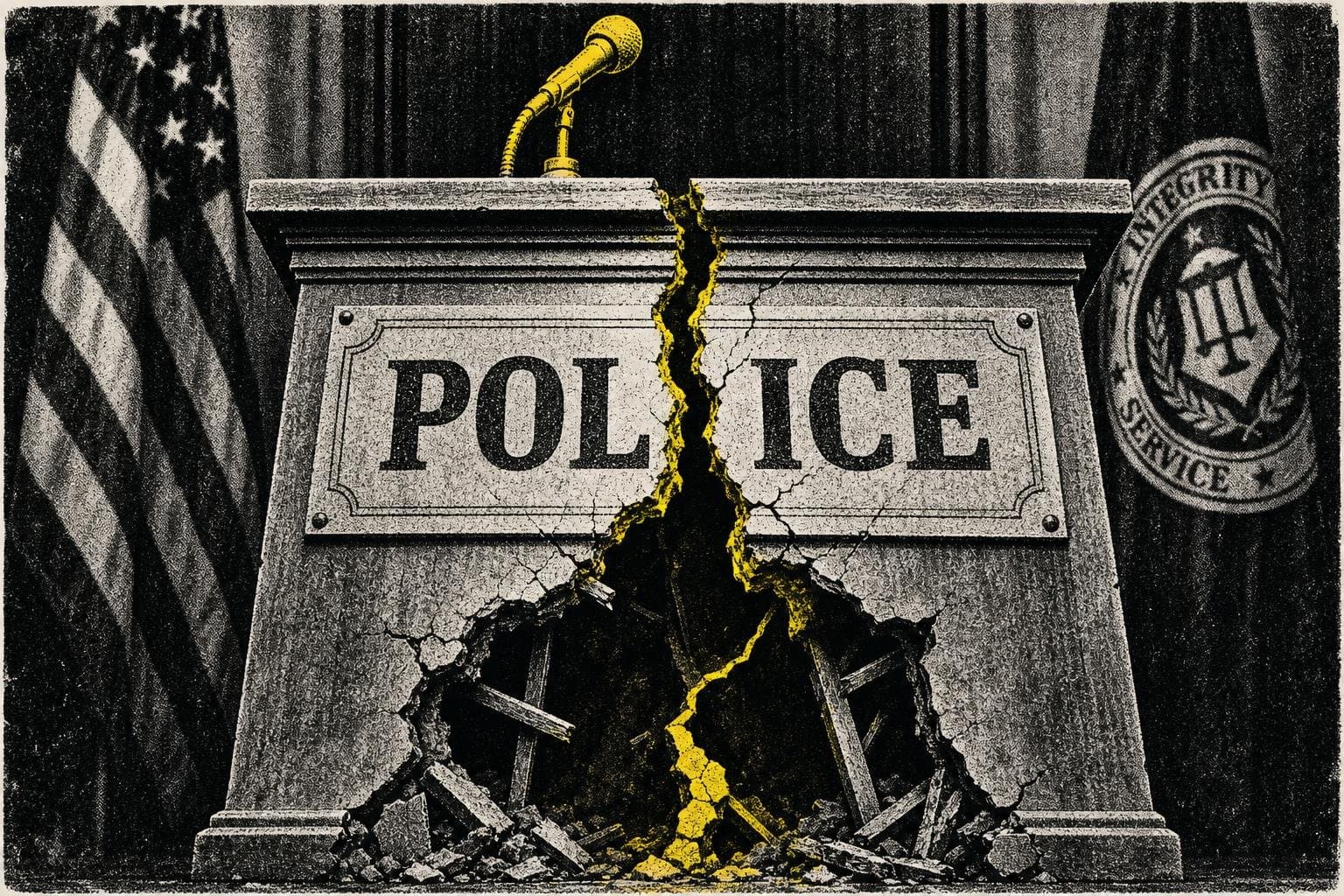

The Trump administration has a story it tells about mass deportation, and it goes like this: ICE is hunting criminals. The dangerous ones. The people who never should have been here and proved it by committing violent crimes. Every arrest is a community made safer.
That story is now collapsing under the weight of the administration's own data.
The Numbers Don't Lie — The Press Conference Does
When Homeland Security Secretary Markwayne Mullin announced 2,197 arrests in New York State last week — a monthlong operation grandly named "Operation Rotten Apple" — he described the targets as the "worst of the worst" criminals. He did not say how many had criminal records. Governor Kathy Hochul said she doubted many did.
She's right to doubt. Federal data obtained by the Deportation Data Project and analyzed by the New York Times shows that a majority of the immigrants arrested in July were accused of violating civil immigration laws but had not been charged with or convicted of any crime. The share with a past violent criminal conviction fell to less than 4 percent. Overall ICE arrests hit 43,000 in June and 49,000 in July — record highs — but the composition of those arrests has fundamentally shifted. The operation is no longer targeting the criminal population it was sold as targeting.
This is the weakest link in the administration's entire public argument, and mainstream media coverage keeps stepping around it. The press conferences get covered. The record arrest numbers get covered. The "worst of the worst" framing gets quoted. What gets buried is the simple arithmetic: if less than 4 percent of July arrests involved violent criminal convictions, and you're making 49,000 arrests, the math produces a very different picture than the one being presented from the podium.
The Machine Doesn't Care About the Story Anymore
Here's what's actually happening: the administration built a deportation infrastructure — more officers, more detention space, more local partnerships, more funding — and that infrastructure now has its own logic. It needs to be fed.
Claire Trickler-McNulty, a former senior ICE official, told the Times that the agency has "more officers, more money, more detention space, more local partners and better systems" and is "finally putting all the pieces together to build out this deportation machine." That's not a criticism — she's describing an operational achievement. But a machine optimized for volume doesn't naturally self-limit to the hardest targets. It finds the easiest ones.
The people being swept up now include those married to U.S. citizens, those who entered legally and were pursuing asylum claims, and those with temporary legal status the administration moved to revoke. Washington Post reporting confirms that ICE is detaining more immigrants without criminal records than at any point since Trump returned to the White House. These are not the people the public was told this campaign was about. They are, however, the people who are easiest to find and process.
The $1.8 million fine sent to Hector Negrete illustrates the same logic. Negrete was 3 months old when his parents brought him to California. He spent years trying to gain legal status, failed, and eventually left on his own — crossing into Tijuana in September 2025 and flying to Guadalajara. The administration's response was a civil penalty of $1,820,352 for failing to comply with a 2009 deportation order. DHS told CNN that more than 100,000 undocumented immigrants have received fines totaling more than $84 billion since the start of the second Trump term — and that the agency has collected more than $1.2 million of that as of mid-July. The fines are not a revenue strategy. They are a pressure strategy. But they are being applied to people who already left.
The Consensus Gets the Optics Right and the Argument Wrong
Mainstream editorial coverage has been appropriately alarmed by the human stories — the asylum seekers, the long-term residents, the people with American spouses. That coverage is doing real work. What it consistently misses is the structural argument underneath.
The conventional media frame treats the shift toward non-criminal arrests as a policy failure or mission creep — as if the administration accidentally drifted from its stated goals. The more accurate read is that the stated goals were always a political frame for a policy of maximum volume. "Worst of the worst" was never an operational constraint. It was a sales pitch. The infrastructure being built doesn't distinguish; it processes.
That distinction matters because it changes what accountability looks like. If this is mission creep, the fix is better targeting. If this is the mission, the fix requires confronting the mission itself.
The press conferences will keep calling them criminals. The federal data will keep telling a different story. The question is which one the midterm electorate decides to believe — and with November approaching, the climate of fear around election integrity gives the administration every incentive to keep the "worst of the worst" frame alive regardless of what the numbers say.


