


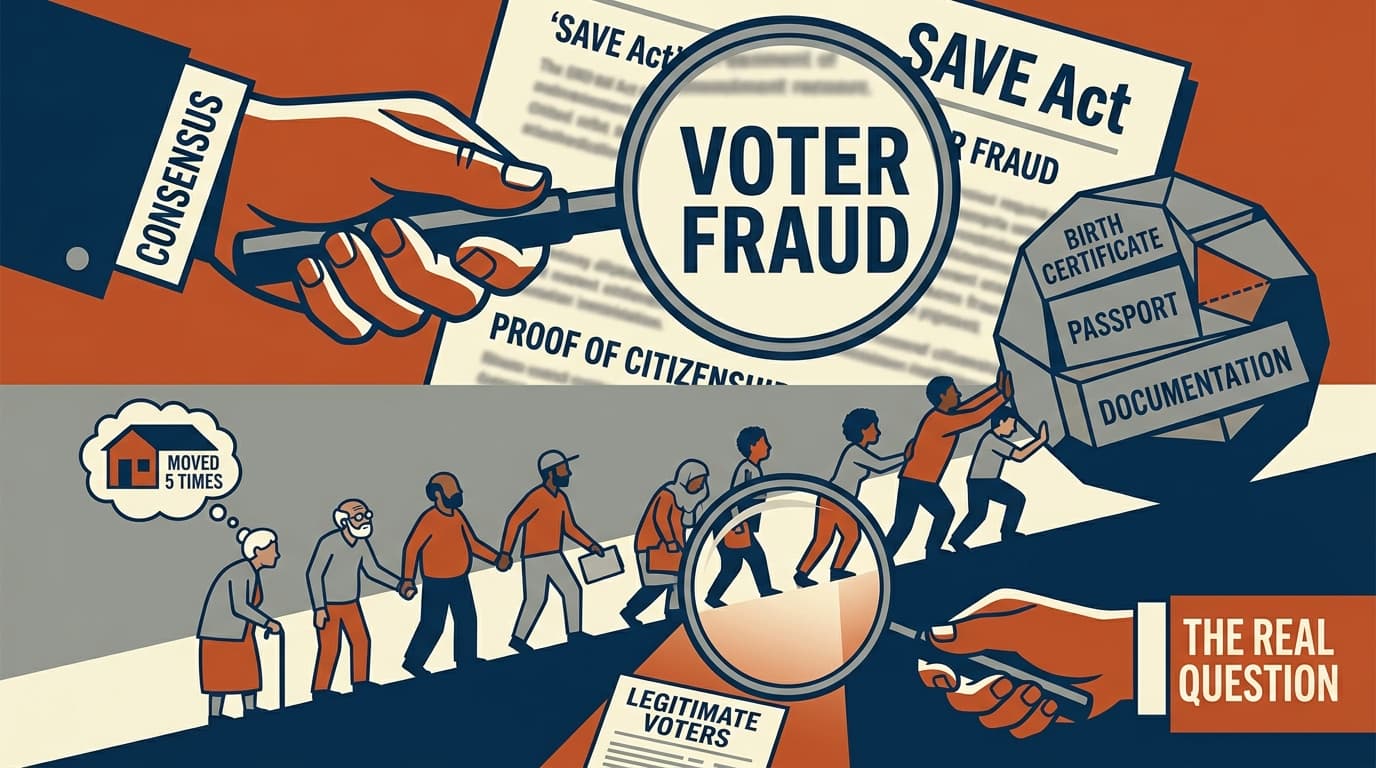

Everyone knows the SAVE Act is about "election integrity." That's the frame. Require proof of citizenship to register to vote, catch the noncitizens supposedly flooding the rolls, restore confidence in elections. Senate Republicans are moving to a vote this week, and the debate has settled into its predictable grooves: one side calls it essential security, the other calls it voter suppression.
Both sides are arguing about the wrong thing.
Here's the assumption nobody wants to examine: that documented noncitizen voting is a problem of meaningful scale. It isn't. Noncitizens are already barred from federal elections. Registering to vote as a noncitizen is a federal crime. The actual documented cases of it happening are vanishingly rare — not because enforcement is lax, but because the incentive to risk deportation for a single vote essentially doesn't exist.
So what does the SAVE Act actually do? It adds a documentary proof-of-citizenship requirement at registration. Sounds reasonable until you ask who doesn't have a passport or birth certificate readily at hand. Not noncitizens — they're already not registering. The people who struggle with document requirements are elderly voters, low-income voters, voters who've moved frequently, voters whose birth records are incomplete. The mechanism doesn't target the stated problem. It targets a different population entirely.
This is the weakest link in the "election integrity" argument, and mainstream coverage keeps stepping around it. The Washington Post editorial page has noted the broader pattern of Trump using media and institutional pressure to shape narratives around the war and other priorities — but the specific policy logic of the SAVE Act gets less scrutiny than it deserves.
The question worth asking: if noncitizen voting is the problem, why is documentary proof at registration the solution? Voter rolls are already cross-checked against citizenship databases. The gap the SAVE Act claims to fill is largely theoretical. The gap it actually creates — eligible citizens who can't easily produce documents — is concrete and measurable.
Who benefits from that gap? Not election security. Watch the implementation details closely. That's where this one gets decided.