


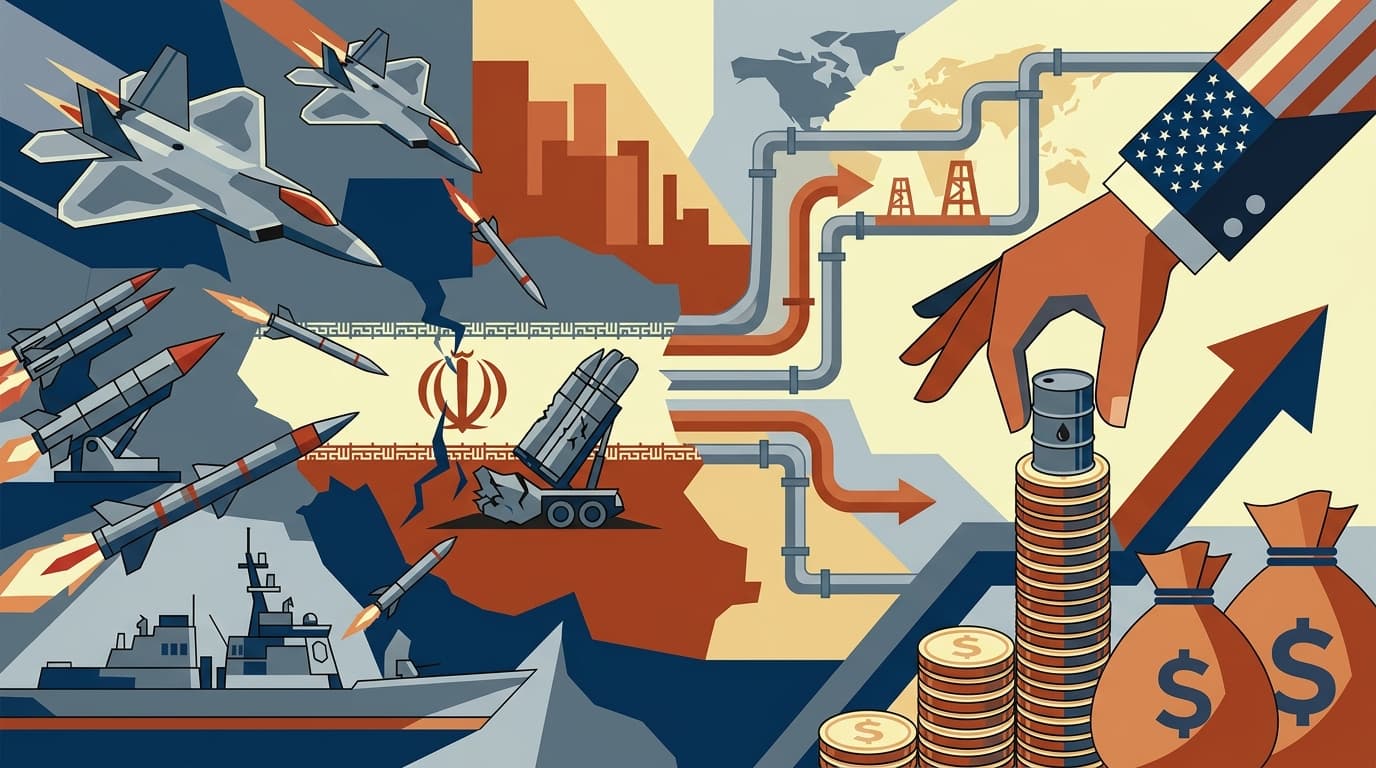

Here's the part of the Iran war coverage that keeps getting buried in the third paragraph: the United States has significantly degraded Iran's military — its air force, navy, and missile systems — while simultaneously watching Iran earn nearly twice as much per day in oil revenue as it did before the conflict began.
Read that again. The country we're bombing is making more money because we're bombing it.
The Consensus View Gets the Scoreboard Wrong
The mainstream editorial line on the Iran conflict has settled into a comfortable frame: America and Israel are winning militarily, but the politics are messy. The NYT, WaPo, and their foreign policy commentariat acknowledge the battlefield success while wringing hands about Trump's style and allied tensions. The implicit assumption is that military degradation equals strategic progress — that if you destroy enough of an adversary's hardware, you're winning.
The NYT's own opinion section called it "an operational success and a huge strategic failure" — which is at least honest — but even that framing undersells the absurdity. It treats the economic dimension as a side effect rather than the central story. Iran controls passage through the Strait of Hormuz. That control, achieved without inflicting much lasting damage on U.S. or Israeli forces, has handed Tehran a revenue windfall that funds the very regime we're trying to pressure into submission.
The weakest assumption in the consensus view is that military metrics and strategic outcomes move in the same direction. They don't, and the Iran war is a live demonstration of why.
Survival Was Always the Win Condition
Foreign Policy, via the Washington Post's Ripple, put it plainly: "Survival and disruption were always Tehran's strategic goals in the event of a war." The Islamic Republic didn't need to win a single air battle. It needed to still exist, still control the strait, and still make the global economy feel the pain. On all three counts, it's succeeding.
This is the historical precedent that keeps getting ignored. Asymmetric adversaries don't fight to win on your terms — they fight to deny you victory on yours. Iran's supreme leader is dead. Its nuclear program is set back. Its air force is largely destroyed. And yet the regime survives, oil revenues are up, and Trump's "visible frustration," as Foreign Policy notes, signals that the quick operation he wanted isn't materializing.
The respectable press covers the killed generals and degraded missile systems because those are concrete, verifiable, and satisfying to report. The revenue story is harder to frame as a headline. But it's the one that tells you who's actually ahead.
The NATO Distraction Compounds the Problem
While the Iran war grinds on, Reuters reported that Trump has threatened to exit NATO, scaling up tensions with allies at precisely the moment when allied coordination matters most. The Strait of Hormuz isn't just an American problem — it's a global shipping chokepoint, and about 40 countries attended a virtual meeting on reopening it, according to the Guardian. Zelenskyy, of all people, offered Ukraine's Black Sea expertise to help.
That's the geopolitical picture: America is threatening to leave its primary alliance while simultaneously fighting a war that requires allied shipping coordination to resolve. The editorial consensus treats the NATO threats as a Trump personality story — erratic, destabilizing, bad optics. What it actually is: a strategic gift to Iran. Every degree of allied friction is a degree of pressure Iran doesn't have to absorb.
What the Groupthink Is Missing
The media consensus has organized itself around a binary: military success versus political failure. That's a comfortable frame because it lets everyone be right about something. Hawks can point to the degraded Iranian military. Critics can point to Trump's approval numbers — 61 percent of Americans disapprove of his handling of the conflict, per a Pew Research survey published in late March.
But the more uncomfortable question — the one that doesn't fit either tribe's narrative — is whether the entire operational premise was flawed from the start. If destroying Iran's military hardware while leaving its regime intact and its chokehold on global shipping untouched was always the likely outcome, then the debate about winning or losing misses the point. The question isn't whether Trump is executing the war well. It's whether the war's logic ever led anywhere other than here.
Watch the Strait of Hormuz shipping data over the next 30 days. If Iran's oil revenue stays elevated while allied coordination on reopening the strait stalls, the "operational success" framing will become harder to sustain — even for the outlets currently clinging to it.