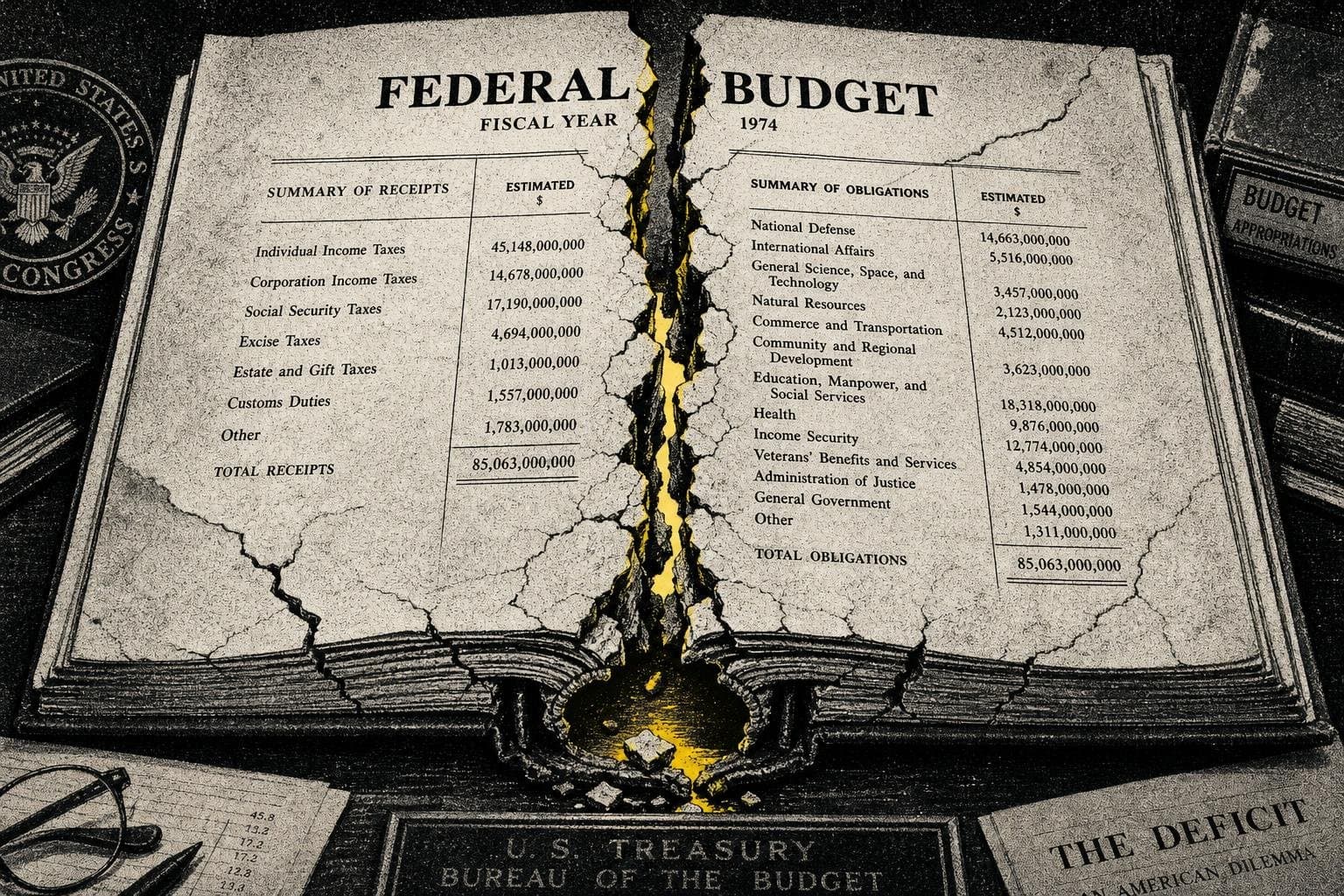

Last week the Treasury Department put a number on something everyone could already feel: the federal deficit hit nearly $2 trillion this fiscal year, up from $1.78 trillion in 2025. Around the same moment, President Trump's administration began mailing $500 checks to nearly a million Americans as a rebate on Affordable Care Act fees, with a personal letter touting his record attached. Put those two facts next to each other and you get the story mainstream outlets are telling: a president who promised to cut spending is instead writing checks with one hand while the deficit explodes with the other, a tidy hypocrisy narrative tailor-made for a midterm election.
It's not wrong, exactly. But it's thinner than it's being presented, and the thinness matters.
The Lede Blames One Man. The Data Blames a System.
Read past the headline and the actual drivers look less like a Trump morality play and more like a bipartisan structural problem that's been building for decades: higher interest rates inflating borrowing costs, rising military spending, Social Security outlays, and falling corporate tax receipts from the 2025 tax package, per the Treasury figures. Interest payments alone are doing heavy lifting — Treasury yields hit their highest levels in two decades earlier this month, a function of accumulated debt from administrations of both parties, not a line item Trump invented this year.
The Committee for a Responsible Federal Budget's Maya MacGuineas put it correctly when she warned the country will face the next crisis "more indebted than ever before," which "will limit our capacity to respond." That's a real warning, and it applies regardless of who's in the Oval Office, because the debt load she's describing was decades in the making. Collapsing that into "Trump broke his promise" is satisfying copy. It's not the same thing as an accurate diagnosis — and even Republicans in Congress seem to know it, with their own defense spending ambitions already running into the reality that the party may lose its House majority before it can pass the budget it wants.
The Checks Are a Symptom of a Weak Economy, Not Just a Campaign Trick
The press has settled on a second, related story: that Trump is throwing money at voters because the midterms are close and the economy feels bad. Also not wrong. The September jobs report showed employers adding just 29,000 jobs and unemployment ticking up to 4.2%, with wage growth falling to its slowest pace since the pandemic. Economist Claudia Sahm's description — "the labor market is stable, but it's not picking up" — is about as understated a summary of economic anxiety as you'll find.
But here's the part that gets flattened in the consensus telling: if the labor market is genuinely soft and real wages are falling behind inflation, direct checks aren't purely a cynical vote-buying scheme layered on top of reckless spending. They're the kind of blunt-instrument relief governments reach for when the underlying economy isn't delivering — which is exactly why Trump's team is leaning so hard on affordability messaging heading into November. Calling it uniquely Trumpian recklessness ignores that the deficit math was already baked in before a single $500 check went out.
Why the Simple Story Is the One That Sells
None of this means Trump gets a pass. He did campaign on cutting spending and has instead presided over the largest deficit since the pandemic stimulus years. But the press has an obvious incentive to tell the simplest version of that story right now. It's an election, and Chuck Schumer is explicitly campaigning on "affordability, corruption and healthcare" as the centerpiece of the Democrats' pitch to retake the Senate. A narrative of presidential hypocrisy is more useful to that campaign than a story about structural deficits that indicts fiscal choices made under multiple administrations.
It's worth remembering, too, that the same press now driving the deficit-hypocrisy frame is simultaneously fighting its own battle with the administration over access and credibility — CNN's own morning newsletter has spent recent editions tracking DOJ investigations into major networks and campaign-trail confrontations between candidates and reporters. None of that invalidates the deficit reporting. But an industry under siege has every reason to reach for the cleanest, most damning version of a story rather than the messier structural one.
The deficit story worth watching isn't whether Trump breaks his cost-cutting promise further before November. It's whether either party, in victory, does anything about the interest costs and structural drivers that will keep compounding no matter who holds the gavel in January.


