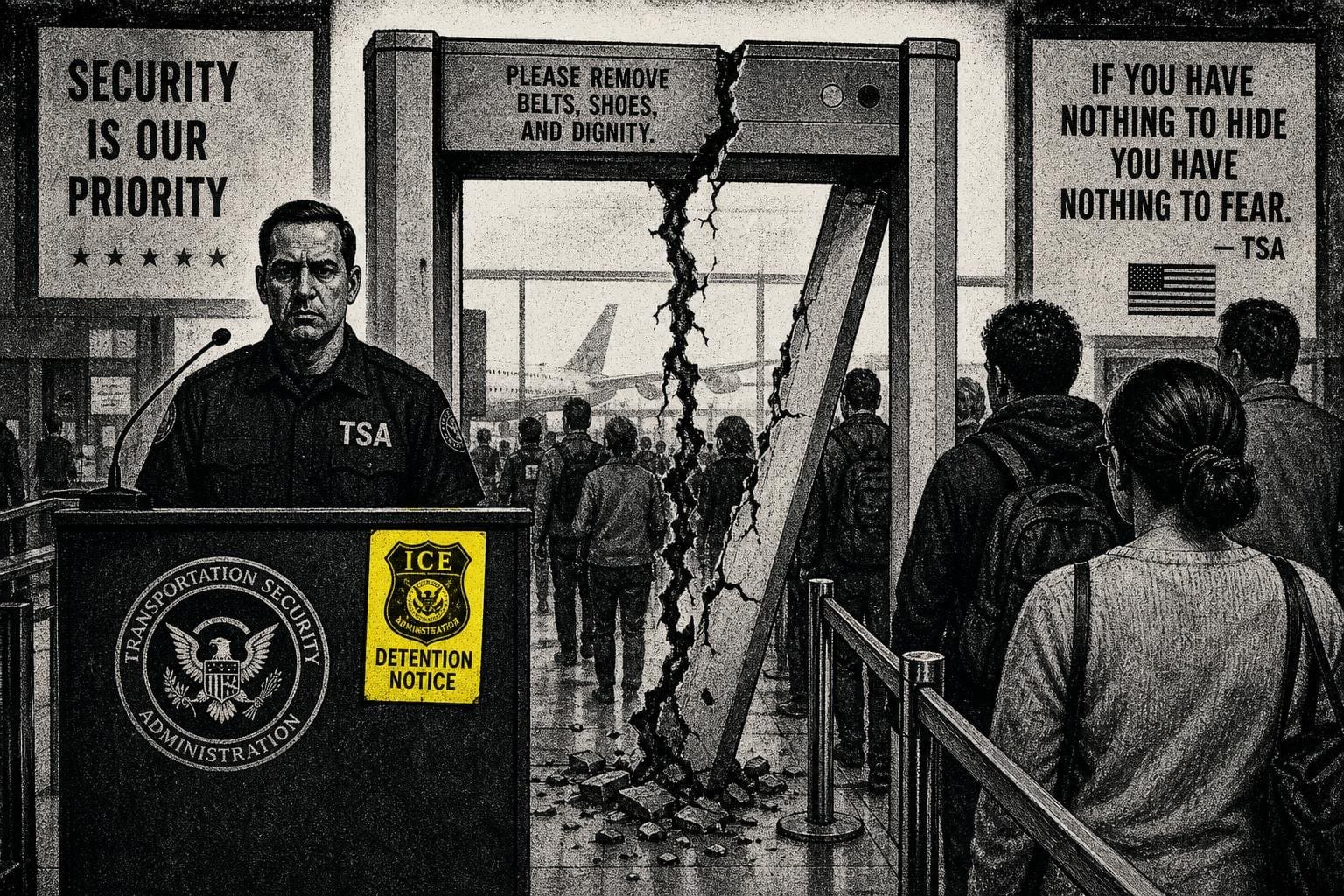

The images are striking: ICE agents in plain clothes at check-in counters, passengers filming on their phones, a woman detained on her way to her father's funeral. The coverage has been appropriately alarmed. What it hasn't been is analytically honest about why this tactic is happening and what it actually reveals about the administration's strategy.
The mainstream read is straightforward: cruelty as spectacle, enforcement theater designed to intimidate. That's not wrong, exactly. But it's incomplete in a way that matters.
The Tactical Logic Everyone Is Glossing Over
The New York Times reported that ICE has conducted enforcement actions at at least 15 airports in recent weeks, targeting people with expired visas — including spouses of American citizens and workers with pending applications. CNN confirmed that the shift followed two fatal shootings involving ICE officers this month, both of which began as traffic stops in Houston and Maine.
That sequencing matters. The administration didn't pivot to airports because airports are symbolically satisfying. It pivoted because traffic stops got officers killed, and airports offer something traffic stops don't: a controlled environment where DHS already receives passenger manifests, TSA is already present, and targets are, by definition, stationary and identified.
"When you're under pressure to ramp up arrests, it's all about what is the fastest and easiest way to get people into custody," former acting ICE director John Sandweg told CNN. Sandweg served under Obama — this isn't a partisan defense of the policy. It's a straightforward operational observation that the press has largely buried under the more emotionally resonant human stories.
The administration's stated goal is around 2,000 arrests a day. Airports, where targets are pre-screened and immobile, are a more efficient path to that number than roadside stops that can turn lethal. The cruelty may be real. The logic is also real. Treating this as pure performance misses the structural incentive driving it.
The Legal Gray Area Is the Point, Not the Problem
The consensus framing treats the visa-overstay population as an obvious overreach — people with pending applications, work permits, spouses of citizens. The implication is that the administration has stumbled into legally murky territory by accident or malice.
The opposite is closer to true. The administration is deliberately operating in that gray area because it's where the numbers are. The Times noted that hundreds of thousands of immigrants overstay visas each year, and that many occupy a legal gray area while awaiting extensions or green cards. Previous administrations deprioritized this group unless they had criminal records. The Trump administration has simply decided that "awaiting approval" is not a protected status.
That's a policy choice, not a legal error. And the courts are actively sorting it out. The 9th Circuit ruled Thursday — in a 2-1 decision that included a Trump-appointed judge in the majority — that the administration cannot deny detained immigrants a chance for release on bond, deepening a circuit split on mandatory detention. Meanwhile, the Supreme Court has already signaled broad deference to executive immigration authority in a pair of sharply divided June decisions.
The legal architecture is genuinely contested. But "contested" is different from "obviously illegal," and the coverage that treats every airport arrest as a constitutional violation is getting ahead of what the courts have actually decided.
What the Outrage Cycle Is Costing Us
Here's the structural problem with the current media frame: by centering every story on the most sympathetic individual case — the woman detained en route to her father's funeral, the tech worker swept up at the gate — the coverage implicitly concedes the administration's framing that everyone else in the visa-overstay population is fair game.
The harder, more important question is the one a Washington Post opinion piece flagged this week: U.S. labor force participation has fallen to its lowest level since 1976, outside the pandemic years. The visa-overstay population isn't just a humanitarian concern — it's a significant portion of the workforce in industries that red-state economies depend on. The airport enforcement surge is accelerating the removal of people whose labor the economy is actively short of.
That's the argument that might actually move Republican senators. It's also the argument that gets the least airtime, because it requires treating immigration as an economic policy question rather than a moral one.
The outrage is understandable. The funeral story is genuinely awful. But a press corps that covers every enforcement action as a human-interest story and never asks who benefits from keeping the debate on those terms is doing the administration a quiet favor — keeping the conversation exactly where the administration wants it.
Watch the circuit split on mandatory detention. If the Supreme Court takes it up, that's the legal question that will define the outer boundary of this entire enforcement surge — not the airport optics.


