


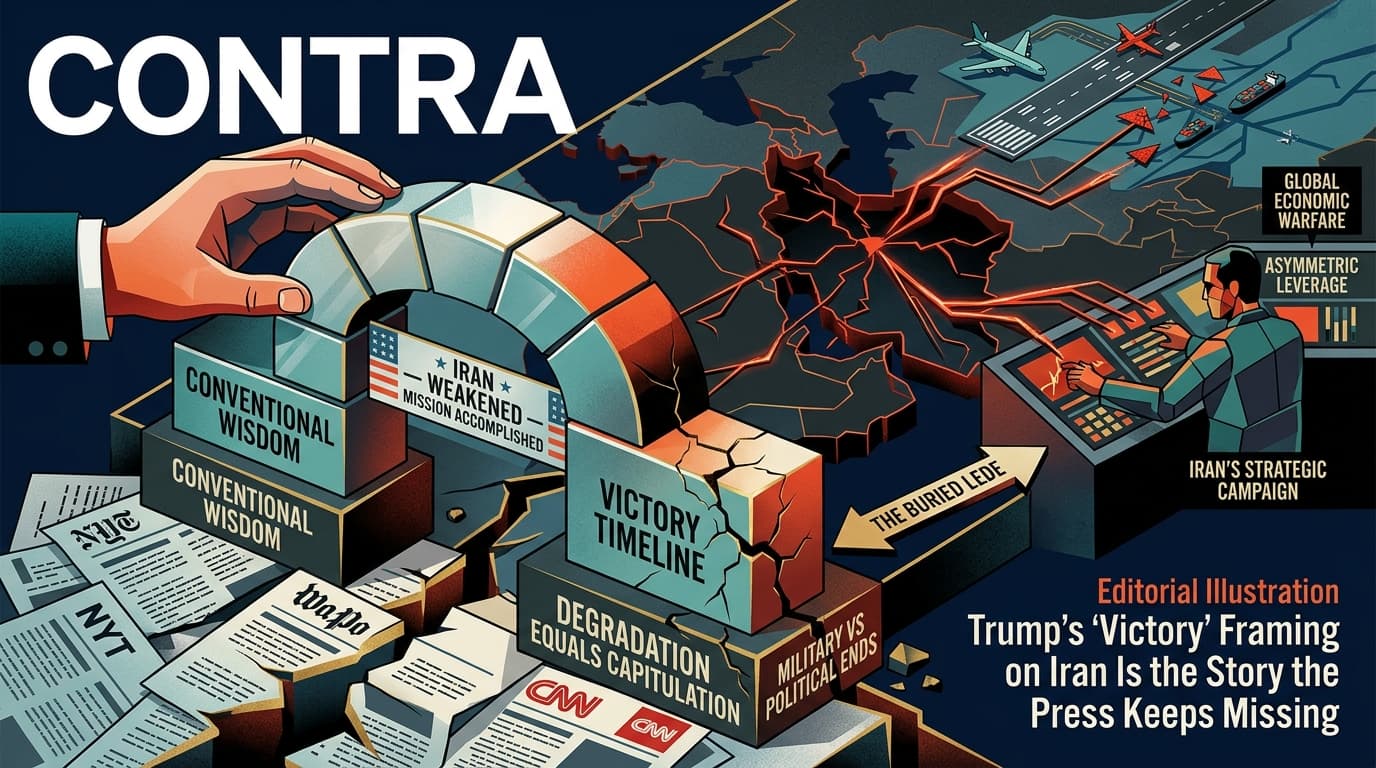

Everyone agrees the U.S.-Israel campaign has badly damaged Iranian forces. That part's not in dispute. What the mainstream press keeps tiptoeing around is the more uncomfortable question: damaged toward what end, exactly?
The conventional wisdom, running through every WaPo and CNN briefing this week, frames this as Trump eager to declare victory against a weakened adversary. The implicit assumption is that "winning" is a coherent concept here — that there's a finish line, and we're close to it.
There isn't. And the evidence is sitting right in the sources everyone's citing.
An Iranian drone struck Dubai International Airport on Monday morning — one of the world's busiest air hubs. Iran has been systematically targeting airports and global infrastructure as part of a deliberate economic warfare campaign. This isn't a collapsing regime firing its last rounds. It's a regime that has absorbed two weeks of punishment and is now exporting the pain outward, into the global economy.
The WaPo's own reporting notes that Iran still has cards to play despite the battering. That's the buried lede. Military degradation and political capitulation are not the same thing — a lesson the last twenty-five years of American foreign policy should have burned into institutional memory by now.
So why does the press keep organizing its coverage around Trump's victory timeline rather than Iran's actual strategic behavior? Partly habit — conflict coverage defaults to the frame of the side doing the striking. Partly access — the White House controls the narrative drip. And partly because "Iran is adapting and escalating economically" is a harder, less satisfying story than "Trump wants to declare victory."
Meanwhile, the White House is threatening broadcast license revocations over war coverage it doesn't like, and CNN's Strait of Hormuz reporting has already riled the administration. Outlets facing that kind of pressure have institutional incentives to soften the edges of their skepticism.
Watch the economic warfare track, not the military scorecard. That's where Iran is actually fighting right now — and it's the story the victory narrative keeps crowding out.