


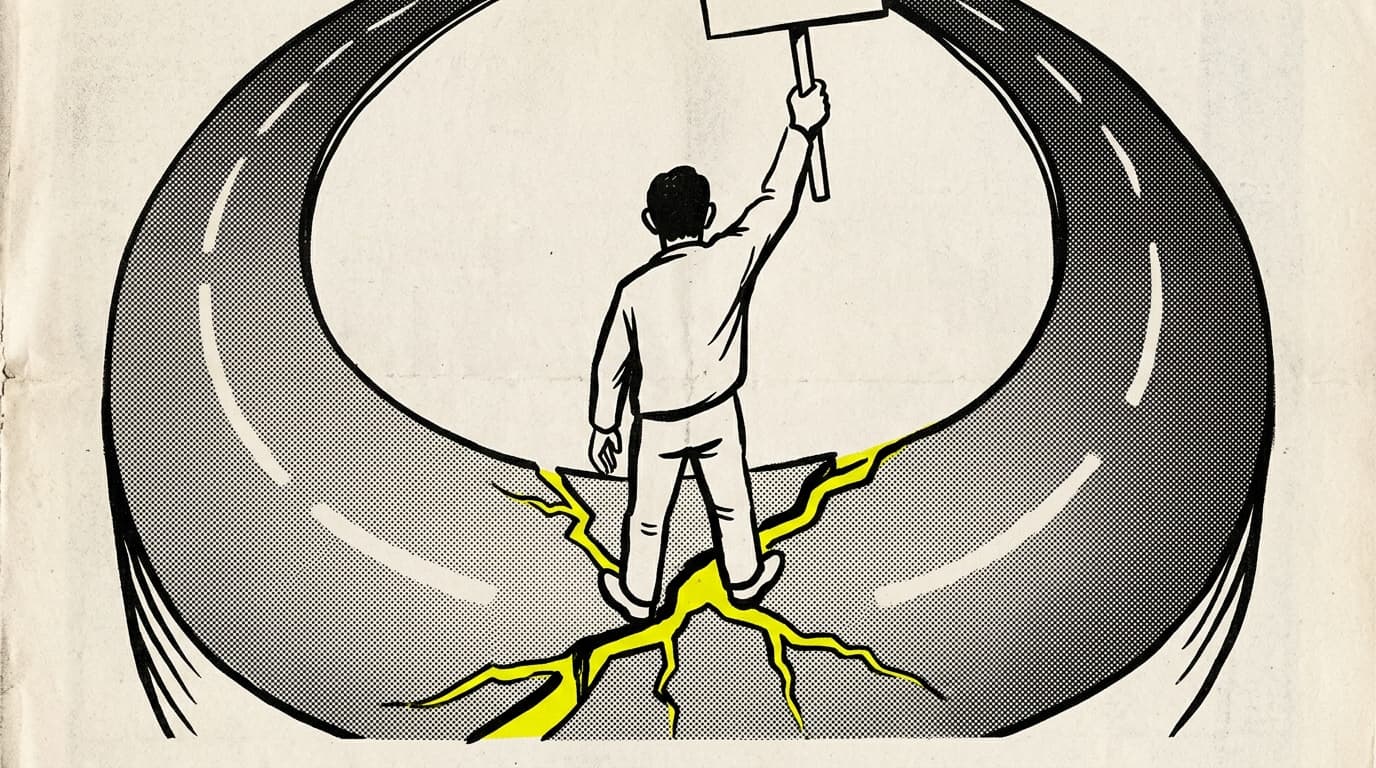

The conventional wisdom on climate activism runs something like this: dramatic disruption forces the issue onto the agenda, makes the comfortable uncomfortable, and ultimately moves the needle on policy. Glue yourself to a road. Throw soup at a painting. Block a bridge. The theory is that even bad press is press, and press creates pressure.
New research from the UK suggests the theory has a serious load-bearing flaw — and the flaw isn't where the critics of activism usually point.
The Counterproductive Loop Nobody Wants to Name
A study of over 1,300 climate campaigners, published this week, found that 17% of all UK climate protests between 2019 and 2024 resulted in arrests — nearly three times the international average of 6.3%. The researchers' conclusion: criminalization doesn't deter activism. It intensifies it. Suppression breeds grievance, grievance breeds escalation, escalation breeds more suppression.
"These kinds of actions are counterproductive as they alienate people from the state," the researchers found.
Here's what's interesting about that framing: the mainstream media conversation about disruptive climate protests almost always focuses on whether they alienate the public from the cause. The research is pointing at something different — that heavy-handed enforcement alienates activists from institutions, pushing movements toward more radical tactics rather than more effective ones. The loop isn't radicalization of bystanders. It's radicalization of participants.
That's a subtler problem, and a more damaging one. A movement that keeps escalating its tactics in response to enforcement pressure isn't building political coalitions. It's building a siege mentality.
The Strategic Retreat Nobody's Covering
Meanwhile, the broader climate movement is quietly telling us something about what actually works — by abandoning what didn't.
Semafor reported in March that the Sunrise Movement, the group most identified with Green New Deal-style climate activism, has largely stopped talking about the Green New Deal. Instead, it's pivoting to electoral strategy — midterm organizing, coalition-building against what it calls authoritarian politics. Rep. Alexandria Ocasio-Cortez and Sen. Ed Markey, who introduced Green New Deal resolutions in 2019, 2021, and 2023, didn't introduce one in this Congress.
That's not a failure of nerve. That's a strategic read on what moves policy. The disruption-and-escalation playbook didn't deliver the Green New Deal. It delivered a lot of arrests, a lot of hostile coverage, and a public that — even when sympathetic to climate concerns — increasingly associated the movement with traffic jams and vandalized artworks.
The Sunrise pivot toward electoral politics is an implicit acknowledgment that disruption protests, whatever their moral clarity, have a ceiling as a political instrument.
What the Consensus Gets Wrong
The media consensus on climate activism tends to treat the disruption debate as a question of optics: do soup-throwing protesters help or hurt the cause's image? That framing misses the structural problem.
Disruptive protest is most effective when it creates a crisis that forces a negotiating partner to the table. Civil rights sit-ins worked because they targeted specific institutions with specific demands and created legal and economic pressure on those institutions. The disruption had a legible ask.
Contemporary climate disruption often lacks that architecture. Blocking a motorway doesn't pressure a specific decision-maker toward a specific policy outcome. It pressures commuters toward irritation. The enforcement response — arrests, criminalization, tougher laws — then feeds the radicalization loop the UK research describes, pulling activists further from the coalition-building that actually changes legislation.
Blue states are already rethinking ambitious climate strategies under pressure from rising electricity costs and federal headwinds. That's the terrain where climate politics actually gets decided — in state legislatures, in utility rate cases, in electoral coalitions. Disruption protests don't operate on that terrain. They operate on the terrain of symbolic confrontation, which feels urgent and often is strategically inert.
The Groupthink Tell
The tell in mainstream climate coverage is the reflexive framing of any criticism of disruptive tactics as either right-wing bad faith or movement betrayal. That framing protects a failed strategy from honest evaluation.
The UK research isn't coming from oil industry lobbyists. The Sunrise Movement's strategic pivot isn't a concession to conservatives. These are signals from within the movement that the disruption playbook has run its course — that the radicalization loop it creates serves the movement's internal culture more than its external goals.
The question worth asking: who benefits from climate activists staying in a cycle of escalation and arrest rather than building the electoral infrastructure that actually threatens incumbent politicians? The answer isn't flattering to the disruption consensus.
Effective climate politics in 2026 looks like what Sunrise is now attempting — and less like what gets filmed for the evening news.