



The NSMBA just put out the call for 20 volunteers to cut a new entrance to Pingu on the North Shore. Routine stuff — a trail day, a shovel, a Sunday morning. But that kind of incremental, community-driven expansion is happening against a very different backdrop than what's unfolding south of the border, and it's worth paying attention to.
In Washington, Evergreen built over 40 new trails in 2024 — two full new systems among them — powered by a professional crew of 15 to 24 full-time builders that swells to around 35 in summer. That's an extraordinary institutional capacity. The kind that produces consistent output year over year, not just when volunteers show up.
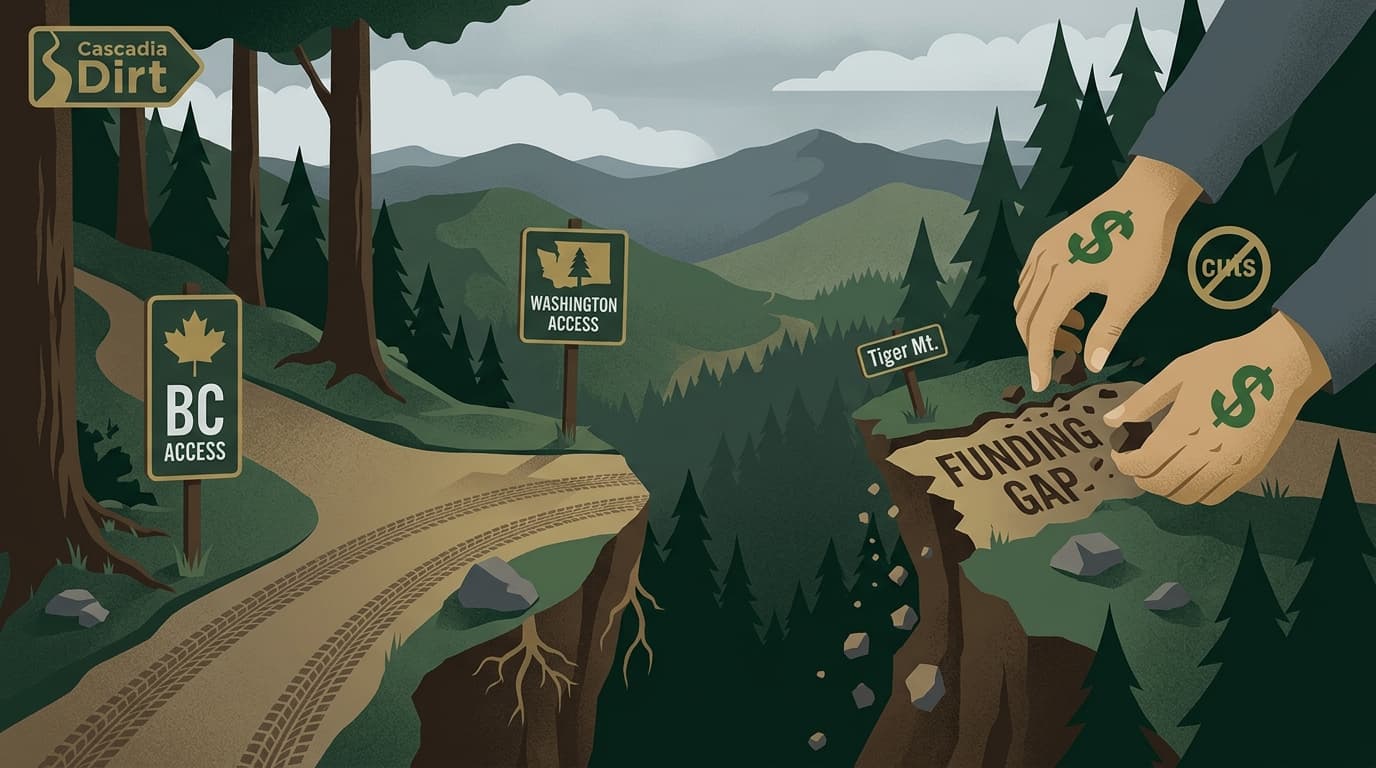
Then the floor dropped out. Washington DNR, Department of Fish & Wildlife, and State Parks collectively absorbed $7 million in cuts in 2025, with $3 million of that coming directly out of operations and maintenance budgets — a 20% reduction per agency. Trails like Tiger Mountain and Raging River sit on DNR land. Evergreen's maintenance contracts run through DNR. The math isn't complicated. And the same report flags that further cuts of nearly $3 million more per year were on the table for 2026.
Meanwhile, Evergreen's early-season update reads like a triage list: storm recovery at Ski Hill in Leavenworth after a severe December event downed hundreds of trees, berm refreshes at Duthie, new Trail E at Raging River still months from a fall 2026 opening. Good work, no question. But the gap between what's being built and what's being lost to deferred maintenance and budget cuts is widening in a way that volunteer trail days alone won't close.
This is the access gap nobody talks about when comparing the two sides of the border. BC's model is messy and underfunded in its own ways — the NSMBA and VMBA are perpetually stretched — but it isn't structurally dependent on state agency contracts that can evaporate with a budget cycle. The North Shore's trail ecosystem has survived decades on community labor and advocacy. Washington built something more professionalized and more productive, and now that professionalization is exposed to exactly the kind of political risk that volunteer-driven systems aren't.
The Raging River Trail E descent is still getting built. Duthie is getting maintained. Evergreen is doing the work. But if those agency funding cuts compound into 2026 and beyond, Washington riders are going to feel it in ways that a trail day can't fix.
Community note: Duthie Jam is scheduled for June 13 — Evergreen is prepping Boot Camp now. Worth putting on the calendar if you're in the greater Seattle area.