


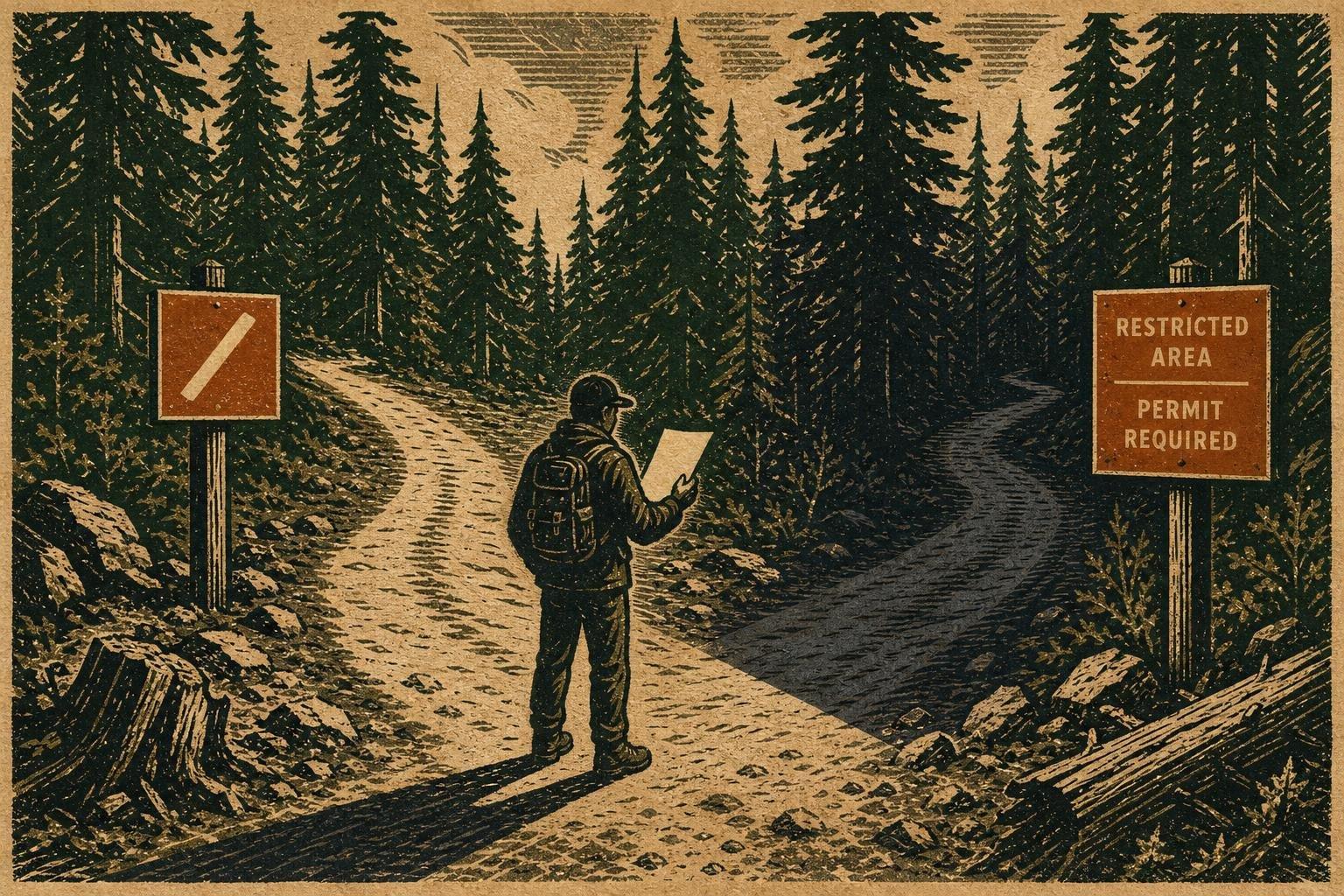

Somebody sent me the assigned topic for this week — a "new e-bike pilot program" at Capitol Forest — and I went looking for it the way I always do: DNR trail notices, Evergreen channels, the usual forums. I came up empty. What I did find was something more useful, if less headline-friendly: a snapshot of just how threadbare Washington's e-bike access rules actually are, state-wide, pilot or no pilot.
The Rule Is "It Depends on Who Owns the Dirt"
Washington's e-bike law doesn't actually set trail policy — it sets a default and then hands the keys to whoever manages the land. Under state statute, Class 1 and 2 e-bikes are presumptively allowed on shared-use paths, but "local jurisdictions or state agencies may restrict or otherwise limit" that access, and Class 3 is barred from shared-use paths entirely unless a local jurisdiction specifically opens the door (Redtail Ebikes). That's not a rulebook. That's a permission slip with the name blank, and every land manager in the state fills it in differently.
The practical result, per the same mapping effort, is a state with roughly 8,711 miles of trail split unevenly by class — about 3,975 miles open to Class 1, 3,090 to Class 3, and 2,848 to Class 2, which State Parks excludes outright (Redtail Ebikes). DNR keeps e-bikes confined to motorized routes almost everywhere, with the notable exception of what that tracker describes only as "one Class 1 pilot" somewhere in the DNR system. No location, no start date, no management plan attached to that line — which is exactly the kind of specific I'm not going to dress up with a place name just because it would make a tidier story. If that pilot is Capitol Forest, I haven't seen the paperwork, and neither, as far as I can tell, has anyone else writing about this right now.
I've been down this road before. When I wrote about Squamish's e-bike situation back in October, the lesson was that nobody local had actually written the rulebook — other jurisdictions were quietly setting precedent by default while Squamish sat on its hands (see /p/nobodys-written-squamishs-e-bike-rulebook-yet-but-watch-whos-wri). Washington's situation reads the same way, just with a state statute standing in for a municipal council: broad permission on paper, fragmented enforcement on the ground, and nobody incentivized to be the one to draw a hard line.
Why a Single Pilot, Wherever It Is, Won't Settle Anything
Here's the thing about pilot programs on public land: they're designed to answer a narrow question — does this specific trail, with this specific use pattern, hold up under e-bike traffic — and they're not designed to set precedent for a 1,400-square-mile forest system. DNR managing one Class 1 pilot somewhere in its network tells you DNR is curious. It doesn't tell you DNR is converting.
Compare that to how other delivery and mobility pilots get built elsewhere. DC's MicroFreight pilot with Amazon spells out the exact fleet size, the speed cap, the prohibited zones, and who's doing the data collection before a single bike rolls (WJLA). That's not a perfect analogy — one's freight, one's recreation — but it's a useful contrast in rigor. A pilot worth trusting comes with public terms. What's circulating about a Washington trail pilot right now doesn't have terms attached, at least not any I can find, which means it isn't ready to be treated as policy yet.
That distinction matters more here than in most places, because Washington's e-bike access fight isn't actually about whether e-bikes are fun or fast or motorized enough to count as cheating — riders have had that argument for a decade and it's not going anywhere. The fight is about whether access decisions get made trail-by-trail through quiet administrative discretion, or through something riders and advocacy groups actually get to weigh in on. A patchwork rule set by statute, enforced inconsistently by a dozen different land managers, is the worst version of that — it gives every agency plausible deniability and no rider a clear answer before they load the bike.
What Actually Deserves Your Attention
If DNR does formalize a Class 1 pilot with a named forest, a trail list, and an evaluation period, that's worth real coverage — the kind with a manager quoted and a map attached, not a line item buried in an e-bike shop's SEO content. Until then, the story isn't the pilot. It's that Washington still hasn't decided, system-wide, who gets to decide. Keep an eye on DNR's public trail notices and any Evergreen Mountain Bike Alliance comment period that references e-bike classifications specifically — that's where this actually gets settled, not in a single quietly-run pilot nobody's publishing details on yet.