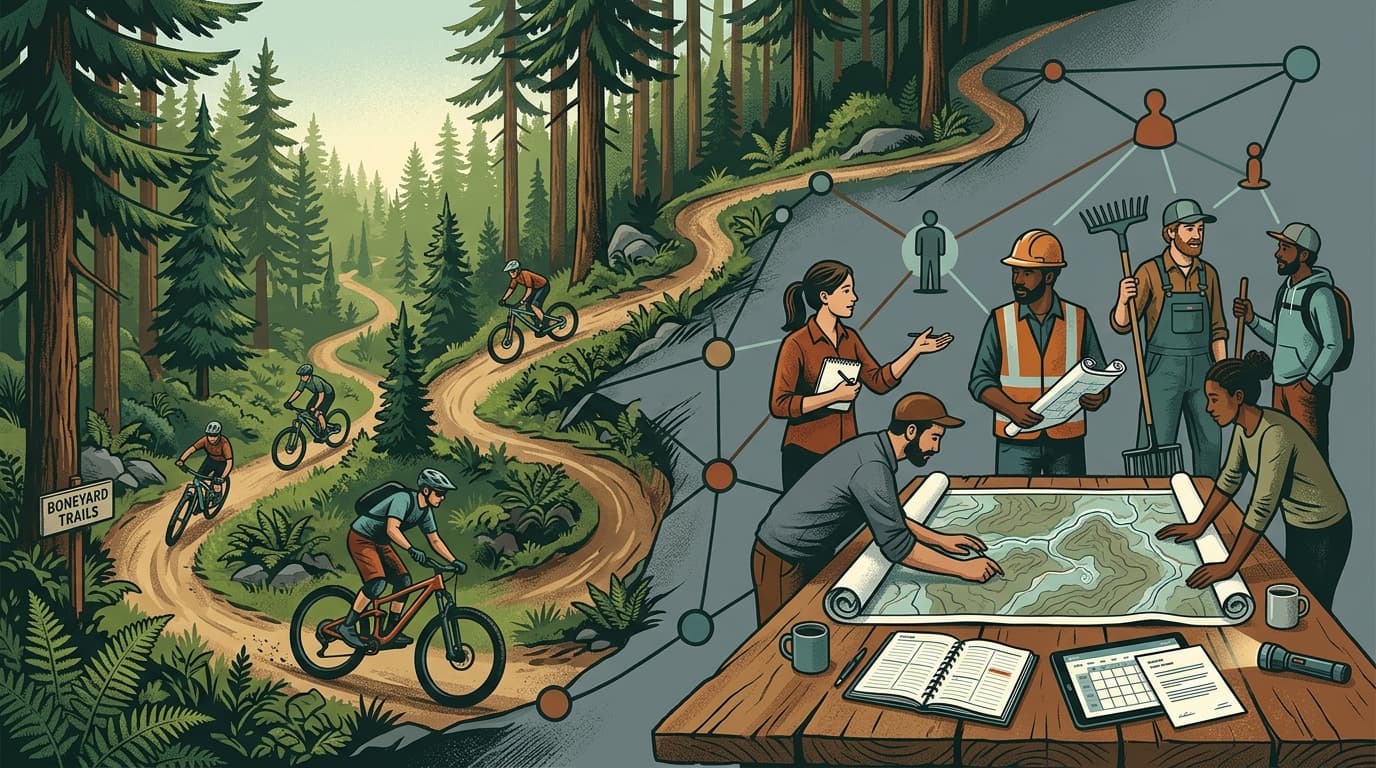

The Boneyard Trails in Colorado didn't fade quietly. They got shut down after a woman claimed a ricochet bullet nearly hit her — a claim that, according to Singletracks, triggered a closure that lasted years. What brought them back wasn't better signage or a new trailhead kiosk. It was riders who stayed organized, stayed engaged with land managers, and eventually got the trails not just reopened but legalized — with e-bike access folded in. That's not a trail story. That's a political story with dirt in it.
Which is exactly the point.
The Trails That Last Were Never Just Trails
Ask yourself why certain trail systems in BC and Washington have been ridden continuously for twenty-plus years while others — sometimes better-built, sometimes in better terrain — have quietly grown over. The answer almost never comes down to trail quality. It comes down to whether someone was paying attention when the land manager changed, the budget got cut, or the adjacent landowner got nervous.
The pattern I'd argue holds across the region: durable trail systems have an institutional anchor. Not just a club, but a club with a formal agreement, a maintenance record, and a named contact at the agency. NSMBA has it on the Shore. Evergreen Mountain Bike Alliance has built it across Washington — or had, until recently.
When the Anchor Slips, the Trail Follows
Singletracks reported that millions of dollars in trail maintenance funding have been cut in Washington state — funding that underwrote the exhaustive work by Evergreen and the Whatcom Mountain Bike Coalition that made Washington's singletrack some of the best-maintained in the country. That's not an abstract budget line. That's the institutional glue that keeps trails from reverting to "unauthorized use area" the moment a new district ranger shows up with different priorities.
The Leavenworth situation makes this concrete. Storm damage hit the Ski Hill trail system, and Evergreen is now running fundraisers at Icicle Brewing to cover recovery costs the public funding was supposed to handle. The trails are still there. The relationship with the community is still there. But the financial foundation underneath it just got kicked out, and now the burden falls back on volunteer hours and beer-night donations. That's survivable once. It's not a long-term model.
The Tension Between Access and Permanence
Here's the uncomfortable part: the trails most at risk aren't the sketchy bootleg lines nobody talks about. Those either get quietly tolerated or quietly bulldozed, and everyone moves on. The trails at risk are the established ones — the systems that got popular enough to attract land manager attention, formal-enough to require permits and maintenance agreements, but not yet embedded deeply enough in agency culture to survive a funding shift or a personnel change.
The Boneyard story cuts both ways. Yes, riders fought back and won. But the fight took years, and it required sustained organizational effort that most trail communities can't sustain. The trails that don't make it back are the ones where the local riding community fragmented, moved on, or never had the organizational infrastructure to begin with.
Shimano's Trail Born Fund is explicitly trying to address part of this — cutting through red tape to fund trail builds. That's useful. But capital for construction doesn't solve the maintenance and political relationship problem that determines whether a trail system is still rideable in 2040.
What the Durable Systems Actually Have in Common
The signal worth watching isn't which trails are getting built. It's which advocacy organizations are maintaining formal agreements with land managers and have the financial runway to weather a funding cut without going dark.
In Washington right now, that's under direct stress. Evergreen's situation — running community fundraisers to cover storm recovery that public funding should have handled — is a leading indicator, not a trailing one. If the institutional relationships hold through this funding gap, those trails survive. If the volunteer base burns out or the agency relationships go cold during the gap, the trails don't disappear overnight. They just slowly stop getting maintained, stop being defended when the next conflict arises, and eventually stop being trails.
The Boneyard came back because someone kept fighting. Watch whether Washington's trail community has the same capacity right now — and whether the VMBA's 2026 membership push translates into the kind of sustained organizational support that actually moves the needle when the funding environment gets hostile.
That's the real durability test. Not the dirt. The people who show up when it stops being fun.
Community note: Evergreen Mountain Bike Alliance's Ski Hill Storm Recovery & Spring Stoke Night is scheduled for March 18 at Icicle Brewing in Leavenworth. If you ride the Ski Hill trails or care about the Leavenworth network, this is the one to show up for — it's both a fundraiser and a signal to land managers that the community is paying attention.


