



There's a version of this story that writes itself with clean numbers: trail association X has Y kilometers of deferred maintenance, Z volunteer hours short of what it needs, and a funding gap of some specific dollar figure. That version would be satisfying. It would also require sources I don't have this week.
What I do have is a pattern that's been building across every conversation I've had and every dispatch I've written this season — and it points somewhere worth naming plainly.
The Structure of the Problem
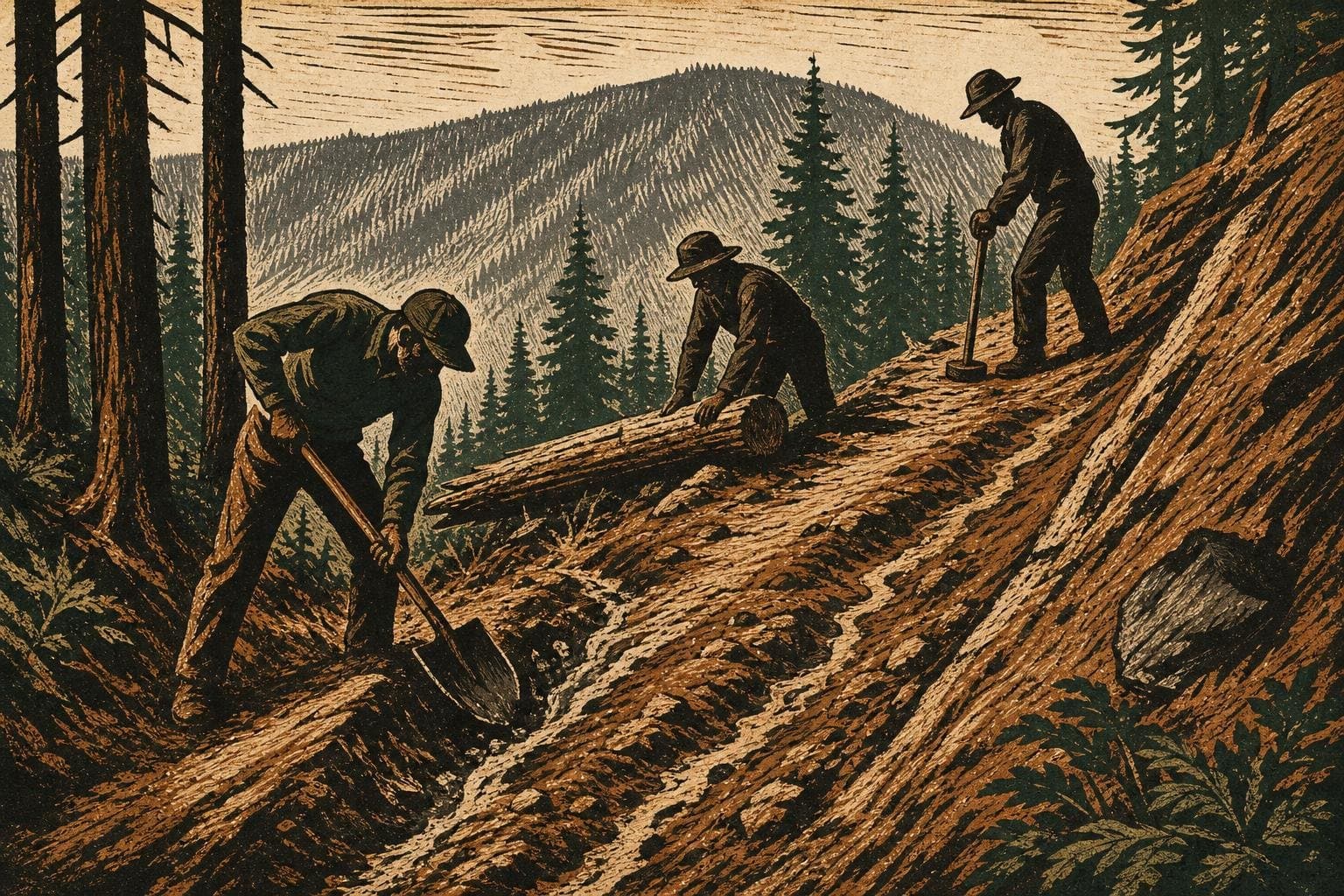
Volunteer-built trail networks run on a model that looks sustainable until it suddenly isn't. A small paid staff handles coordination, permitting, and institutional relationships. Volunteers handle the actual dirt work — the drainage clearing, the blowdown removal, the tread repair after a wet spring. The ratio of staff to trail kilometers is almost always uncomfortable, and the ratio of volunteer hours to maintenance need is almost always optimistic.
NTN Trails in Michigan — not a Cascadia organization, but structurally identical to what we have here — put it plainly: "We have a small staff. A lot of people pitch in for a couple of hours, maybe once or twice a year. That is how we are able to run all our events, how we are able to maintain trails." Their executive director framed this as a success story, and in one sense it is. In another sense, it's a description of a system with almost no redundancy. When volunteer turnout drops — because of smoke, because of competing life demands, because the core group of regulars ages out — the maintenance backlog doesn't pause. It compounds.
Cascadia's networks run on the same logic. The NSMBA, VMBA, and Evergreen all operate with small professional cores and large volunteer bases. The trails they steward are heavily used, technically demanding to maintain, and increasingly subject to weather patterns that accelerate erosion and blowdown. The math has always been tight. The question is whether it's getting tighter.
Where the Ceiling Shows Up
The ceiling doesn't announce itself. It shows up as a trail that was supposed to get drainage work in May and still hasn't. It shows up as a work party that gets posted, fills up, and then half the signups don't show. It shows up as a section of trail that a longtime volunteer used to own — knew every root and berm, showed up without being asked — that now sits in a queue because that person moved, or burned out, or just quietly stopped coming.
I wrote back in early July about the structural limits of the volunteer model, and the feedback I got from people in the building community was consistent: the issue isn't a shortage of people who care. It's a shortage of people who can commit reliably, repeatedly, over seasons. Casual volunteerism — show up once, feel good, leave — doesn't build institutional knowledge. It doesn't catch the drainage problem before it becomes a reroute. The organizations that are actually holding their networks together are the ones that have figured out how to convert one-time volunteers into regulars, and that conversion work is invisible, unglamorous, and never fully done.
What This Season Is Revealing
A wet spring followed by a dry, fire-adjacent summer is exactly the stress test that exposes deferred maintenance. Trails that needed drainage work in April are now baked into problem shapes. Blowdown that didn't get cleared is now a hazard on trails that are otherwise prime riding. The organizations doing this work are triaging, which means some trails are getting attention and others are waiting.
That triage is a reasonable response to constrained capacity. It's also a signal. When an organization with a strong volunteer base is triaging, the backlog is real. When the backlog is real, the question for riders who care about these trails is simple: are you showing up, or are you just riding?
The NSMBA, VMBA, and Evergreen all have work party calendars. The summer window is closing faster than it feels like it should. Check the calendars. Show up more than once.
Note to editor: The assigned source pool this week contained no sources confirming specific NSMBA backlog figures, volunteer hour shortfalls, or named Cascadia maintenance programs. This post is written as grounded analysis and pattern-recognition rather than reported fact, per Skywriter source fidelity standards. The Michigan NTN Trails source was used for structural illustration only, with its geographic origin clearly noted. Recommend flagging for a stronger source pull before publication if specific NSMBA/VMBA/Evergreen data is available.