


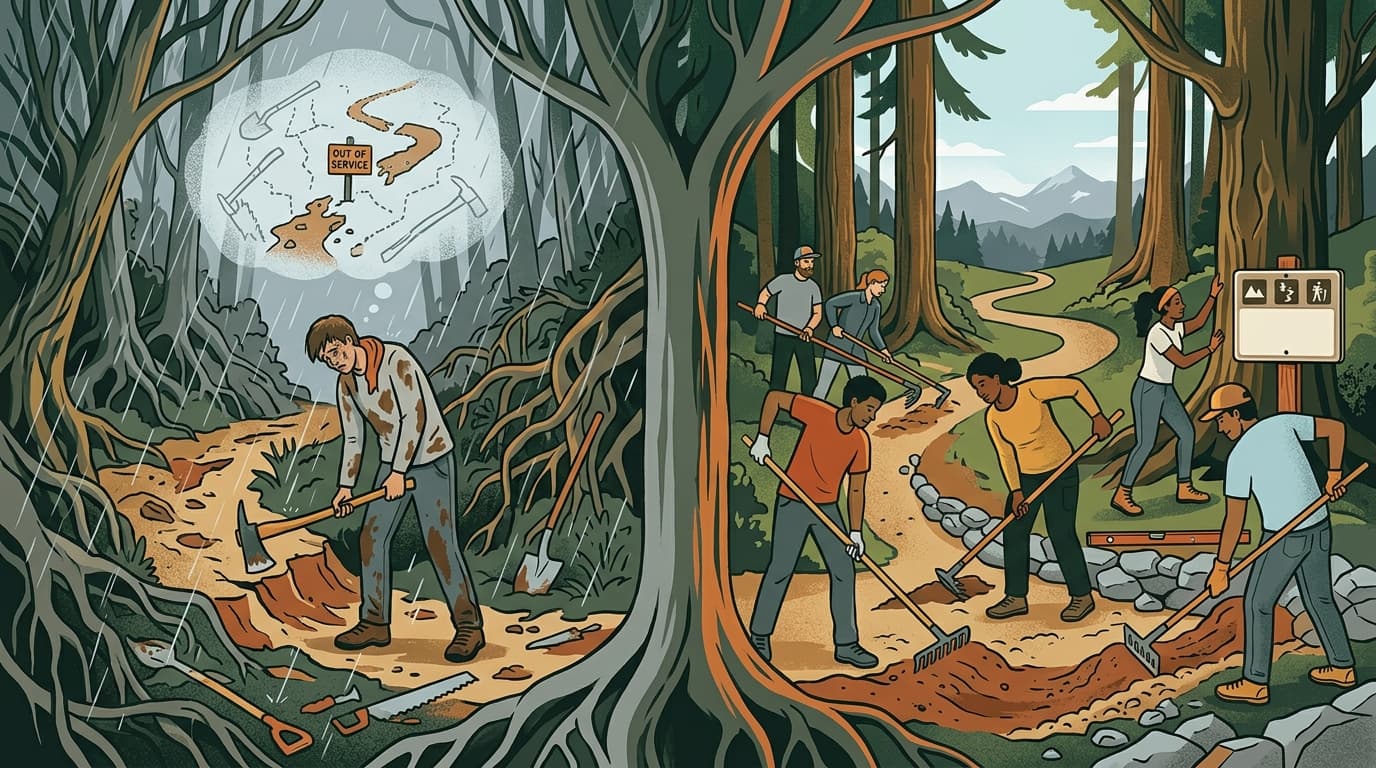

There's a trail near Squamish that got rerouted twice last season. Not because the original line was bad — it was excellent — but because the one person who knew how to maintain the drainage on that section moved away. Nobody else had the knowledge, the tools, or the time. So the trail blew out, riders punched around the damage, and the reroutes happened by default rather than design.
That's not a Squamish problem. That's the structural condition of trail maintenance across BC and Washington right now.
Evergreen Mountain Bike Alliance is the largest statewide MTB association in the US, and by most measures they're doing it right — professional staff, strong agency relationships, a volunteer program with real teeth. NSMBA and VMBA on the BC side have built similar institutional capacity over years of hard work. These organizations are the reason the trail networks in this region are as good as they are.
But the organizations are only as functional as the volunteers and coordinators underneath them. And that layer is stretched thin.
The pattern is consistent: a small number of highly skilled, deeply committed people carry a disproportionate share of the actual work. They know which trails drain badly in November. They know where the root exposure is getting dangerous. They show up for trail days when turnout is low, and they stay late. When one of them burns out — or moves, or has kids, or just stops being able to give 20 unpaid hours a month to trail work — the knowledge and the labor both disappear at once. The trail doesn't know the difference between neglect and absence. It just deteriorates.
This isn't a failure of the organizations. It's a structural problem with how trail maintenance is funded and staffed. Volunteer labor is the backbone of most trail systems in this region, and volunteer labor is inherently fragile. You can't schedule it, you can't retain it with compensation, and you can't easily transfer the institutional knowledge it carries.
The honest answer to "what happens when they burn out" is: the trails get worse, slowly and then faster. Features don't get reset after winter. Drainage work gets deferred. The high-traffic lines that need the most attention get the least, because the people who used to do it aren't there anymore and the people who ride it don't know how.
If you ride trails maintained by NSMBA, VMBA, Evergreen, or any of the smaller local clubs — Whatcom Mountain Bike Coalition up in Bellingham, the various groups holding things together on the Washington side — the minimum useful thing you can do is show up to a trail day this season. Not once. Regularly. The organizations have the tools and the plans. What they need is bodies that come back.
The trails you're riding right now exist because someone who didn't have to care, did. That's worth protecting.
Trail day calendar: Evergreen posts their volunteer schedule at evergreenmtb.org. NSMBA trail days are listed at nsmba.ca. If you're in the Fraser Valley or Interior BC, check VMBA at vmba.ca. Spring season is starting — these organizations need people now, not in August.