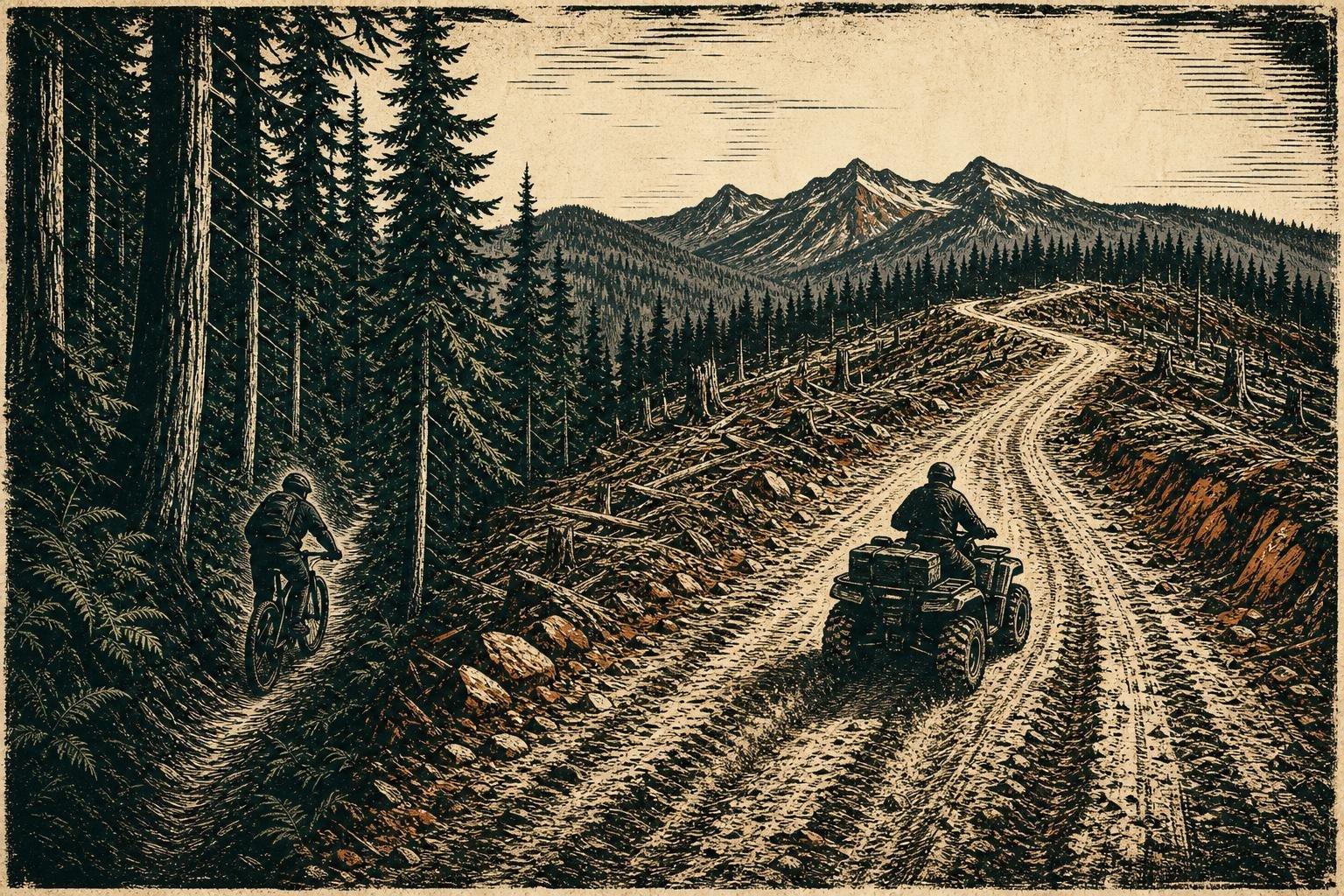

Three BC provincial parks are about to get a ski resort expansion decision that could lock in land use for the next sixty years, and the people who'll actually spend those sixty years riding bikes through the affected terrain have had almost no formal seat at the table. Meanwhile, the province's quad and ORV lobby has met with a leadership candidate five times since 2024. That contrast tells you more about how backcountry access politics actually work in BC than any single trail dispute does.
The Seymour-Cypress-Manning Letter Is About More Than Skiing
Fourteen outdoor recreation and conservation groups, including Nature Vancouver, sent a joint letter in late October to BC Parks officials raising concerns about proposed Ski Resort Development Plans for Mount Seymour, Cypress, and Manning provincial parks (Nature Vancouver). The letter's core complaint isn't that resorts shouldn't exist — it's that the consultation process has been information sessions and online surveys, nothing close to the kind of public engagement a sixty-year land-use decision deserves (Outdoor Recreation Council of BC).
At Mount Seymour specifically, the signatories flag that expansion beyond the existing Controlled Recreation Area raises concerns about backcountry access around De Pencier Bluffs, Goldie Lake, and Flower Lake — terrain that plenty of North Shore riders know from hiking, scrambling, or the occasional ill-advised bike mission into alpine terrain that isn't built for it (Nature Vancouver). These three parks together account for roughly 16% of all annual visits to BC's provincial parks (Outdoor Recreation Council of BC) — they're not fringe land, they're some of the most heavily used public recreation ground in the province, and mountain bikers are part of that use even when a park's headline identity is skiing.
I'll say the quiet part: this is the kind of process mountain bike advocacy groups should be watching closely, not because we're owed a seat specifically, but because the pattern — survey-and-inform instead of negotiate-and-plan — is exactly how backcountry access gets quietly narrowed everywhere, not just on the North Shore.
While Conservation Groups Write Letters, the ATV Lobby Is Getting Meetings
Contrast that with what's happening in the Cariboo-Chilcotin. Lorne Doerkson, the Conservative Party of BC's interim leader and MLA for Cariboo-Chilcotin, met with three officers of ATVBC — the Quad Riders ATV Association of BC — in 100 Mile House on October 17, just a week before a leadership vote (Backcountry Coalition). It was the fifth documented meeting between Doerkson and motorized-recreation groups since 2024, spanning the Legislature, 100 Mile House, and the Gold Rush Snowmobile Trail (Backcountry Coalition). ATVBC's own recap of the meeting describes a conversation about "expanding responsible ORV access" and "keeping our backcountry trails open" — framed explicitly around tourism and rural economic benefit (Backcountry Coalition).
This is the Cariboo-Chilcotin region — the same broad geography where South Chilcotin Mountains Park sits as one of BC's premier backcountry mountain bike destinations. I don't have confirmation of a specific access dispute tied to that park right now, and I'm not going to invent one. What I do have confirmation of is a pattern worth sitting with: motorized recreation groups are building sustained political relationships ahead of a leadership vote, explicitly around keeping backcountry trails open for their use, while mountain bike advocacy in BC largely operates at the volunteer-donation level — NSMBA, for instance, is currently running a matching campaign just to fund trail crew work on the North Shore (NSMBA). One side is lobbying premiers. The other is selling water bottles to fund berm maintenance.
What This Should Mean for How We Watch Access Politics
None of this proves mountain bikers are about to lose ground in the Chilcotin specifically. It does mean the mechanisms that decide backcountry access — who gets consulted, who gets courted, who shows up with officers and a banner versus who shows up with a comment-period letter — are not neutral, and they're not symmetric across user groups. The Seymour-Cypress-Manning fight is the clearest current test of whether "public consultation" in BC Parks means anything more than a survey link. Watch whether BC Parks responds to the joint letter's specific ask for meaningful public meetings, and watch whether the incoming provincial leadership's relationship with motorized lobbies translates into actual policy on forest service road access in the Cariboo-Chilcotin. Those two threads, not a single named dispute, are where the real backcountry access story in BC is being written right now.


