


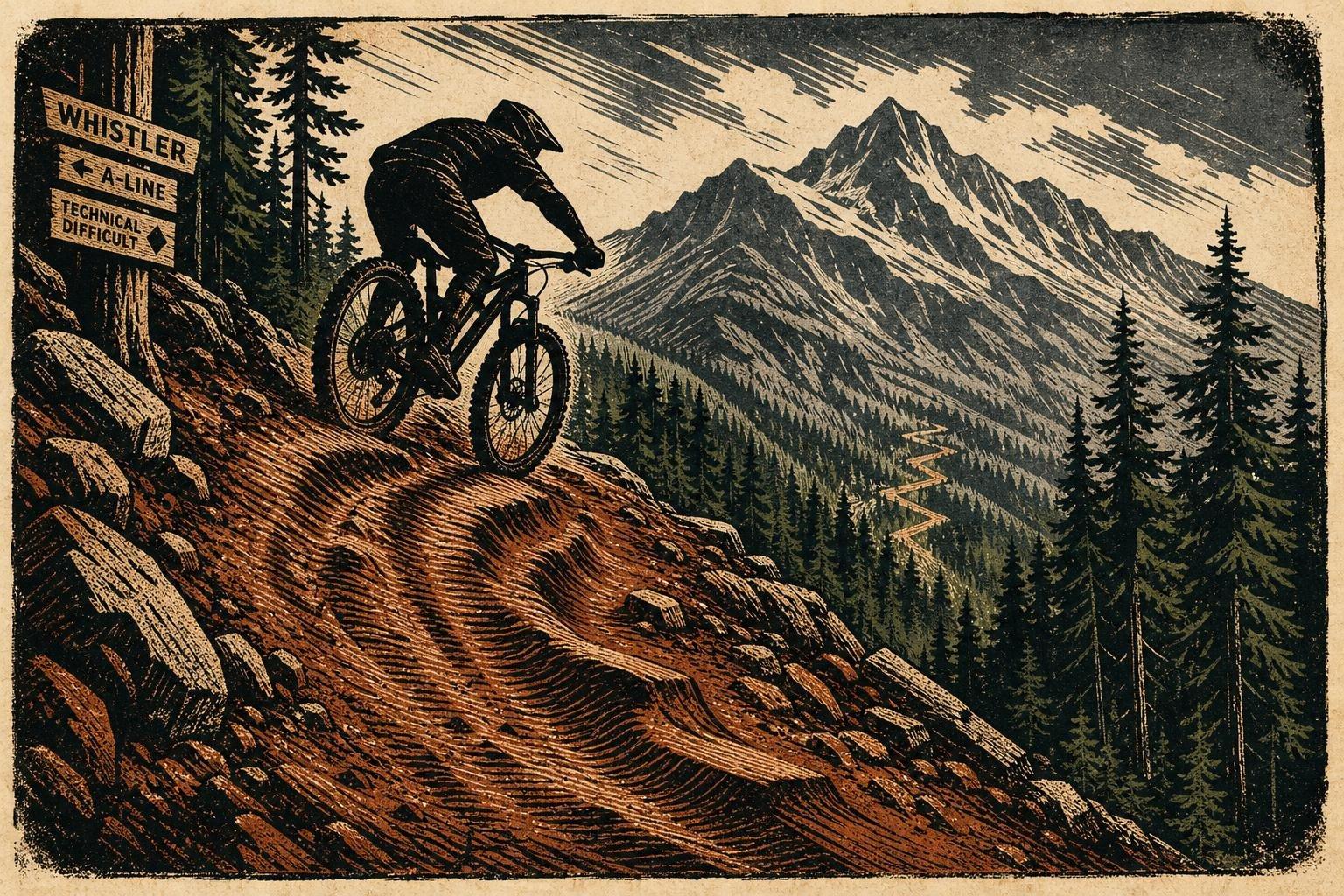

Every year around this time someone asks me what Whistler Bike Park has planned for next season, and every year I go looking for an actual document — a lift upgrade announcement, a trail-build schedule, something with a line item attached to it. This year, same as most, I came up empty. There's no public 2026 lift-and-trail investment plan sitting anywhere in the record right now, no press release from Whistler Blackcomb outlining new pod builds or crowd-management moves. If you've seen chatter to that effect, it's chatter, not confirmed scope.
What does exist is a scattering of ground-level signal about what the park actually is right now — and that's arguably more useful than a glossy capital-plan PDF anyway, because it tells you what riders are experiencing rather than what marketing wants you to expect.
The Trail Network Itself Is the Real Investment Record
The park's living inventory sits on Trailforks, which tracks trail flow direction, difficulty mix, and how hard specific lines get ridden over a rolling nine-month window. It's not a press release — it's closer to a pulse. When a trail shows up heavily skewed toward "downhill primary" with high local popularity scores, that's not spin, that's activity logs. If you want to know whether a given line in the park is getting hammered this season, that's where to look before you trust any marketing copy about new flow or expanded terrain. I'd rather cross-reference Trailforks activity data against whatever official announcement eventually drops than take a bike park's word for it on crowding or capacity.
Riders Are Already Reporting the Wear — Just Not Through a Formal Channel
The clearest evidence that Whistler's park is getting pounded this season comes from an odd place: a tire durability test. Singletrack's October roundup notes the crew spent time "trying to destroy tyres in Whistler" as a feature exercise, part of a month that also covered World Cup racing, a factory fire at Atherton HQ, and the usual gear reviews (Singletrack). You don't pick Whistler as your torture-test venue by accident. The park's rock gardens and braking bumps are notorious for chewing through rubber faster than most North American terrain, and if a UK publication is flying out specifically to abuse tires there, that's a tell about how aggressive and consequential the riding surface has become after a full season of traffic. It's not a crowding study. But it's corroborating evidence that the terrain is seeing heavy, sustained use — which is the precondition for every crowding conversation this park eventually has.
Community content backs the same picture from a different angle. A Pinkbike community blog post from rider Kade Edwards documents a summer spent "cruising around Whistler and the Coast" with fellow rider Finley Kirschenmann, shot by photographer Hugh Saint Jacques and supported by Burgtec and Trek (Pinkbike). It's a personal video blog, not an access story, and I'm not going to pretend it's evidence of park policy. But it's one more data point that Whistler remains the default pilgrimage destination for sponsored riders and amateurs alike — which is exactly why crowding keeps coming up as a topic every single year, plan or no plan.
What I'm Actually Watching For
The honest version of this story is that Whistler Bike Park doesn't need a flashy capital announcement to stay the center of gravity for Cascadia riding — it's already operating at a load that's visibly wearing down tires and pulling sponsored riders north every summer. The crowding question isn't going away, but right now it's being answered by rider reports and trail-wear anecdotes, not by any published lift or trail-build roadmap.
If Whistler Blackcomb does put out a formal 2026 investment plan — new lift capacity, new trail pods, anything that changes how many bodies the park can move per hour — that's worth a dedicated post the moment it's real. Until then, the story is simpler and less flattering to the hype cycle: the park is busy, the tires prove it, and nobody's published a plan to do anything about it yet.