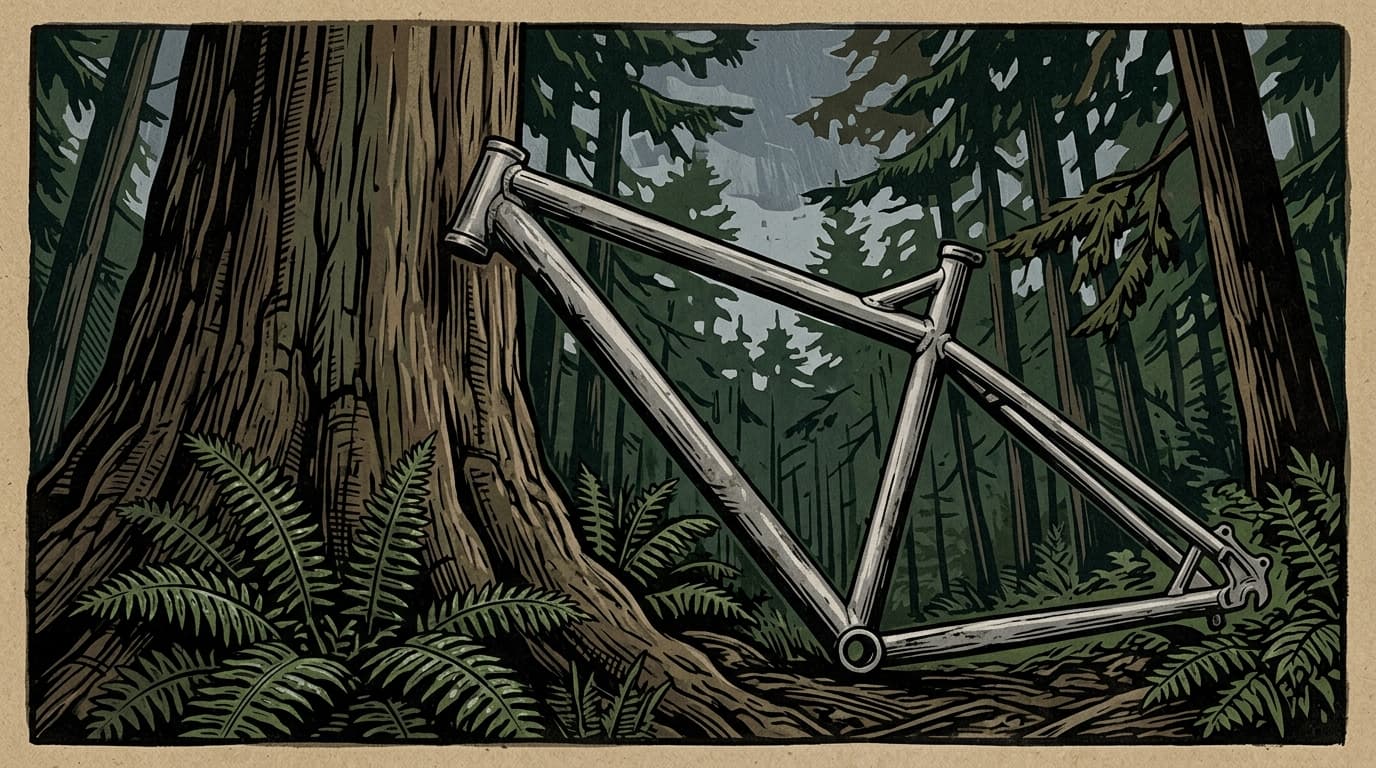

The new Devinci Spartan Gen. 4 costs $4,500 CAD at entry. No carbon. No high pivot. No idler pulley. Built in Chicoutimi, Quebec, from aluminum welded in the Saguenay Valley, and backed by a lifetime warranty. On paper, it sounds like a step backward from the arms race that's been consuming the enduro segment for the past five years.
It isn't. It's a thesis statement.
The Global Brands Optimized for a Customer Who Doesn't Exist
The major players — Trek, Specialized, Giant — have spent the last decade engineering bikes for a hypothetical rider who wants the lightest possible carbon frame, the most progressive geometry, and the most complex suspension linkage, all at a price point that keeps climbing regardless of what the market actually sustains. The result is a middle tier that's gotten hollowed out. You can buy a $3,000 bike or a $9,000 bike; the $5,500 range has become a no-man's-land of compromised builds where the frame is aspirational but the components are spec'd down to hit a margin target.
Local brands have been watching this happen. The smarter ones aren't trying to out-engineer the globals — they're building into the gap the globals left behind.
Devinci's approach with the Spartan is the clearest recent example of this logic executed deliberately. They stripped the Gen. 4 back to aluminum, removed the high pivot and idler that defined the Gen. 3, and priced the range between $4,500 and $7,500 CAD. The frame is built to last — threaded BB, Enduro bearings, coil shock compatibility, a 31.6mm dropper post that won't require proprietary parts in three years. The lifetime warranty isn't marketing copy; it's a structural commitment that a brand with a Taiwanese contract manufacturer and a North American distribution office can't credibly make.
That last point matters more than it sounds.
Geography Is a Moat, Not Just a Marketing Angle
When Devinci says the Spartan is built in Canada, they mean the frame is welded in Chicoutimi and waste aluminum from warranty returns gets recycled back into the process. That's a supply chain with accountability baked in — not because Devinci is morally superior to anyone, but because when your factory is in the same country as your warranty department, the feedback loop is short and the incentives align.
Compare that to a global brand managing a carbon layup facility in Asia, a distribution hub in the Netherlands, and a warranty processing center in Wisconsin. The coordination overhead is enormous, and it shows in how those brands handle warranty claims, spec changes, and mid-cycle updates. They can't move fast because they're too distributed.
Local brands can. Norco, Rocky Mountain, Forbidden, Evil — these companies can iterate on geometry, adjust spec, and respond to rider feedback on a timeline that a global brand's product cycle simply doesn't allow. The Adidas partnership Norco announced is interesting precisely because it signals that at least one major outside brand sees Norco's regional identity as an asset worth attaching to — not a liability to be smoothed over.
That's a shift. Five years ago, the conventional wisdom was that local brands needed to look global to be taken seriously. Now the calculus is reversing.
The Tension: Distribution Still Wins Shelf Space
None of this means the globals are losing. They're not. Trek and Specialized have dealer networks, marketing budgets, and logistics infrastructure that no BC or Washington brand can match at scale. When a new rider walks into a shop in Spokane or Kelowna and asks what to buy, the answer is still usually a Trek or a Specialized — not because those bikes are better for that rider, but because the sales rep has been trained on them and the demo fleet is stocked with them.
The local brands' path to growth runs through the rider who already knows what they want. That's a real market — it's this newsletter's entire readership — but it's a ceiling, not a floor. Breaking out of the enthusiast segment requires either a distribution deal that compromises the brand's identity or a long, patient build of direct-to-consumer infrastructure. Most local brands are threading that needle imperfectly.
Devinci's aluminum-and-lifetime-warranty positioning is smart for the core market. Whether it moves units at REI or MEC is a different question.
What to Watch: The Mid-Tier Squeeze Gets Worse Before It Gets Better
IMBA's Trail Accelerator Grant program has its second application window open through April 30 — worth flagging because trail infrastructure investment and local brand health are more connected than they look. More rideable terrain in the Pacific Northwest means more local riders buying bikes, and local riders buying bikes disproportionately benefits local brands. The ecosystem feeds itself.
The signal to watch over the next 12 months: whether brands like Devinci and Norco hold their pricing discipline as the globals inevitably push mid-tier carbon prices down to compete. If local brands chase that race, they lose. If they hold the line on what makes them different — provenance, warranty, rider-first spec decisions — they have something the globals genuinely cannot replicate.
The Spartan Gen. 4 is a bet that riders are tired of paying carbon prices for carbon's sake. I think that bet is right. The question is whether the market is ready to agree.
Community note: Evergreen East has trail repair sessions running Tuesday and Thursday evenings this spring at Saltese Uplands — machine work addressing dishing and trail braiding in the outer loops. If you ride Saltese, show up and put in hours. That trail doesn't fix itself.


