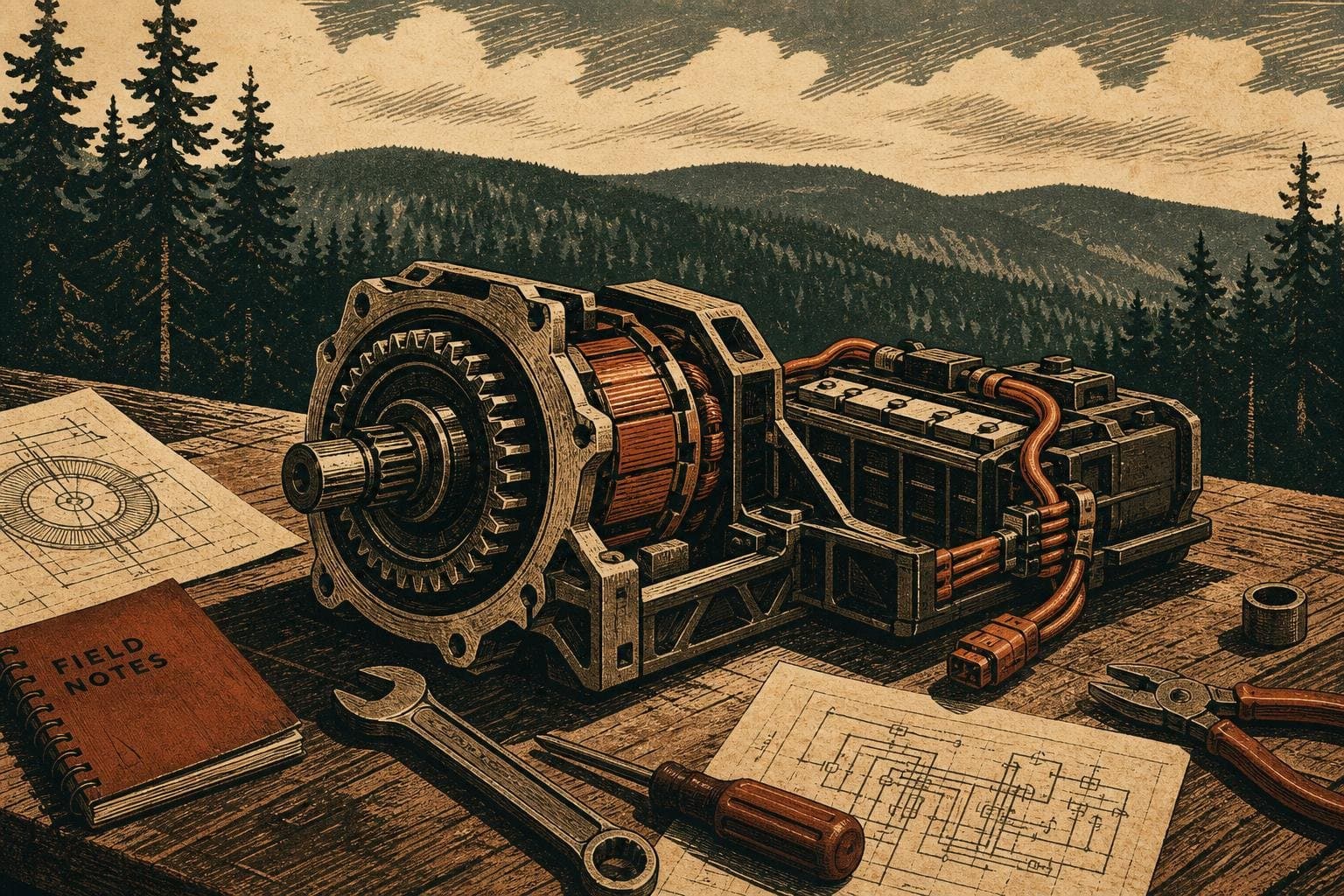

The assigned topic here is Forbidden's vertical integration strategy and its ripple effects on the regional manufacturing ecosystem. I want to be straight with you about what the sources actually show: there's no primary document, no Forbidden press release, no trade filing that lays out a formal vertical integration roadmap. What we do have is product evidence — and product evidence, read carefully, tells a story.
So let's read it carefully.
The Avinox Signal
Forbidden's 2026 Dreadnought E lineup runs on the Avinox drive system — a proprietary motor platform that Forbidden developed rather than sourcing from Bosch, Shimano EP8, or Brose like most of the e-MTB field. The Dreadnought E T2 spec sheet lists the Avinox M2S delivering 130 Nm of continuous torque, 150 Nm in Boost mode, and 1,300 W of peak power, paired with an 800 Wh integrated battery and a full-colour OLED display managed through the Avinox Ride app.
That's not a badge-engineered motor from a third-party supplier with Forbidden's logo on it. That's a complete drive ecosystem — motor, battery, display, wireless controls, and companion app — developed under Forbidden's own brand. For a company that started in 2019 with a small team where everyone pitched in on whatever needed doing, building a proprietary motor platform is a significant strategic commitment.
The question worth sitting with: why would a 14-person company headquartered on Vancouver Island go to the trouble?
What Vertical Integration Actually Buys You
The conventional answer is margin. If you're sourcing a Bosch motor, Bosch captures a chunk of the bike's value. Build your own motor, and that margin stays in-house. For a brand selling bikes in the range the Dreadnought E occupies, that's real money.
But there's a second answer that matters more for how Forbidden fits into the Cascadia ecosystem: control over the ride experience. The Avinox system's assist modes — ECO, TRAIL, TURBO, BOOST — are fully customizable through the app. That's not just a feature list item. It means Forbidden can tune the motor's behavior to match how their bikes are designed to ride, rather than working around whatever Bosch or Shimano decided was the right power curve for the average European e-bike buyer.
Forbidden's design philosophy has always centered on geometry and weight balance — the relationship between rear-centre and front-centre, where the rider's center of gravity sits. They're best known for high-pivot, idler-equipped designs that behave differently under power than a conventional suspension layout. A third-party motor tuned for a conventional bike is a compromise on a high-pivot platform. A proprietary motor you can tune yourself is not.
That's the real logic of the Avinox system. It's not just about margin. It's about not letting a supplier's engineering assumptions undermine your own.
What This Means for the Regional Picture
I wrote about Forbidden's gravity push back in June, framing the Dreadnought E as a platform bet rather than a single product launch. The Avinox system is what makes it a platform rather than a bike. If Forbidden can iterate on the motor and app independently — tuning power delivery for new frame geometries, updating firmware without waiting on a third-party supplier's release schedule — they have something Rocky Mountain, Norco, and Kona don't: a proprietary technical foundation that compounds over time.
For the broader Cascadia manufacturing ecosystem, the implications cut both ways. On one hand, a BC-based brand building its own drive system is a genuine industrial development — the kind of technical capability that tends to attract engineering talent, create supplier relationships, and generate the sort of institutional knowledge that's hard to replicate. That's good for the region.
On the other hand, vertical integration at this level requires capital and headcount that most small Cascadia builders don't have. The gap between what Forbidden is doing with Avinox and what a five-person shop in Bellingham or Squamish can realistically attempt is wide and getting wider. The component crunch I covered last week exposed which builders had supply chain resilience. The Avinox move suggests Forbidden was already thinking several steps past that problem.
What to Watch
The honest caveat: the sources available here don't confirm whether Avinox is fully Forbidden-developed or a white-label system built in partnership with another manufacturer. That distinction matters enormously for how much of the value chain Forbidden actually controls. If it's a true in-house development, the strategic implications are substantial. If it's a rebranded system from a contract manufacturer, the story is more modest.
What would resolve that question: Forbidden's own technical documentation, a teardown from a credible independent reviewer, or a supplier disclosure. None of those are in the current source pool. So treat the vertical integration thesis as directionally supported by the product evidence, not confirmed by primary documents.
Watch for independent Dreadnought E reviews that get into the motor's provenance, and watch for whether Avinox shows up on any future Forbidden models outside the Dreadnought E line. If it does, that's the clearest signal that this is a platform play rather than a one-bike experiment.


