
The rocket made the decision before any engineer did.
Webb's primary mirror spans 6.5 metres across — a gold-coated beryllium structure that needed to be the largest mirror ever deployed in space. The Ariane 5 rocket that carried it had a payload fairing roughly 4.57 metres in diameter. A 6.5-metre monolithic mirror cannot fit inside a 4.57-metre tube. That constraint, stated plainly, is why Webb has 18 hexagonal segments instead of one piece of glass. Everything else — the actuation system, the alignment algorithms, the deployment choreography — flows from that single physical incompatibility between the mirror the science demanded and the rocket that existed.
This sounds like a compromise. It was actually an engineering unlock.
The Constraint That Became the Architecture
The science case for Webb required a primary mirror large enough to collect infrared light from galaxies formed in the first few hundred million years after the Big Bang. Infrared observation is the whole point: Webb peers through cosmic dust clouds and detects heat signatures from objects too faint and too redshifted for visible-light telescopes. More aperture means more light-collecting area, which means fainter and more distant targets become reachable. The 6.5-metre diameter wasn't an arbitrary ambition — it was the minimum the science required.
A monolithic mirror that size was never seriously on the table for a space mission. The largest practical monolithic optical mirrors built for ground-based observatories run about 8 to 8.4 metres, and those sit in fixed mountain-top domes. They don't need to fold, survive launch vibration, or operate at 40 kelvin in deep space. Even if you could manufacture a 6.5-metre single-piece mirror — and the manufacturing tolerances at cryogenic temperatures would be brutal — you'd have no way to get it off the ground.
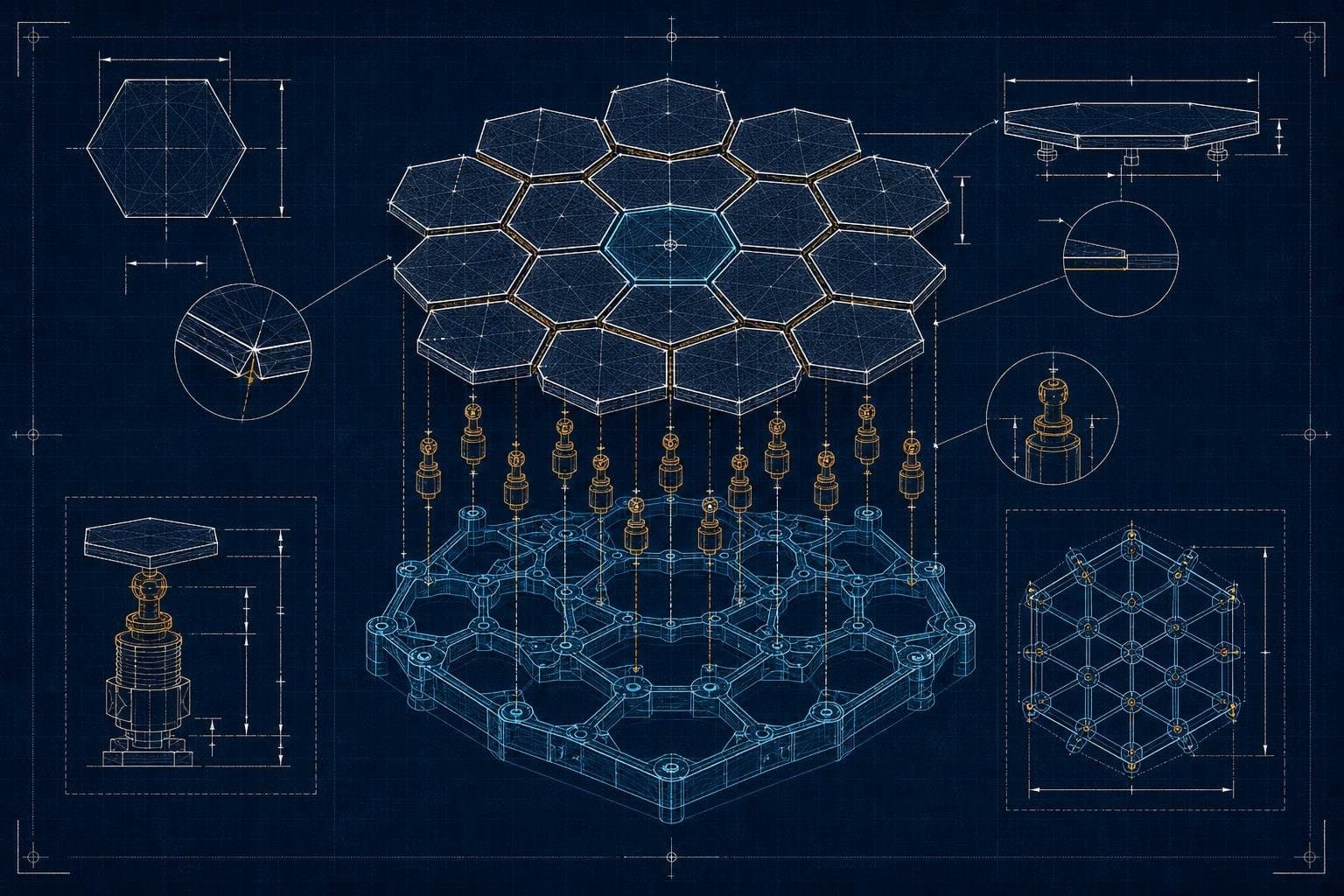
Segmentation solved the packaging problem by breaking the mirror into 18 hexagonal pieces, each 1.32 metres across, that could fold against the telescope's backplane for launch and then deploy once Webb was in space. The whole observatory had to fold down small enough to fit inside the rocket, then reassemble itself in flight, automatically, on the coast out to L2. The segments aren't a workaround for the "real" mirror — they are the mirror, and they work because the engineers solved a harder problem than simply making one big piece.
18 Mirrors That Have to Act Like One
Here's where the engineering gets genuinely interesting. Eighteen separate mirrors are useless unless they behave as a single optical surface. Each segment is mounted on actuators — small motorized mechanisms that can adjust the segment's position and tilt with nanometer-scale precision. After deployment, the alignment process used Webb's own instruments to measure how the wavefront of light from a single star was being distorted by misaligned segments, then iteratively corrected each one until all 18 contributed coherently to a single focused image.
The material choice reinforces this. Webb's primary mirror is made of beryllium, a metal chosen specifically because it maintains its shape predictably as temperature drops toward the cryogenic operating environment around 40 kelvin. Beryllium's thermal expansion coefficient is low and well-characterized, which means engineers could model exactly how each segment would contract during cooldown and pre-compensate. A glass mirror of that size would behave less predictably at those temperatures and would be significantly heavier — both serious problems when every kilogram costs money and every thermal surprise costs pointing accuracy.
The segmented architecture also introduced a failure mode that a monolithic mirror doesn't have: if any one of the 344 single points of failure during deployment had gone wrong, the entire $10 billion mission was lost. About 80% of those risks were tied to the unfolding sequence. Engineers called the deployment period the "30 days of terror." That's the honest cost of the segmented approach — you've traded manufacturing impossibility for deployment complexity, and deployment complexity in a spacecraft 1.5 million kilometres from Earth with no repair option is a very specific kind of terrifying.
The Design Pattern That's Now Spreading
What makes Webb's mirror architecture worth studying beyond the telescope itself is that the same trade-off logic is driving the next generation of ground-based observatories. The Giant Magellan Telescope uses seven 8.4-metre mirrors forming a 25.4-metre equivalent aperture, and the Thirty Meter Telescope uses a segmented primary to reach apertures no monolithic mirror could achieve. The constraint that forced Webb's hand — you cannot manufacture, transport, or deploy a single mirror beyond a certain size — turns out to be universal. Segmentation stopped being a space-specific workaround and became the standard architecture for any telescope that needs to be genuinely large.
Webb's 18 segments didn't compromise the science. They enabled it. The mirror that seemed like a concession to rocket geometry turned out to be the only mirror that could have existed — and the alignment system that makes 18 pieces behave as one is, arguably, more impressive than any single piece of glass could have been.
The next time you see one of Webb's images, you're looking at light that was collected by 18 separate mirrors, each adjusted to nanometer precision, acting in concert from a parking spot 1.5 million kilometres away that no human being can reach. That's not a workaround. That's the whole trick.


