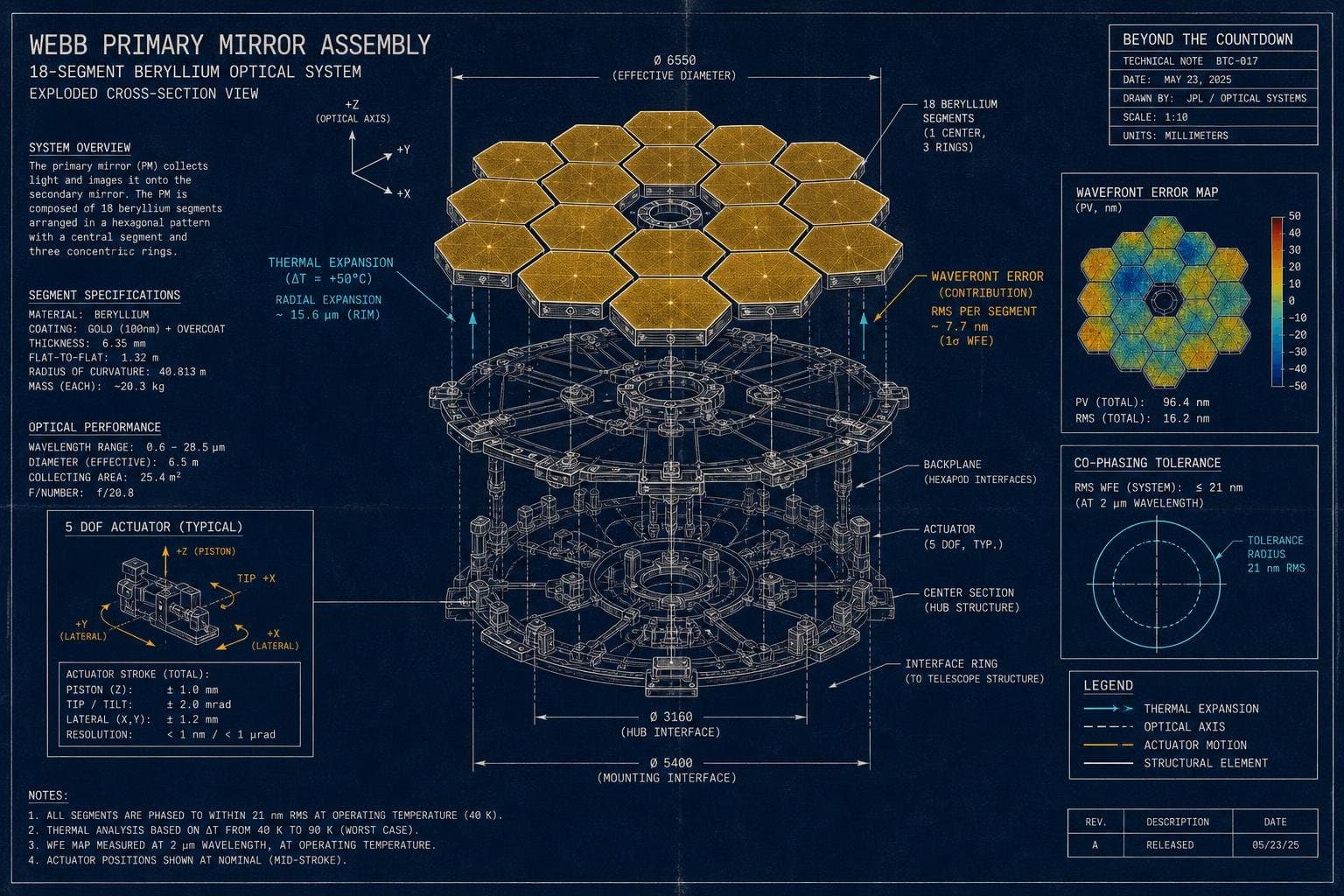

The engineers who designed Webb's primary mirror set their performance targets conservatively. They had to. You don't get a second chance to adjust a mirror sitting at the L2 Lagrange point, 1.5 million kilometers from Earth, operating at temperatures near 50 Kelvin. So when NASA reported that Webb's segmented gold mirror delivers images "twice as sharp as pre-launch estimates," that gap between prediction and performance deserves more scrutiny than it usually gets. It's not luck. It's the payoff from a specific set of thermal engineering decisions that were, at the time, genuinely uncertain bets.
I wrote about why Webb's mirror is 18 segments — the rocket fairing made that decision before any optical engineer did. But segmentation creates a problem that a monolithic mirror never has: 18 independent pieces of beryllium, each mounted on actuators, each subject to slightly different thermal loads, each capable of drifting out of phase alignment by nanometers as temperatures fluctuate. The alignment problem is continuous, not one-time. And the thermal environment at L2 is not as stable as it sounds.
The Tolerance Stack That Keeps Engineers Up at Night
Here's the constraint that makes this hard: to function as a single coherent mirror, Webb's 18 segments must maintain co-phasing to within a fraction of the wavelength of light they're collecting. At near-infrared wavelengths, that means surface errors on the order of tens of nanometers — roughly 1/1000th the width of a human hair — across a structure spanning 6.5 meters. Any thermal gradient across that structure translates directly into wavefront error.
Research published in the Journal of Astronomical Telescopes, Instruments, and Systems this past July makes the stakes concrete for next-generation designs. That work — a segment-level thermal sensitivity analysis from a team at the Space Telescope Science Institute — found that achieving starlight suppression at the level needed for direct exoplanet imaging requires wavefront stability at 100 parts per trillion. The analysis showed that thermal drifts in the telescope structure propagate differently across each segment, and that tolerance requirements are non-uniform: outer segments can tolerate more thermal variation than inner ones, because the apodization masks used in coronagraphic modes weight their contributions differently.
Webb doesn't need coronagraphic performance at that extreme level for most science, but the underlying physics is identical. Temperature gradients across the primary mirror create differential expansion in the beryllium substrate and the actuator mechanisms, which shifts segment tip, tilt, and piston — the three degrees of freedom that determine whether 18 mirrors act as one. The engineering solution Webb uses is a combination of passive thermal stability (the five-layer sunshield keeps the entire cold side of the telescope in a remarkably stable thermal bath) and active wavefront sensing and control, run periodically to measure and correct any drift.
Why Beryllium, and What It Cost
The choice of beryllium for the mirror segments was itself a thermal trade-off. Beryllium has a specific stiffness — the ratio of its elastic modulus to its density — that makes it exceptional for cryogenic optical applications. It also has a relatively low coefficient of thermal expansion at operating temperatures, which means dimensional changes as the mirror cools from room temperature to ~50 Kelvin are predictable and manageable. The alternative materials considered for large space mirrors each carry their own trade-offs, as a recent review of large-aperture optical mirror manufacturing in Light: Advanced Manufacturing documents: achieving sub-nanometer surface accuracy requires not just the right material but sustained innovation in both fabrication and metrology, with the two disciplines tightly coupled.
Beryllium's downside is that it's expensive, difficult to machine, and toxic as a dust — which constrained where and how the segments could be fabricated and tested. Every design choice that simplified thermal behavior added cost or manufacturing complexity somewhere else in the system. That's the constraint optimization in practice: you're not finding the perfect solution, you're finding the least-bad combination across a dozen competing requirements simultaneously.
What the Interferometry Result Actually Reveals
The NASA report on Webb's aperture masking interferometry mode is worth reading as a thermal engineering validation, not just a science story. AMI works by placing a mask with seven hexagonal pinholes in the light path, effectively turning the primary mirror into an array of smaller interferometric baselines. The technique is exquisitely sensitive to wavefront errors — if the segments were drifting or poorly co-phased, the fringe patterns AMI produces would degrade immediately. The fact that Webb is delivering AMI science at twice the angular resolution originally predicted is direct evidence that the thermal control system is holding alignment tighter than the conservative pre-launch models assumed.
That gap between predicted and actual performance is the real engineering story. The teams who built Webb's thermal and wavefront systems were working at the edge of what could be verified on the ground — you can't fully simulate L2 thermal conditions in a test chamber. They built in margin, tested conservatively, and the system outperformed. For the engineers designing the next generation of large segmented space telescopes, that margin is now data. The thermal tolerance budgets that once had to be estimated can now be calibrated against a decade of Webb operational experience — which is exactly the kind of inheritance that makes the next hard problem slightly less hard.


