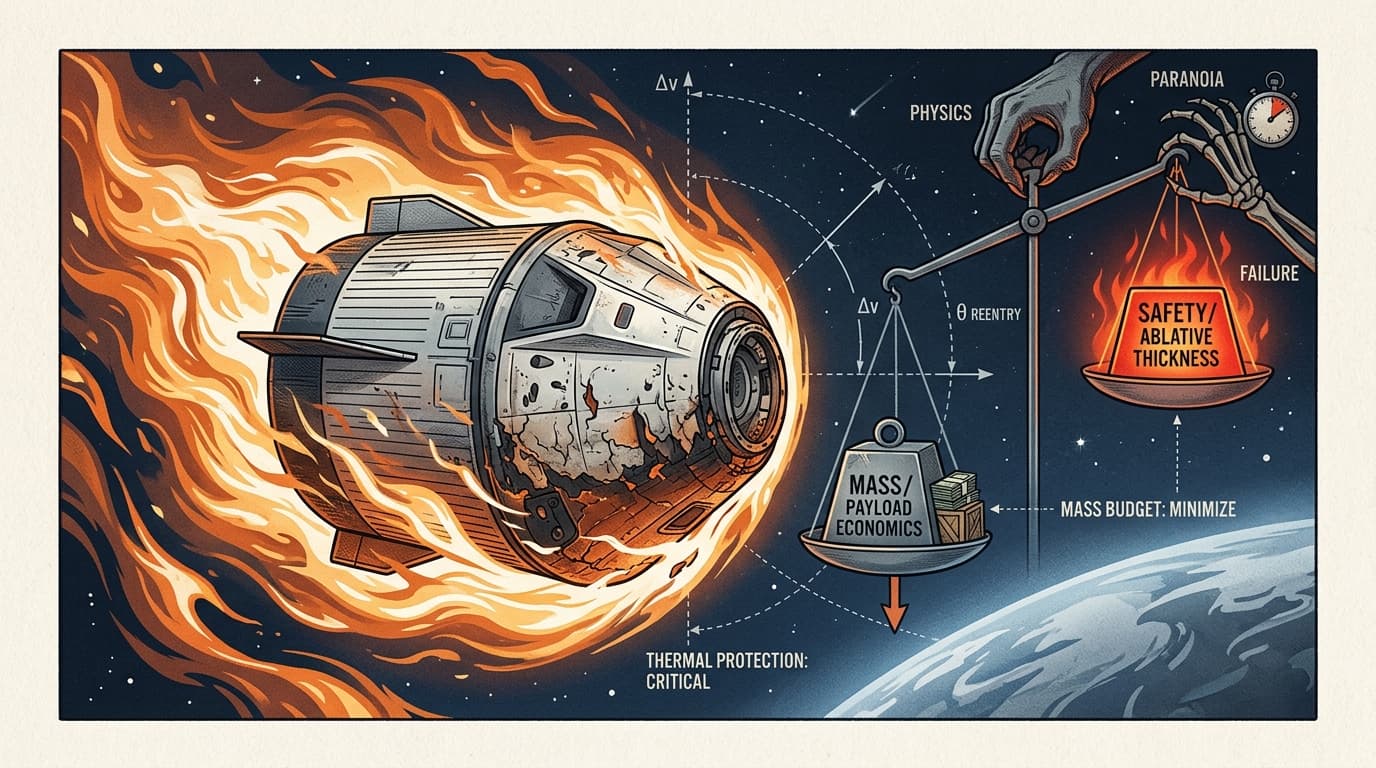

There's a number that haunts every thermal protection system engineer: 2,900 degrees Fahrenheit. That's roughly the surface temperature a capsule's heat shield faces during a high-energy Earth reentry — hot enough to ionize the air around the vehicle into plasma, hot enough to vaporize most materials humans have ever manufactured. The heat shield's job is to stand between that plasma and the crew or payload behind it. Its failure mode is not "degraded performance." Its failure mode is "the vehicle ceases to exist."
Given that, you might expect heat shield design to be conservative to the point of absurdity — just pile on material until you're confident, and accept the weight penalty. For the first fifty years of human spaceflight, that was more or less the approach. Apollo's AVCOAT ablator was thick, heavy, and deliberately over-engineered. Nobody lost sleep over the mass budget when the alternative was a crew of three burning up over the Pacific.
But that calculus has shifted, and it's shifted in ways that expose some genuinely hard engineering tensions. Reusable spacecraft demand heat shields that survive multiple entries without full replacement. Commercial missions demand heat shields that don't consume so much mass budget that the payload economics collapse. And an increasingly ambitious set of planetary missions — Mars, Venus, the outer planets — demands heat shields that work in atmospheric conditions we can barely simulate on Earth. The result is that thermal protection system design has become one of the most constrained optimization problems in aerospace engineering: you're simultaneously minimizing weight, maximizing reusability, maintaining safety margins that regulators and mission designers demand, and doing all of it with materials that behave in ways that are still not fully understood at the fundamental level.
That last part is worth sitting with for a moment. We have been flying ablative heat shields since the 1960s. And we are still, in 2025, running experiments to understand exactly why they fail.
Ablation Is Not a Bug — But Spallation Might Be
The basic physics of an ablative heat shield is elegant in a counterintuitive way. Instead of trying to reflect or absorb heat, an ablator sacrifices itself. The material heats up, chars, and then the char layer either vaporizes or physically breaks away — carrying the thermal energy with it before it can conduct inward to the vehicle structure. The char layer also acts as an insulator, slowing the heat front. The net effect is that a relatively thin layer of ablative material can protect a vehicle from temperatures that would instantly destroy the underlying structure, as long as the ablation rate is controlled and predictable.
"Controlled and predictable" is doing a lot of work in that sentence.
NASA's Hypersonic Materials Environmental Test System (HyMETS) facility has been running experiments specifically designed to understand a failure mode called spallation — where chunks of the char layer physically break off during reentry rather than ablating smoothly. This matters enormously for two reasons. First, spallation is less predictable than smooth ablation, which means your safety margins have to account for worst-case chunk loss rather than average material removal rates. Second, spalled particles become high-velocity projectiles in the flow field, which can damage other parts of the vehicle — a particular concern for winged vehicles or anything with exposed sensors or mechanisms downstream of the heat shield.
The HyMETS work uses mass spectrometry to analyze what's actually happening at the molecular level during ablation and spallation events. The goal is to build better predictive models — not just empirical "this material survives X heat flux for Y seconds" data, but actual mechanistic understanding of why the char layer coheres or fractures under different conditions. That kind of understanding is what lets you design thinner heat shields with confidence, because you know your margin calculations are based on physics rather than conservative guesswork layered on top of conservative guesswork.
This is the core tension in ablative TPS design: the safety margin you need is directly proportional to how well you understand the failure modes. Better physics models mean you can carry less material for the same confidence level. Worse models — or novel materials in untested conditions — mean you pad the margin, and padding the margin means weight, and weight means either smaller payload or larger rocket or both.
For a single-use capsule on a cost-plus government contract, that trade is manageable. For a reusable commercial vehicle flying dozens of missions, it compounds into an existential business problem.
Reusability Breaks the Ablator's Core Assumption
Here's the thing about ablative heat shields: they work by consuming themselves. That's the mechanism. An ablator that doesn't ablate isn't protecting anything. Which means that every time you fly an ablative heat shield, it's thinner than it was before — and at some point, it's too thin to protect the vehicle through another entry.
For Apollo, this was fine. The capsule flew once. The heat shield was inspected post-splashdown mostly out of engineering curiosity, not operational necessity. For Orion, which is designed for multiple flights, the situation is more complex. NASA has put significant engineering effort into understanding how AVCOAT — the same basic material family used on Apollo, though reformulated — degrades across missions and how to inspect and certify it for reuse. The answers are not simple.
SpaceX took a fundamentally different approach with Dragon, using PICA-X (a derivative of NASA's Phenolic Impregnated Carbon Ablator) and designing the heat shield geometry to minimize ablation rates while still handling the thermal environment. The reusability record for Dragon heat shields has been impressive in operational terms, but the inspection and recertification process after each flight is non-trivial — you're looking for microcracking, delamination, and localized over-ablation that might not be visible on the surface but could compromise the next entry.
Starship represents the most aggressive reusability bet in the history of heat shield design. Rather than an ablative system, SpaceX chose ceramic tiles — a reusable, non-ablating approach that, in principle, can survive many entries without material loss. Ship 39's recent cryoproof testing validated the V3 design's structural integrity under propellant loading conditions, and the vehicle incorporates a redesigned TPS with improved aerodynamic flap placement intended to reduce the thermal loads on the most vulnerable areas during reentry. The tile approach trades the predictable, physics-based protection of ablation for a system that must survive intact — any tile loss exposes the underlying structure to direct plasma contact, which is how Columbia was lost.
The engineering response to that risk is redundancy in tile attachment, improved gap-filler materials between tiles, and extensive testing of the tile system under simulated reentry conditions. But the fundamental vulnerability remains: a reusable tile system's failure mode is sudden and catastrophic in a way that a well-designed ablative system's failure mode is not. An ablator that's slightly thinner than expected still provides most of its protection. A missing tile provides none.
This is not an argument that tiles are wrong for Starship — the operational economics of replacing ablative heat shields on a vehicle designed to fly hundreds of times would be prohibitive. It's an argument that the reusability requirement fundamentally changes the risk profile of the TPS, and that the safety margins required to manage that risk are different in character, not just in magnitude, from what you'd calculate for a single-use vehicle.
The Weight Budget Is a Zero-Sum Game, and TPS Always Loses First
Every kilogram of heat shield is a kilogram that isn't payload. On a vehicle going to low Earth orbit, that trade is painful but manageable — launch costs have dropped enough that the economics can absorb a conservative TPS design. On a vehicle going to Mars, or returning samples from an asteroid, or entering the Venusian atmosphere, the trade becomes brutal.
Mars entry is particularly instructive. The Martian atmosphere is thin enough that you can't rely on it for much aerodynamic braking — you hit the top of the atmosphere at interplanetary velocities and have very little time to shed that energy before you need to deploy a parachute or fire retrorockets. The heat flux is lower than Earth reentry in absolute terms, but the duration is longer, and the combination of low atmospheric density and high entry velocity creates a heating environment that's genuinely different from anything in the Earth-return database. You can't just scale your Earth-reentry TPS and call it done.
NASA's Tech Briefs coverage of recent aerospace manufacturing developments highlights work on printable heat shield formulations — NASA-developed materials that can be manufactured on-demand rather than through the traditional labor-intensive layup process. The significance here isn't just cost reduction, though that matters. It's that printable formulations allow you to vary material properties across the heat shield surface in ways that are difficult or impossible with traditional manufacturing. You can put denser, more ablation-resistant material at the stagnation point where heating is highest, and lighter, less robust material at the edges where the heat flux is lower — optimizing the weight distribution for the actual thermal environment rather than designing the whole shield to survive the worst-case point.
That kind of spatial optimization is where the real weight savings live. A heat shield designed to the average heating environment across its surface is carrying dead weight everywhere the heating is below average. A heat shield designed to the local heating environment at each point is carrying exactly the material it needs, no more. The gap between those two approaches, in terms of mass, can be significant — and on a planetary mission where every kilogram of TPS mass is a kilogram that isn't science payload or propellant, significant is an understatement.
The challenge is that spatially optimized heat shields are harder to model, harder to test, and harder to certify. Your safety margin calculations now have to account for spatial variation in material properties, potential interfaces between different material zones, and the possibility that the actual heating environment doesn't match your predictions in ways that happen to stress the zones where you put lighter material. The physics models have to be better, not just good enough.
This is where the HyMETS spallation research connects back to the weight optimization problem. If you don't understand why and when spallation occurs, you can't confidently design a spatially optimized heat shield — because spallation behavior might differ between your dense stagnation-point material and your lighter edge material in ways that create unexpected failure modes at the interface. Better fundamental understanding of ablation and spallation mechanics is the prerequisite for the kind of precision TPS design that planetary missions increasingly require.
Safety Margins Are a Bet on Your Own Ignorance
NASA's Aerospace Safety Advisory Panel 2025 annual report reflects the institutional tension that runs through all of this: the pressure to move faster, fly more, and reduce costs is real and legitimate, but it exists in direct tension with the safety margins that protect against the failure modes you haven't fully characterized yet. The ASAP's role is specifically to flag when that tension is being resolved in ways that concern them — when schedule pressure or cost pressure is eroding margins that exist for good engineering reasons.
The history of spaceflight is, in part, a history of safety margins that turned out to be correct and safety margins that turned out to be insufficient. The O-ring temperature sensitivity on Challenger was understood at some level before the accident — the safety margin had been eroded by operational pressure and incomplete communication of the risk. The foam strike that doomed Columbia was a known phenomenon that had been observed on previous flights and classified as acceptable based on analysis that turned out to be wrong.
In both cases, the failure wasn't that the engineers didn't have safety margins. It was that the safety margins were calculated based on an incomplete understanding of the failure mechanism. The margin looked adequate given what was known; it wasn't adequate given what was true.
This is the deepest reason why the HyMETS spallation research matters beyond its immediate engineering applications. Every time you improve your mechanistic understanding of a failure mode, you improve your ability to set safety margins that are calibrated to reality rather than to the limits of your knowledge. A safety margin that says "we add 40% thickness because we're not sure exactly how spallation behaves under these conditions" is a different kind of margin than one that says "we add 15% thickness because our physics model predicts this spallation rate and we've validated the model against test data across this parameter range." The second margin is smaller, but it's more defensible — and on a mass-constrained mission, defensible smaller margins are exactly what you need.
The Thermal and Fluids Analysis Workshop (TFAWS) that NASA runs annually is one of the institutional mechanisms for propagating this kind of improved understanding across the community — getting the people who run the arc jet tests and mass spectrometry experiments in the same room as the people who design the heat shields and write the certification requirements. The gap between "we understand this phenomenon better" and "that understanding is reflected in how we design and certify vehicles" is not automatic, and TFAWS is part of how NASA tries to close it.
What the next few years will test is whether that knowledge transfer can keep pace with the operational tempo that commercial spaceflight demands. SpaceX is flying Starship on a cadence that would have been unimaginable for government programs. The certification frameworks, the inspection protocols, and the safety margin calculations all have to evolve to handle vehicles that accumulate flight experience faster than traditional analysis cycles can process it. The physics of ablation and spallation don't care about your launch schedule — but the engineering institutions that manage TPS safety have to find ways to learn from flight data in something closer to real time.
Watch for how NASA's updated TPS certification guidance evolves in response to Starship's increasing flight rate, and whether the ASAP's 2026 reporting cycle flags any specific concerns about the pace of that evolution. The tension between operational tempo and safety margin rigor is going to be one of the defining engineering governance questions of the next decade — and thermal protection systems are where it's most acutely visible, because the consequences of getting it wrong are both immediate and total.


