


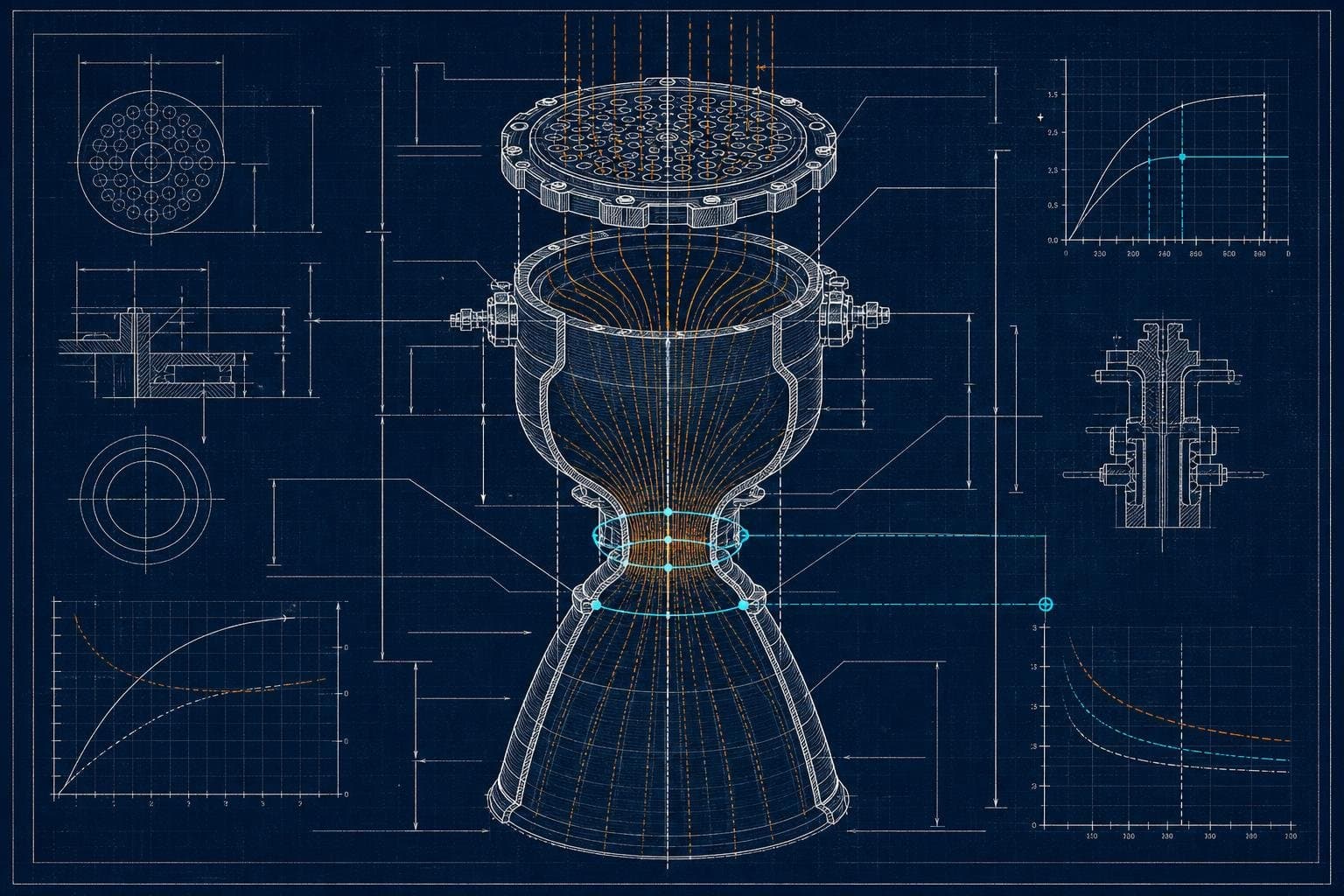

The hardest moment in a lunar landing has nothing to do with the final touchdown. It happens roughly 10 kilometers up, when the lander transitions from a high-energy descent burn to the precision phase — and the engine has to do something deeply counterintuitive: throttle down aggressively while the vehicle is still moving fast, still heavy with remaining propellant, and still far enough from the surface that a guidance error compounds into a miss.
This is the throttling problem, and it sits at the intersection of two competing demands that don't resolve cleanly.
Efficiency Wants You to Burn Hard and Fast
Rocket engines are most efficient at or near their design thrust level. Throttling down — reducing propellant flow to cut thrust — typically degrades specific impulse, the measure of how much thrust you extract per unit of propellant consumed. An engine optimized for a particular chamber pressure and nozzle expansion ratio loses efficiency when you force it to operate well below that design point. The propellant you burn at reduced throttle is doing less work per kilogram than propellant burned at full thrust.
For a lunar lander, this matters enormously. Every kilogram of propellant saved during descent is payload capacity recovered — science instruments, crew supplies, surface equipment. The mission architecture is built around a propellant budget, and that budget has no slack. NASA's Artemis III lander test program exists precisely because the gap between modeled performance and actual flight behavior is where missions get into trouble.
The efficiency argument pushes toward a descent profile that stays near full throttle as long as possible, then cuts the engine late and hard — minimizing time spent in the inefficient partial-throttle regime.
Precision Wants You to Slow Down Early and Carefully
The problem is that the Moon doesn't cooperate with aggressive late braking. The lunar surface near the south pole — the target for Artemis III — is heavily cratered, with slopes and boulder fields that make landing site selection a live decision, not a pre-programmed coordinate. The crew and the guidance system need time to assess the actual touchdown zone, which means the lander has to be slow enough and low enough to make that assessment meaningful.
That requires extended time in the throttled regime. The lander has to hold a controlled hover or near-hover while the crew evaluates the surface. And hovering is propellant-expensive precisely because you're fighting gravity at low efficiency.
This is the tension I wrote about from a different angle when covering the single-engine bet in the Artemis lander design: simplicity in the propulsion system trades against the flexibility you'd want for extended precision maneuvering. A single engine with a wide throttle range is a different engineering problem than a cluster of smaller engines you can switch on and off for fine control.
What the Test Program Has to Prove
NASA's Artemis II mission served as a systems test — a crewed dress rehearsal, in the words of Orion Vehicle Manager Branelle Rodriguez, that returned "flight truth" to rewrite the engineering backlog before Artemis III attempts the first crewed lunar landing in more than half a century. The lander test program inherits that same logic: you don't know where your models are wrong until the hardware flies.
The throttling question is exactly the kind of problem that looks solved on paper and reveals itself in flight. Propellant slosh at partial throttle, combustion stability at the low end of the thrust range,