


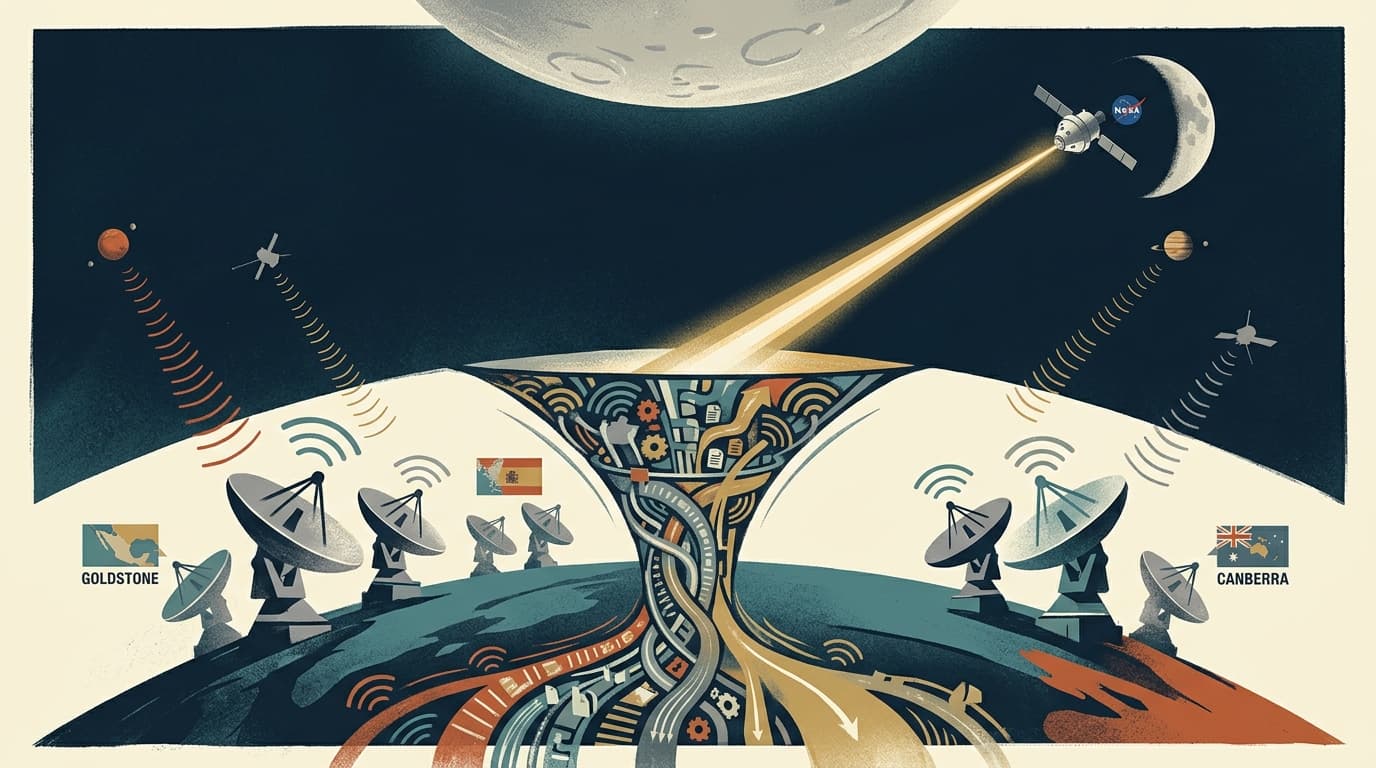

The Artemis II coverage has been full of justified excitement about O2O — the Orion Artemis II Optical Communications System that's been beaming 4K video from lunar distance, capping more than two decades of development by NASA and MIT. It's a genuine technical achievement. But zoom out one level and a structural tension becomes visible: the spacecraft got dramatically more capable, and the ground infrastructure holding it together is still, in fundamental ways, the same architecture that supported Apollo.
The Ground Segment Is the Constraint
When Orion leaves Earth orbit on Artemis II, communication responsibility shifts entirely to the Deep Space Network — a system of large radio antennas at three sites worldwide, managed out of JPL in Pasadena. The DSN handles everything: navigation data, telemetry, voice, video, scientific return. Three ground stations, globally distributed to maintain coverage as Earth rotates, serving every deep-space mission NASA is running simultaneously.
That last part is the constraint hiding in plain sight. The DSN doesn't serve Artemis II exclusively. It serves every active deep-space mission — planetary probes, Mars orbiters, interplanetary science spacecraft. Scheduling antenna time is a genuine resource allocation problem, and it's been getting harder as mission count grows. The architecture was designed for an era when deep-space missions were rare and bandwidth demands were modest. Neither of those things is true anymore.
O2O is a partial answer to the bandwidth problem — laser links can carry far more data than radio for a given power budget, which is exactly why NASA spent two decades developing it. But O2O still requires ground receivers pointed at the spacecraft. The optical ground stations are a new layer on top of the existing DSN, not a replacement for it. The fundamental constraint — a small number of fixed ground assets serving an expanding mission manifest — doesn't disappear because the link layer got faster.
What the 40-Minute Blackout Actually Reveals
The Artemis II lunar flyby includes roughly 40 minutes of complete communication blackout as the spacecraft passes behind the Moon. Radio and laser signals alike are blocked by the lunar body itself. The crew is genuinely isolated — no telemetry out, no commands in, no voice contact with Houston.
That's not a failure of the communication system. It's a geometric constraint that no ground-based architecture can solve. The only fix is relay infrastructure in lunar orbit — satellites positioned to maintain line-of-sight with spacecraft on the far side and with Earth simultaneously. NASA has been working toward lunar relay capability as part of the broader Artemis infrastructure, but for Artemis II, the blackout is simply accepted as a mission parameter.
This is the pattern that keeps recurring in deep-space communication: the spacecraft capability advances faster than the supporting infrastructure. O2O is a genuinely impressive terminal. The ground receivers it needs are still being built out. Lunar relay satellites that would eliminate the blackout problem don't yet exist in operational form. The mission flies anyway, with the constraints managed rather than solved.
The Receiver Problem Is Still Open
On the physics side, there's active research into what comes after O2O-class systems. Researchers at Chalmers University of Technology have demonstrated a noise-free optical amplifier that achieves record receiver sensitivity at high data rates — the kind of system that could eventually support optical links from Mars or beyond. The key engineering insight in their approach: push complexity to the ground receiver rather than the spacecraft. Let the Earth-side system generate most of the signal processing overhead, keeping the space-side transmitter simple. That's the right trade given the constraints — spacecraft power and mass budgets are always scarce, ground stations can be upgraded.
But "demonstrated in a lab" and "integrated into operational DSN infrastructure" are separated by a long development and procurement cycle. The Chalmers work was published in late 2024. It won't be in operational ground stations for years, possibly longer.
That gap — between what's technically demonstrated and what's operationally deployed — is the real story behind the O2O headlines. The laser terminal on Orion represents the leading edge of what's possible. The ground infrastructure supporting it represents a different, slower investment cycle. As missions get more ambitious and data-hungry, that gap is the thing worth watching.
The next meaningful milestone: whether NASA's lunar Gateway program produces operational relay satellites before crewed lunar surface missions require them. That's the infrastructure decision that will determine whether "40 minutes of silence" becomes a historical footnote or a recurring constraint on every mission that follows.