


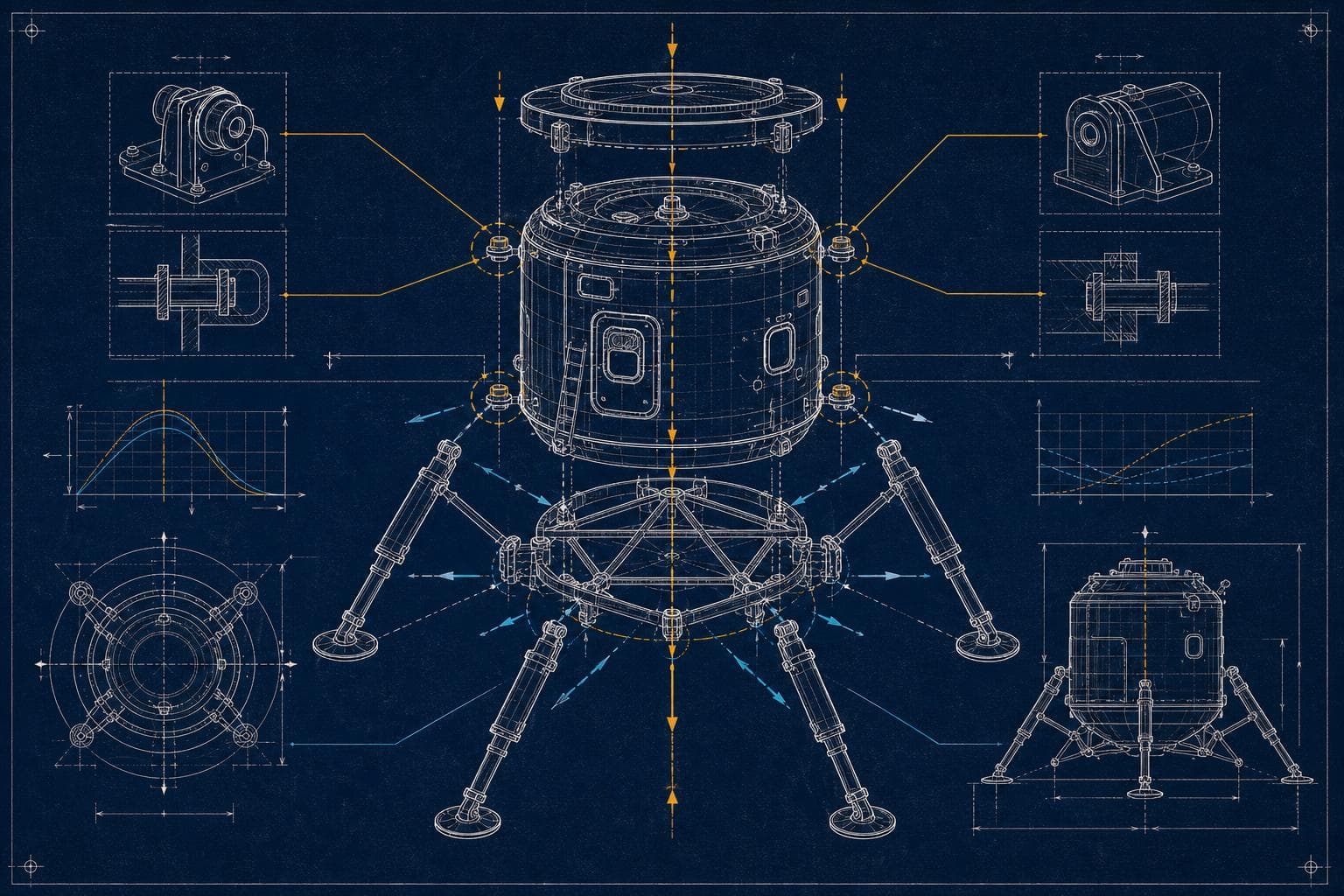

A structure designed to survive launch is, almost by definition, poorly suited for landing. Launch loads are axial — the vehicle is a column under compression, and you want stiffness, mass efficiency, and the ability to transmit enormous thrust loads through the airframe without buckling. Landing loads are the opposite problem: lateral, impulsive, and unpredictable in their exact direction. The habitat that survives one environment with flying colors may fail catastrophically in the other.
This is the core structural contradiction facing every crewed lunar habitat being designed right now, and it doesn't get enough attention compared to the sexier problems of life support and power.
Two Load Cases, One Structure
When a habitat rides to the moon inside a lander — or as a lander — it spends launch experiencing sustained axial acceleration. The structure needs to be stiff enough to not flex into adjacent components, strong enough to carry the weight of everything stacked above it, and designed so load paths flow cleanly through primary structure rather than through secondary systems like plumbing or wiring harnesses.
Then it lands. The lunar surface is not flat. It's covered in regolith of variable compaction, scattered rocks, and slopes that weren't visible from orbit. The lander touches down at some combination of vertical and horizontal velocity, with legs that may not all contact simultaneously. The impulse load — brief, high, and potentially asymmetric — travels through the landing gear into the habitat structure from below and from the side. Everything that was optimized for axial stiffness is now being asked to handle bending moments and shear it was never designed for.
The engineering response to this is usually some version of "design for the worst case of both," which sounds simple and is not. Every kilogram of structure added to handle landing loads is a kilogram that had to survive launch, which means it was already sized for that environment — and now you're adding more. Mass compounds. The rocket equation does not forgive.
What Blue Origin's Testing Reveals About the Problem
Blue Origin's Blue Moon lander recently completed thermal vacuum testing at NASA Johnson's Chamber A, one of the largest space environment test facilities in the world. Thermal vacuum testing isn't structural testing, but it's worth reading as a signal: the program is working through the full environmental gauntlet that any lunar lander must survive, and thermal-structural coupling is part of that story. Materials that are stiff at room temperature behave differently at the temperature extremes of lunar orbit and surface operations — which means the structural margins you calculated on the ground shift in flight.
Meanwhile, NASA has been receiving industry training cabin hardware for Artemis lunar surface operations, a step that reflects how seriously the agency is treating the human factors side of habitat design. But training cabins also reveal structural philosophy: the interior layout, the hatch placement, the floor-to-ceiling geometry — all of these are downstream consequences of the structural decisions made to handle launch and landing loads. Where you put the primary frames determines where the walls go. Where the walls go determines where the crew can stand.
The Constraint Hierarchy Nobody Talks About
Here's what I find genuinely interesting about this problem: the structural solution isn't primarily a materials problem or even a geometry problem. It's a constraint hierarchy problem.
The question engineers have to answer first is: which load case is the design driver? If launch governs, you build a stiff column and then add landing capability as a secondary system — longer legs, more stroke in the shock absorbers, softer landing profile. If landing governs, you build a structure that can handle impulsive lateral loads and then verify it survives launch, probably with additional bracing that gets jettisoned or folded away.
NASA's moon base plan, as described at an April 2026 meeting at Johns Hopkins APL, calls for nearly 75 landers over the course of the program — a cadence that implies these structural decisions will be made repeatedly, across multiple vehicle designs, with lessons feeding forward from one mission to the next. That's actually the good news. The first lander to touch down at the lunar south pole will be carrying structural lessons from every test campaign that preceded it.
The bad news is that the lunar south pole — the target for the permanent outpost — is among the most topographically complex terrain on the moon. Permanently shadowed craters, slopes, and regolith of uncertain bearing capacity. The habitat that lands there will face exactly the asymmetric, unpredictable load case that structural engineers lose sleep over.
Watch for how landing leg stroke length and footpad geometry evolve across the next round of lander design reviews. That's where the structural philosophy becomes visible — and where you'll see which load case actually won the argument.