



Liquid hydrogen is the most efficient chemical rocket propellant available. It's also, at -253°C, one of the coldest substances you'll ever try to store on a spacecraft — and the Moon's surface doesn't care about your cryogenic management plan.
That tension sits at the center of Blue Origin's Blue Moon MK1 lander, which recently completed its thermal vacuum testing campaign inside Chamber A at NASA's Johnson Space Center. The same facility that certified Apollo hardware is now validating a vehicle that has to solve a version of the same problem Apollo engineers faced, with significantly higher stakes: how do you manage extreme thermal environments when your propellant is already at the edge of what physics allows?
The Problem Is the Propellant
The BE-7 engine runs on liquid hydrogen and liquid oxygen — a combination that delivers exceptional specific impulse, which matters enormously when you're trying to land a roughly 3,000-kilogram spacecraft on the Moon without in-space refueling. Blue Origin's MK1 is designed as a single-launch cargo vehicle, which means every kilogram of propellant it carries has to do real work. High-efficiency propellants earn their place.
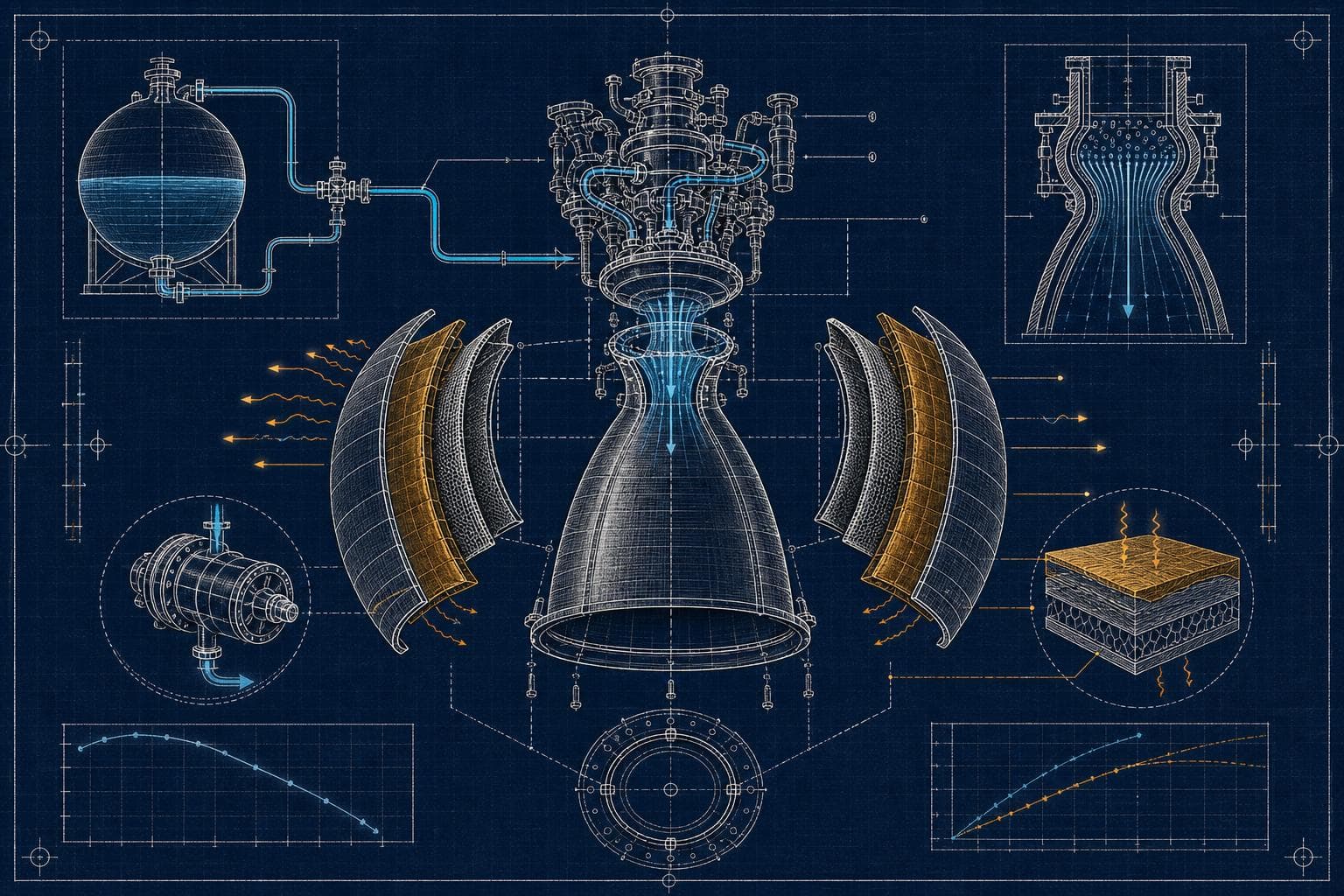
But liquid hydrogen demands a thermal management architecture that would make a refrigeration engineer nervous. The propellant boils at -253°C — just 20 degrees above absolute zero. Any heat leak into the tank, from solar radiation, from the engine itself, from the lunar surface radiating absorbed sunlight, accelerates boiloff. Boiloff means lost propellant. Lost propellant means reduced delta-V margin. And on a precision landing mission targeting within 100 meters of a designated site near Shackleton Crater, margin is everything.
The thermal challenge isn't just keeping the propellant cold during transit. It's managing the transition from cruise configuration to powered descent — a phase where the engine goes from cold-soaked dormancy to full combustion in a sequence that has to work correctly the first time, on a vehicle that can't be retrieved if something goes wrong.
What TVAC Testing Actually Validates
The thermal vacuum campaign at Johnson Space Center wasn't just a checkbox. Chamber A testing replicated the vacuum of space and the extreme temperature swings the spacecraft will encounter during transit and lunar surface operations, allowing engineers to evaluate system performance and verify structural and thermal integrity before flight.
That phrase — "extreme temperature swings" — is doing a lot of work. A lunar lander in transit experiences the deep cold of shadowed space. On approach, it faces solar heating on sun-facing surfaces while other panels remain near absolute zero. At the lunar South Pole, the target landing zone near Shackleton Crater sits in a region where permanently shadowed craters hold water ice precisely because they never see direct sunlight — but the surrounding terrain does. The thermal gradient across a landed vehicle can be severe.
The BE-7 and its associated cryogenic fluid systems have to perform across this entire range. TVAC testing is where you find out whether your insulation design, your propellant conditioning approach, and your engine start sequence actually hold together when the environment stops cooperating.
The Constraint Hierarchy Driving Every Trade-Off
I'd argue the most instructive thing about the MK1's design philosophy is what the single-launch, no-refueling constraint forces. When you can't top off your tanks in lunar orbit, you can't afford to lose propellant to boiloff during a long transit. That pushes you toward aggressive insulation — but insulation adds mass. Mass reduces payload capacity. Payload capacity is the product you're selling.
Every thermal management decision on a cryogenic lander lives inside that triangle: insulation performance, mass budget, and mission duration. The engineers who chose liquid hydrogen accepted a harder thermal problem in exchange for better propellant efficiency. Whether that trade pays off depends entirely on how well the thermal architecture performs across the full mission profile — which is exactly what Chamber A was designed to answer.
The broader context here matters: NASA is targeting as many as 21 lunar landings over the next two and a half years, with nine penciled in for 2027 alone. That cadence requires landers that work reliably, not just ones that work once. Thermal management that performs under TVAC conditions but degrades across repeated mission profiles would be a serious problem for a program trying to establish routine lunar access.
The MK1 is now returning to the Space Coast for final preflight preparations ahead of its targeted late 2026 launch. The thermal vacuum campaign is behind it. The actual thermal environment is still ahead — and that's the test that counts.