



Perseverance travels a few hundred meters on a good day. Not because the wheels can't spin faster — because every meter requires a conversation with Earth that takes, at minimum, eight minutes one way and often much longer. The rover waits. Scientists analyze. Commands go up. The rover moves again. It's exploration at the speed of bureaucracy, and it's been the defining constraint of surface science since Spirit first rolled onto Gusev Crater in 2004.
A study published in Frontiers in Space Technologies suggests that constraint is breakable — and the solution looks less like a car and more like a dog.
The Bottleneck Isn't the Rover, It's the Handshake
The communication delay between Earth and Mars ranges from roughly 4 to 22 minutes one way, depending on orbital geometry. That means every single decision — turn left, extend the arm, take a reading — requires a round-trip that can consume nearly an hour of clock time. Rovers are engineered to be cautious precisely because a mistake on Mars can't be corrected in real time. The result is a machine that is, by design, slow.
The researchers behind the ANYmal study framed this cleanly: "traditional single-target, human-supervised robot and instrument control methodologies are constrained by operational limitations, particularly on Mars, where long communication delays hinder real-time decision-making." The fix they tested wasn't faster hardware or a better antenna. It was a different operating philosophy — semi-autonomous, multi-target exploration where the robot decides what to examine next, rather than waiting for Earth to tell it.
The results are striking. The semi-autonomous system completed missions up to three times faster than traditional human-supervised methods while still accurately identifying key geological targets. That's not a marginal improvement. That's a different category of mission.
Four Legs Solve a Problem Wheels Never Could
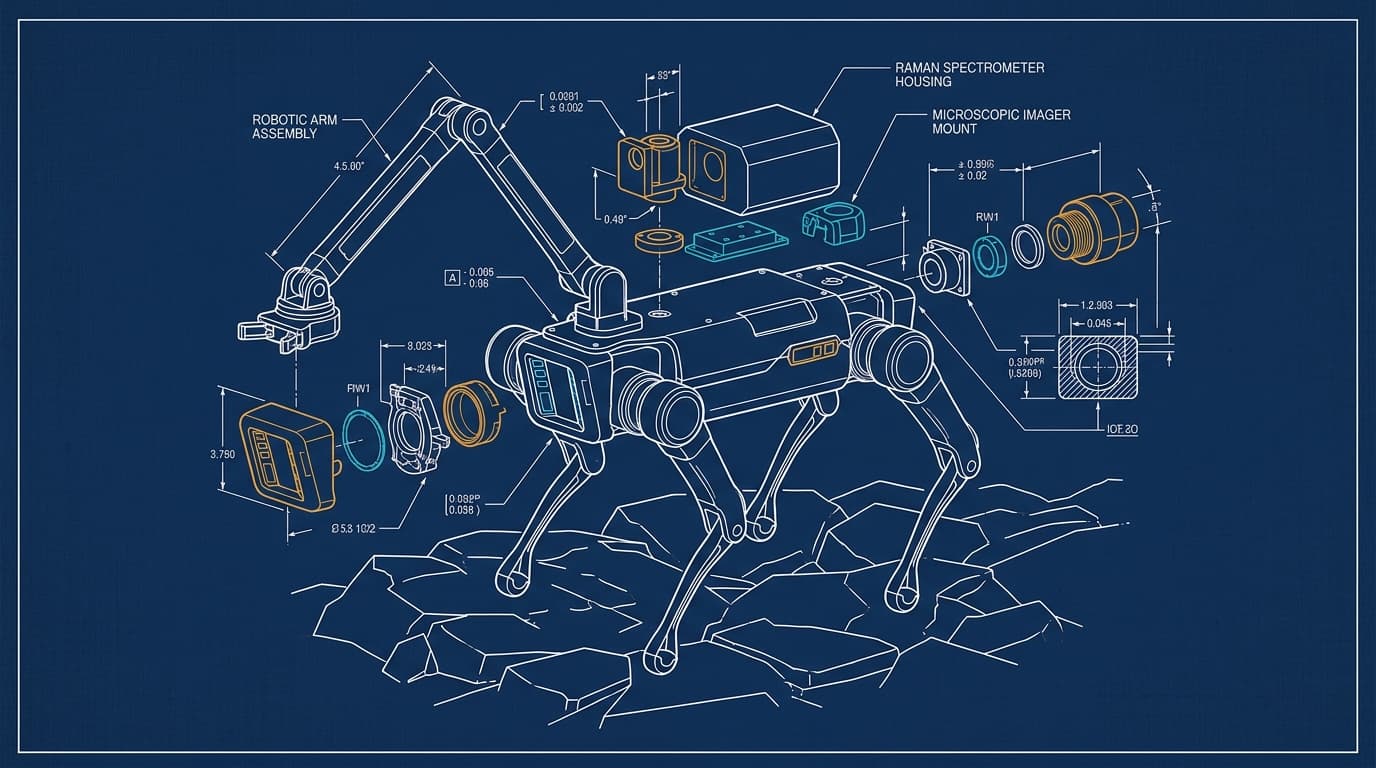
The ANYmal robot — built by Anybotics and tested in Mars and lunar analogue environments — brings a second advantage beyond autonomy: it can go where wheeled rovers can't. Legged robots can access crater walls, fractured terrain, and ice-rich slopes that have been effectively off-limits to every wheeled mission we've ever flown. Opportunity spent years skirting the edges of craters that a legged system could descend into.
The instrument loadout in this study was deliberately minimal — a microscopic imager and a Raman spectrometer mounted on a robotic arm. The researchers wanted to know whether a lean payload could still produce meaningful science. The answer was yes: even compact tools were sufficient to identify rocks important for astrobiology and resource exploration when the robot could autonomously sequence through multiple targets in a single sortie.
This is the counterintuitive design insight worth sitting with. We've spent decades trying to pack more instruments onto rovers to maximize science return per mission. The ANYmal research suggests a different optimization: fewer instruments, more targets, faster cadence. The science return comes from coverage, not from depth at any single location.
What the Trade-off Actually Looks Like
Semi-autonomy isn't free. The robot is making decisions that scientists on Earth would normally make — which rock to approach, when a reading is sufficient, when to move on. That's a genuine transfer of scientific judgment to an algorithm, and it requires trusting that the system's target-selection logic is sound enough to not systematically miss what matters.
The researchers tested this directly, comparing autonomous multi-target runs against human-supervised single-target runs. The autonomous system held up. But I'd argue the real test comes when the terrain is genuinely ambiguous — when the interesting sample is the one that doesn't look interesting at first pass. That's where human intuition has historically earned its keep, and it's the open engineering problem that will define how much autonomy future missions can responsibly hand off.
The trajectory is clear regardless. As missions push further from Earth — future Titan missions face communication delays exceeding an hour — full autonomy stops being a nice-to-have and becomes the only viable operating mode. The ANYmal work is early-stage, but it's pointing at the architecture those missions will need.
Watch for whether ESA's follow-on work with lead author Gabriela Ligeza's group moves toward terrain-specific autonomy benchmarks — the moment someone publishes a standardized test for rover decision-making quality is the moment this field gets serious about the handoff problem.