



Watch the replay from Flight 14 and the moment that sticks isn't the ascent. It's the ending: Starship splashes down north of Hawaii, tips over, and erupts in flames — a dramatic coda to a flight that had already reached orbit for the first time, delivered 26 Starlink satellites, and survived an engine shutting down early en route, according to NBC News, via The Associated Press. SpaceX had been targeting a six-orbit, ten-hour mission to validate readiness for Artemis; flight controllers cut it to roughly three hours once the bad engine was no longer needed and the primary objectives were in hand, per that same report. NASA Administrator Jared Isaacman congratulated the team for "managing every step in a safe, responsible and especially inspirational way" — notably not for a clean landing, because there wasn't one.
That gap between "reached orbit" and "ended in fire" is exactly where the steel-versus-composite question lives.
Steel Does a Job Composite Can't Do as Cheaply
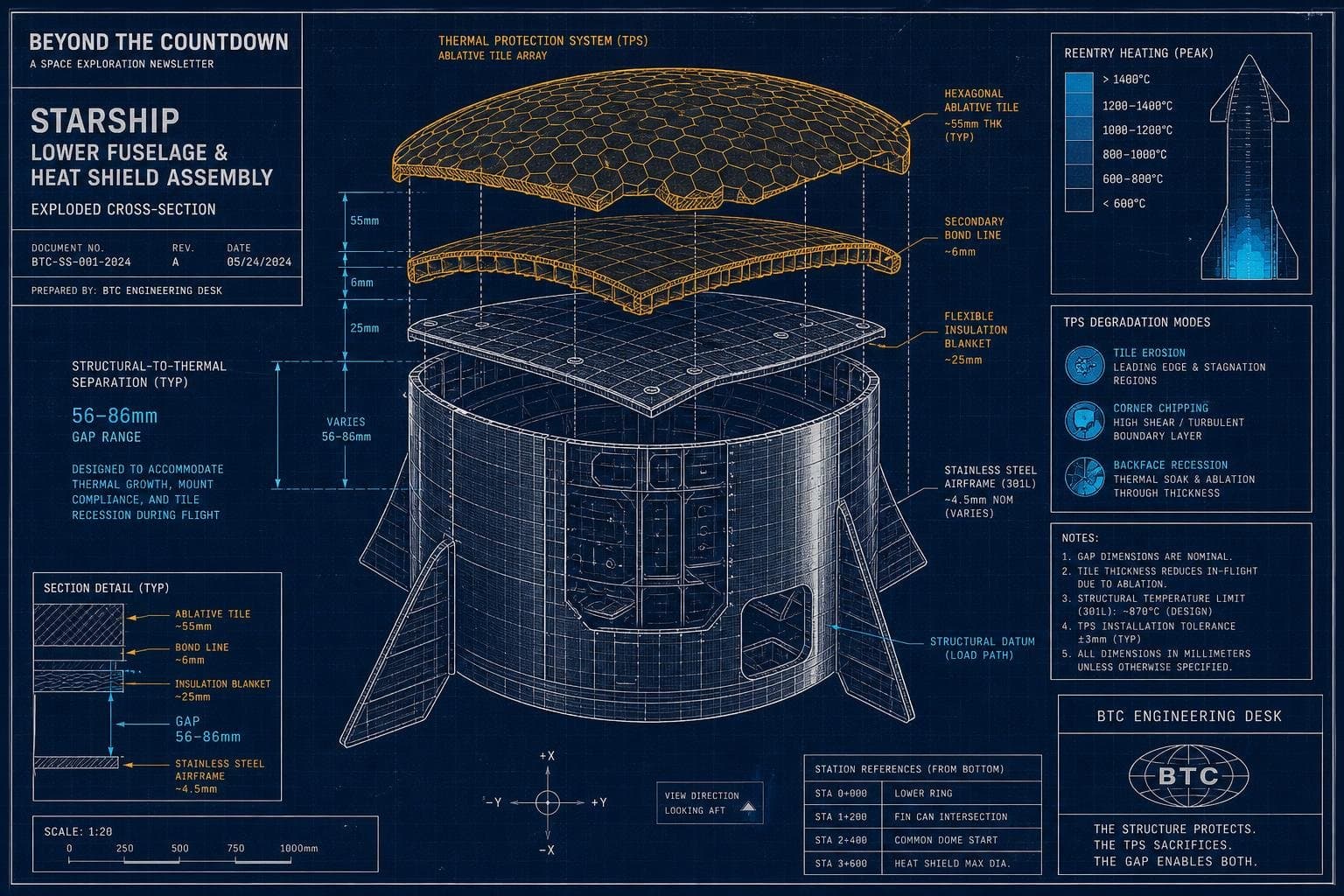
SpaceX's choice of stainless steel for Starship's airframe has been public for years, and the reasoning the company has given is structural and economic, not thermal: steel keeps most of its strength at cryogenic propellant temperatures and holds up reasonably well under the heat of reentry on its own, where carbon composite would need heavier insulation to avoid losing strength at high temperature. It's also dramatically cheaper and faster to weld and repair than autoclaved composite, which matters enormously when you're trying to iterate through dozens of vehicles instead of building one flawless orbiter. I'd frame it as a bet that mass savings from an exotic composite skin weren't worth what you'd give up in manufacturing speed and in-field repairability — a classic constraint trade where the "better" material on paper loses to the material you can actually produce at the rate your test program demands.
What steel does not solve is reentry heating at the surface. That's a separate problem, bolted onto the structure rather than solved by it.
The Tiles Are Still the Hard Part
That's where the real action is, and it's not unique to Starship. A decade-long collaboration between NASA and the Advanced Light Source at Lawrence Berkeley National Laboratory has been watching ablative heat shield materials degrade in real time, under X-ray imaging that recreates reentry temperature, pressure, and gas conditions as they evolve — rather than relying on before-and-after snapshots, as engineers long had to, according to Berkeley Lab's news center. Researcher Vishnu Oruganti, now at NASA Johnson Space Center, noted that "nearly every major NASA ablative heat shield material has been studied with this technique," including those relevant to Artemis and Mars entry missions, per the same piece. That's heat-shield materials science broadly — the Berkeley work doesn't speak to Starship's tile system specifically — but it underscores the point: the hard, still-being-solved engineering problem in atmospheric entry isn't the load-bearing skin underneath. It's the sacrificial layer riding on top of it, degrading on purpose, that everyone is still working to model and predict more precisely.
Starship's steel airframe gets it through the structural loads of ascent and the mechanical stress of reentry heating. What determines whether the vehicle lands intact or tips over in flames is a separate system entirely — the thermal protection layer, and whatever damage accumulated on it during the hottest minutes of descent. Flight 14's ending doesn't tell us which failed; the public reporting doesn't attribute the splashdown fire to a tile loss, an engine issue, or a landing dynamics problem. But it's a reminder that "the rocket reached orbit" and "the rocket survives reentry cleanly" are two different engineering milestones, cleared on two different timelines.
What to Watch Next
SpaceX's next moves on the Starship program — and whether the next flight gets a repeat go-ahead from regulators, following the FAA clearance granted ahead of Flight 14 per Aviation Week — will say more about where the thermal protection system actually stands than any structural material decision will. The steel bet looks settled. The tile bet is still being graded flight by flight.