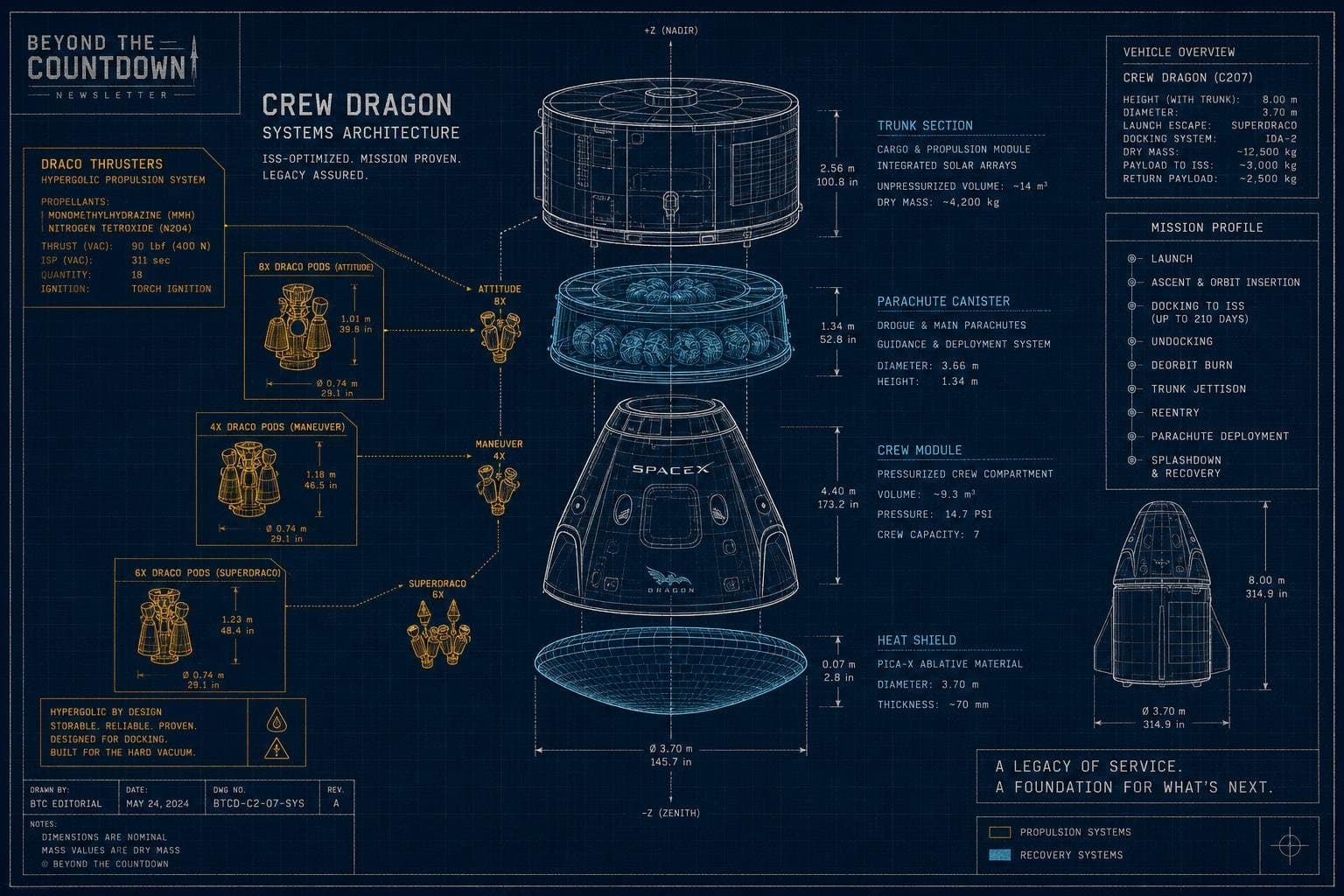

Here's a number that should bother anyone who thinks about sunk costs: NASA put $3.1 billion into developing and certifying Crew Dragon. SpaceX was contractually obligated to fly six missions with it. It's flown 13, with a 14th launching imminently, and it recently agreed to keep going through Crew-17. By any measure, SpaceX has more than paid back NASA's investment. And now it's telling the agency, and the commercial space-station builders counting on it, that it's done after the International Space Station retires around 2030.
That's not a scandal. It's a predictable output of how SpaceX allocates engineering and manufacturing capacity, and it's worth walking through why, because the decision says more about constraint optimization than about loyalty.
A Spacecraft Built for a Mission Profile That's Disappearing
Dragon's entire architecture — the hypergolic Draco and SuperDraco engines, the parachute-and-splashdown recovery sequence, the trunk that gets jettisoned before reentry — was optimized around a specific mission: ferry crew and cargo to a single destination, the ISS, reliably and repeatedly, for a customer (NASA) that needed redundancy against a prior single-point-of-failure problem. That architecture earned its keep. SpaceX's own cargo lineage shows the stakes of getting it wrong: the uncrewed CRS-7 mission disintegrated 139 seconds after launch in 2015 due to a strut failure in the second stage, three years after CRS-1 flew the company's first operational station resupply run in 2012. Dragon's reliability since then has been the foundation of NASA's confidence in commercial crew.
But reliability built for one orbital destination doesn't automatically extend to a future where NASA wants deep-space hardware and the company's own roadmap is centered on a fully reusable Starship. Maintaining Dragon's production line, its recovery ships, its parachute and heat-shield refurbishment cycle, and its crew-rated safety certification is a continuous resource draw. If the destination market shrinks to a handful of commercial stations flying a few crew rotations a year, the unit economics of keeping that whole supply chain warm stop making sense next to a vehicle SpaceX is already building for Mars-class ambitions.
The Revenue Mix Explains the Timing
The more interesting constraint isn't technical, it's financial, and it explains why this decision is landing now rather than five years ago. In its recent public filings tied to going public, SpaceX made clear that Starlink already generates the majority of its revenue, and that the company expects that share to keep growing. NASA used to be the anchor customer that justified Dragon's existence. Now it's one revenue stream among several, and arguably not the one shaping the company's capital allocation. When your biggest growth vector is a satellite constellation and your biggest moonshot is a reusable deep-space transport, a crew capsule tuned for low-Earth-orbit taxi runs becomes a legacy system you keep flying only as long as contracts require, not a platform you keep investing in.
That's the trade SpaceX appears to have made: optimize for where the company is going, not where NASA's commercial LEO strategy assumed it would still be standing in 2031.
Who Inherits the Gap
This leaves Axiom Space, Voyager Space, and Vast Space — all building private stations meant to succeed the ISS — without a confirmed crew ride once Dragon steps back. The obvious backup, Boeing's Starliner, isn't ready to absorb that load. NASA now targets 2028 for Starliner's next crewed flight, pending an uncrewed demonstration flight, Starliner-1, that could happen as early as December 2026 or January 2027. That schedule traces directly back to the thruster failures and helium leaks that stranded astronauts Butch Wilmore and Suni Williams on the ISS for 286 days before they came home aboard a Crew Dragon. The backup plan for Dragon's exit is a vehicle whose own return to crew service depends on fixing the exact kind of propulsion problem that made Dragon indispensable in the first place.
Watch what NASA does next on Starliner-1's actual launch date, and whether Axiom or Vast announce an alternative crew-transport agreement before 2030 arrives. The low-Earth-orbit economy NASA spent two decades trying to build was always going to run on whichever vehicle's business case survived contact with the company that builds it.


