
There's a moment in the Artemis II commander's post-mission interview that cuts right to the engineering logic of the whole program. Reid Wiseman was asked when he knew the mission was actually going to happen. His answer: "When the solid-rocket motors lit."
Not when the countdown reached zero. Not when the engines ignited. When the solids lit — because at that point, there's no stopping it. That irreversibility is a feature, not a bug. And it's the first thing you need to understand about why solid rocket motors dominate the Artemis launch architecture.
The Choice That Looks Obvious Isn't
The SLS stack that launched Artemis II on April 1, 2026 is a liquid-fueled rocket at its core. Four RS-25 engines burn liquid hydrogen and liquid oxygen in the core stage. The upper stage is liquid. Orion's service module propulsion is liquid. So why are the two largest thrust contributors on the vehicle solid?
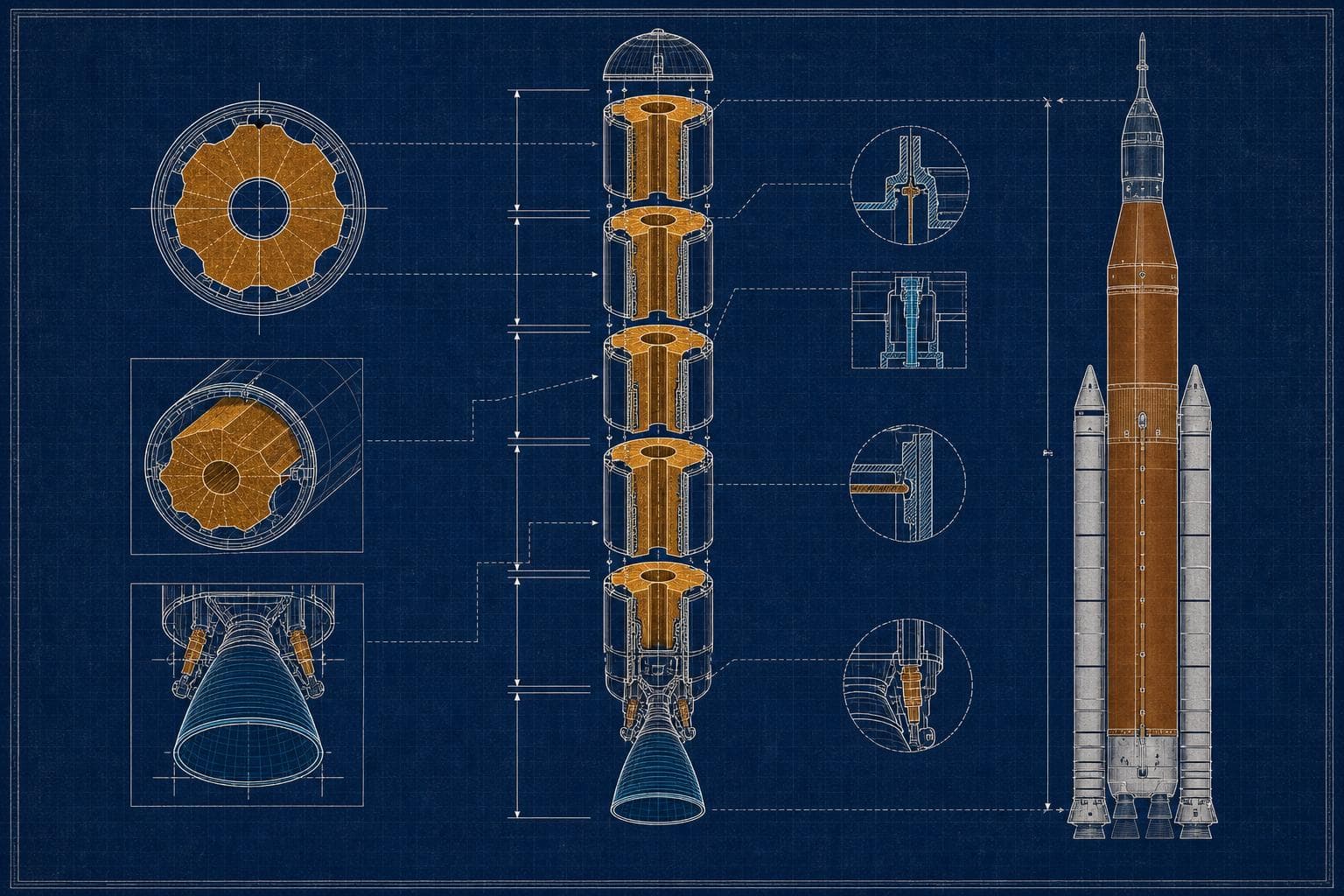
Northrop Grumman's twin solid rocket boosters delivered over 7.2 million pounds of thrust at liftoff — more than 75% of the SLS rocket's total thrust at launch. That's not a supplemental contribution. That's the primary lift mechanism for the first two minutes of flight, when the vehicle is heaviest and gravity is working hardest against it.
The engineering case for solids at this phase comes down to three constraints that liquid systems handle poorly: thrust density, simplicity under load, and ignition reliability.
Liquid engines produce enormous thrust, but they require turbopumps, propellant conditioning, ignition sequences, and active control systems — all of which take time to reach stable operation and introduce failure modes. At liftoff, you need maximum thrust immediately, with no tolerance for a slow ramp-up. Solid motors ignite completely and produce full thrust almost instantaneously. There's no pump startup transient, no propellant conditioning window, no ignition delay. The chemistry does the work.
The simplicity argument compounds this. A solid motor is essentially a casing, a propellant grain, and a nozzle. The RS-25 engines on the core stage are marvels of engineering — and they're correspondingly complex, with thousands of parts that must function correctly under cryogenic conditions. Stacking four of those next to two massive solid boosters means the solids absorb the brute-force lift requirement while the liquid engines handle the precision throttling and trajectory shaping once the vehicle is moving.
The Trade-Off They Accepted
None of this is free. Solid motors have one significant liability that liquid systems don't: you cannot turn them off.
Once a solid rocket motor ignites, combustion continues until the propellant is exhausted. There's no throttle, no shutdown command, no abort-by-cutting-fuel. This is why Northrop Grumman also supplies attitude control motors for crew safety — small solid motors that can push the Orion capsule away from the stack in an abort scenario, because you can't simply stop the boosters if something goes wrong.
The design accepts this constraint because the alternative — liquid strap-on boosters — introduces its own failure modes at the worst possible moment. Liquid boosters require propellant loading, pressurization, and active management during the countdown and early flight. They can be shut down, yes, but they can also fail to start, fail to reach full thrust, or develop leaks in the propellant lines connecting them to the core vehicle. For a crewed mission where the first two minutes of flight are the highest-risk window, the reliability of a solid ignition sequence outweighs the flexibility of a liquid shutdown capability.
Northrop Grumman's boosters also carry direct heritage from the Space Shuttle program — over 135 Shuttle missions used the four-segment booster variant. The Artemis version added a fifth segment for additional performance, but the fundamental design was already flight-proven across decades of crewed operations. When you're building a new vehicle for crewed deep-space flight, that heritage is worth a great deal.
What This Means for What Comes Next
Artemis III is already taking shape in the Vehicle Assembly Building at Kennedy Space Center, with the core stage vertical and awaiting its engine section ahead of a 2027 target. The solid booster architecture carries forward unchanged — the same five-segment motors, the same thrust split, the same two-minute burn profile before separation.
The interesting engineering question for Artemis III isn't the launch vehicle. It's what happens after the solids drop away and the mission transitions entirely to liquid propulsion for lunar orbit insertion, descent, and ascent. That's where the constraint calculus shifts completely — and where the solid-versus-liquid argument gets answered differently, for different reasons, at every subsequent mission phase.
The solids got the crew off the ground. Everything after that is a different problem.


