


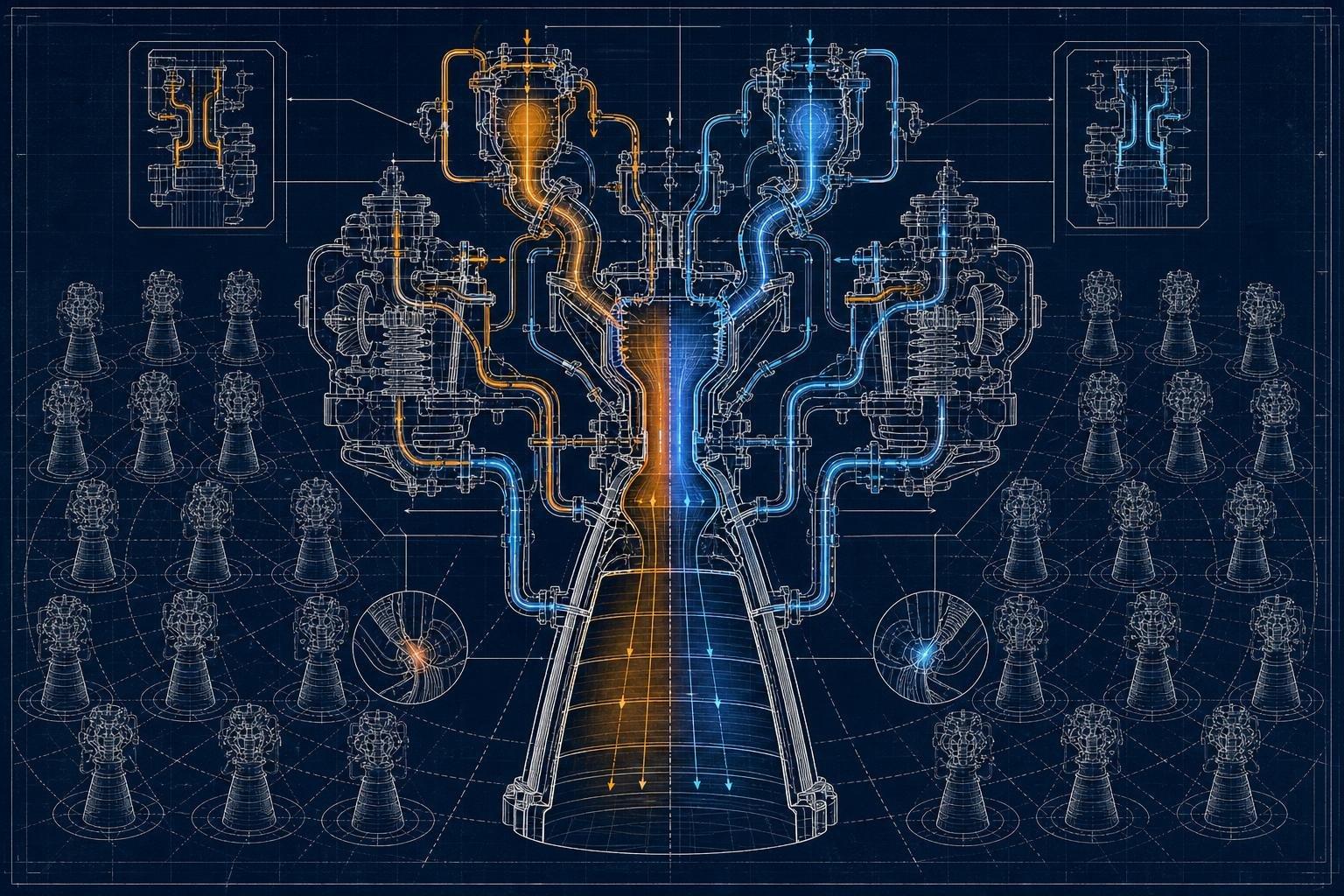

Thirty-three engines lit in near-perfect sync, then thirty-two of them relit minutes later for a boostback burn — that's the number that should stop you on Flight 15. Getting one staged-combustion engine to ignite reliably is hard. Getting thirty-three of them to do it in formation, repeatedly, across a single flight, is the real argument for why SpaceX chose the hardest combustion cycle in rocketry and has spent a decade making it routine.
The Cycle Nobody Else Commits To
Most liquid rocket engines use a gas-generator cycle: burn a small slice of propellant in a separate, fuel-rich (or sometimes oxidizer-rich) chamber just to spin the turbopumps, then dump that exhaust overboard unburned. It's simpler to build and tune, which is exactly why India's space agency chose it for its new methane engine. ISRO's LME-1100, which completed a gas-generator ignition test on its propulsion complex in October, is explicitly designed around that architecture because it's "cost-effective and industry-friendly" to manufacture at scale, according to the agency's own description of the program (via Lapaas Voice). That's not a knock on ISRO — it's a rational constraint choice for an agency building its first methane engine family. You don't start with the hardest cycle in the catalog.
A full-flow staged combustion engine like Raptor does something almost perverse by comparison: it routes all of the propellant through two preburners — one fuel-rich, one oxidizer-rich — so that both turbopumps get driven by fully-reacted, high-pressure gas before the leftover propellant ever reaches the main chamber. Nothing gets dumped overboard unburned. Every bit of fuel and oxidizer does useful work twice: once spinning a turbine, once burning in the main chamber. The payoff is higher chamber pressure and better specific impulse for the same propellant load. The cost is that you're now running two separate hot-gas generators instead of one, with two sets of turbopump seals that have to survive both an oxidizer-rich and a fuel-rich combustion environment without eating each other alive.
Why SpaceX Took the Harder Path Anyway
The gas-generator route is the obvious choice when your constraint is development risk and manufacturing simplicity. SpaceX's constraint was different: Starship's whole architecture depends on getting booster mass down and reuse cadence up, which means every kilogram of engine dry mass and every percentage point of specific impulse compounds across dozens of flights. That's the logic visible in Raptor's own version history. Teslarati's reporting on the engine's evolution lays out the trend plainly: Raptor 1 produced roughly 185 metric tons of sea-level thrust at about 2,080 kilograms of engine mass, Raptor 2 pushed that to 230 tons while cutting mass to roughly 1,630 kilograms, and the Raptor 3 target is 280 tons at around 1,525 kilograms. That's a thrust-to-weight trajectory that gets steeper with every revision — more force, less structure, same combustion cycle underneath.
A gas-generator engine can be iterated too, but it starts from a lower ceiling on chamber pressure and propellant utilization. Full-flow staged combustion gives SpaceX more headroom to keep squeezing mass out of the engine without hitting a performance wall, which matters enormously when you're bolting 33 of them onto a single booster, as Flight 15's ascent configuration shows (SpaceX). Thirty-three gas-generator engines dumping unburned turbine exhaust is thirty-three small efficiency losses stacked on top of each other. At that engine count, the margin you buy back by not wasting propellant on turbopump drive gas starts to look like the difference between closing the mass budget and not closing it.
The Bill Comes Due in Turbomachinery, Not Thrust
None of this is free, and the sourced record makes that visible too. Flight 15's booster relit 32 of its planned 33 engines for the boostback burn, and the burn itself ended early with the root cause still under investigation at the time of reporting (SpaceX; Aviation Week). I'd read that as the honest cost of the full-flow architecture's real complexity: with two preburners and tighter turbopump tolerances per engine, multiplied by 33 engines per flight, the failure surface for something subtle to go wrong is larger than it would be with a simpler cycle. SpaceX's bet has always been that the performance ceiling is worth the engineering debt of chasing down problems like that one engine at a time, across many flights, rather than designing around a lower but safer performance envelope from the start.
What's worth watching next isn't another thrust number — it's whether SpaceX identifies a root cause for the early boostback burn-out and whether Raptor 3's lighter, higher-thrust targets hold up once they're flying in the same 33-engine cluster that just proved the cycle can work at scale.