


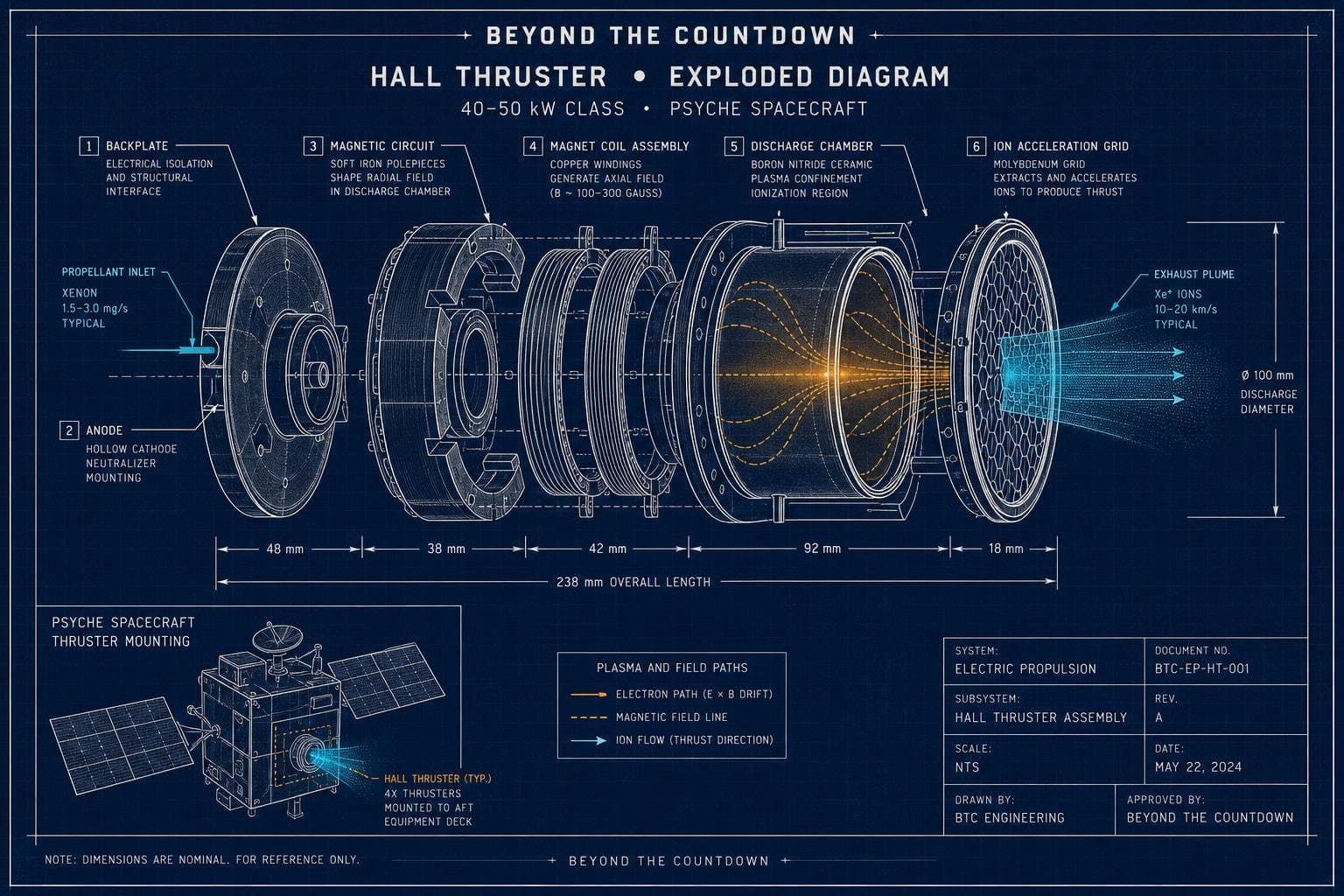

A spacecraft the size of a small van, built to reach an asteroid 173 miles wide, and NASA didn't put a single conventional rocket engine at its core. Psyche runs on solar electric propulsion — a thruster system that produces barely enough force to lift a sheet of paper on Earth. That sounds like a liability until you understand what problem the mission was actually solving.
The Real Constraint Isn't Thrust — It's Mass Budget
Chemical thrusters are the default answer when you need force fast: launch vehicles, planetary landers, anything working against gravity on a clock. But chemical propulsion pays a brutal tax in propellant mass, because every pound of thrust comes from burning propellant at a fixed, comparatively low exhaust velocity. For a mission with no landing, no atmosphere to fight, and years rather than minutes to get where it's going, that tax stops making sense.
Psyche launched October 13, 2023, from Kennedy Space Center on a Falcon Heavy, and it won't arrive at its target asteroid until August 2029 — nearly six years in transit. That's the kind of timeline where the math flips. Electric propulsion accelerates propellant to much higher exhaust velocities than chemical combustion can achieve, which means the spacecraft gets far more momentum change out of every kilogram of propellant it carries. The price is thrust so low it has to run almost continuously, shaping a trajectory over years instead of executing a handful of decisive burns. For a mission measuring distance in years rather than hours, that's not a compromise — it's the entire point of the design.
Low Thrust Rewrites the Trajectory, Not Just the Engine
The trade-off doesn't stop at the propulsion system. It cascades into how the whole mission gets flown. Chemical-propulsion missions tend to lean on a small number of precisely timed impulsive burns and gravity assists, because that's what matches their burn profile. Low-thrust electric propulsion behaves differently — it's shaping the orbit gradually over long arcs, which means the gravity-assist geometry that works for a chemical mission doesn't automatically work for an electric one.
That's visible in current trajectory-design research examining why a single Venus flyby isn't sufficient to set up a rendezvous with the asteroid Psyche, work being done under a Tisserand-based reachability framework for gravity-assist selection (MDPI, Aerospace). I'd treat that as a window into the broader challenge rather than a settled account of Psyche's actual flight path: when your propulsion system spends years nudging rather than days burning, the set of gravity-assist combinations that actually get you to rendezvous — rather than just a flyby — shrinks and shifts in ways that chemical-mission trajectory tools weren't built to find. Electric propulsion doesn't just change the engine room. It changes the whiteboard where the whole mission gets plotted.
The Thrusters Still Have an Accuracy Problem
Here's the part that doesn't make it into the launch-day press releases: Hall thrusters are hard to characterize precisely, and that uncertainty matters a lot more when you're flying one continuously for years rather than firing it in short, well-instrumented bursts. Current work out of the University of Michigan's aerospace department is tackling exactly this — building optimal experimental design methods to calibrate how a Hall thruster's plasma plume responds to background pressure inside ground test facilities, using the SPT-100 thruster as a test case (Journal of Applied Physics, AIP Publishing). Ground vacuum chambers can't perfectly replicate the pressure of deep space, so engineers testing these thrusters on Earth are chasing a moving target: how much of a thruster's measured performance is the thruster itself, and how much is an artifact of the chamber it's sitting in.
That's not a footnote to the propulsion story — it's the reason electric propulsion missions take so much validation before they fly. A chemical engine's performance is comparatively easy to bound; a Hall thruster's plume behavior under facility-pressure effects is still an active research question with dedicated test campaigns built around it. Choosing electric propulsion for a mission like Psyche doesn't just mean accepting a years-long cruise instead of a punchy chemical burn. It means betting that the uncertainty in a thruster's long-duration behavior is manageable enough to stake a $985-million-class mission on, years before arrival.
What's worth watching next isn't the asteroid encounter in 2029 — it's whether facility-pressure calibration work like the Michigan study starts closing the gap between how Hall thrusters perform in a vacuum chamber and how they perform in actual deep space, because that gap is exactly what future low-thrust mission planners have to budget margin against.