


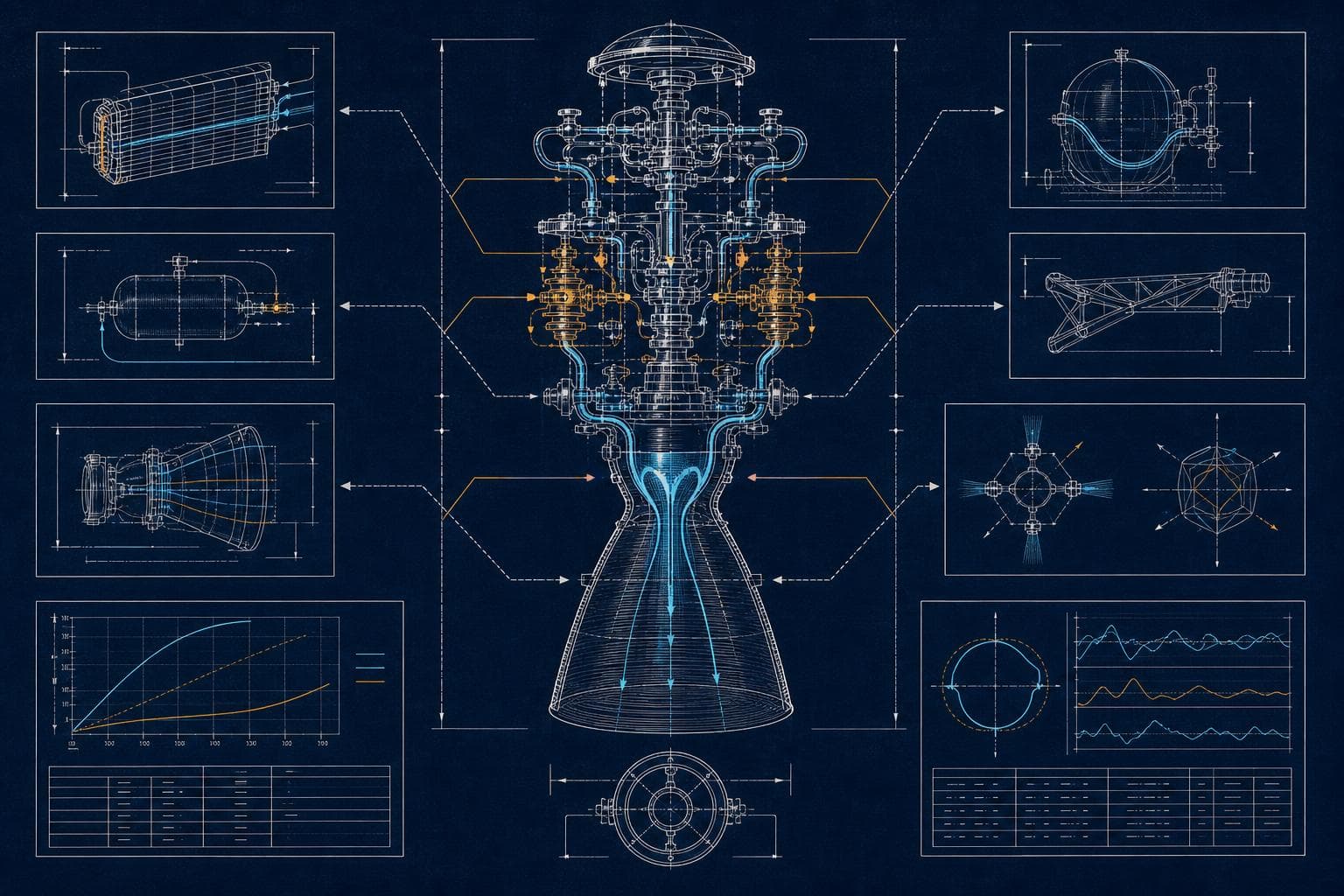

Pick your propellant, and you've just made choices about your tanks, your thermal management, your launch window flexibility, your ground support infrastructure, and your mass budget — before a single other subsystem engineer has opened a CAD file.
This is the cascade problem. Propulsion sits at the top of the spacecraft design tree not because thrust is the most important thing a spacecraft does, but because propulsion constraints propagate everywhere else. Every other system negotiates with the propulsion choice already on the table.
The Propellant Decides the Architecture
The clearest way to see this is to compare propellant families and watch what falls out.
Cryogenic propellants — liquid oxygen paired with liquid hydrogen or methane — deliver high specific impulse, which means more velocity change per kilogram of propellant. That's the fundamental currency of spaceflight. But cryogens boil off. Liquid hydrogen starts evaporating the moment you load it, which means your launch window isn't just a trajectory calculation — it's a race against your own propellant mass. Futurion's analysis of Starship lunar logistics makes this concrete: tanker sorties, boil-off margins, and contingency propellant can dominate the total flight count in ways that never appear in the cargo manifest. The propellant choice doesn't just affect the rocket — it restructures the entire campaign schedule.
Storable propellants (hypergolics, for instance) sidestep the boil-off problem entirely. They sit in tanks at room temperature for years. That's why they've dominated spacecraft attitude control and orbital maneuvering for decades — not because they're efficient, but because they're patient. The trade is toxicity, handling complexity, and lower performance. Your ground crew needs full hazmat protocols. Your launch site needs specialized facilities. You've traded a thermal engineering problem for a logistics and safety problem.
Nuclear thermal propulsion, which NASA has been developing through its Space Nuclear Propulsion program, pushes the trade further still. NASA's nuclear propulsion work targets roughly twice the specific impulse of the best chemical engines — a genuine performance leap for deep space missions where propellant mass is the dominant constraint. But the cascade cuts deep: nuclear systems require radiation shielding that adds mass, impose crew separation distance requirements that reshape vehicle geometry, demand specialized launch approval processes, and create end-of-life disposal constraints that chemical systems don't face. You're not just choosing an engine. You're choosing a regulatory pathway, a structural architecture, and an operational doctrine.
Mass Budget Is a Zero-Sum Negotiation
Here's where the cascade becomes visceral for every other subsystem lead.
Every kilogram of propellant you carry is a kilogram not available for payload, structure, power systems, or science instruments. The propulsion choice sets the propellant fraction — and that fraction is ruthless. Engineering analysis of single-stage versus two-stage launch architectures shows how dramatically propellant combination affects payload fraction: the choice between LOX-RP1 and LOX-LH2 isn't just a performance number, it's a structural and mass budget decision that cascades through stage sizing, inert mass fractions, and ultimately what you can actually deliver.
When the propulsion team locks in their propellant and engine cycle, they've handed every other team a constraint they didn't choose. The power team now knows how much mass they have for solar panels or batteries. The thermal team knows what heat loads the engine generates and where. The structures team knows the tank geometry, which determines the vehicle's moment of inertia, which affects attitude control, which feeds back into — propellant consumption for maneuvering.
It's not a linear chain. It's a coupled system where the propulsion choice is the boundary condition everything else solves against.
The Lesson Isn't "Choose Carefully" — It's "Choose Early"
The practical implication for mission design is that propulsion decisions need to be made before they feel urgent, because by the time the cascade becomes visible, it's expensive to reverse.
Emerging propulsion technologies — nuclear electric, advanced plasma thrusters, next-generation methane engines — each carry their own cascade signatures. Electric propulsion offers extraordinary efficiency but demands large power systems, which means large solar arrays, which affects drag in low orbits and attitude control authority. The performance gain is real; so is the ripple through every other subsystem.
The engineers who navigate this well aren't the ones who find the best propulsion system in isolation. They're the ones who map the cascade early, understand which constraints are hard and which are negotiable, and make the propulsion choice with the full coupled system in view.
Everything else is downstream.