



Sixteen miles in 37 hours. That's what ERNEST, NASA's new rover prototype, just completed in the California desert — more than ten times the speed at which Perseverance can navigate on Mars. The comparison is striking, but the gap between those two numbers isn't a failure of Perseverance's design. It's a window into one of the most deliberate engineering trade-offs in planetary exploration: wheels that are built to take damage so the mission doesn't have to stop.
The Wheel Is a Constraint, Not a Component
On Earth, a wheel is a solved problem. On Mars, it's a negotiation between traction, mass, terrain damage, and the fact that you cannot send a repair crew.
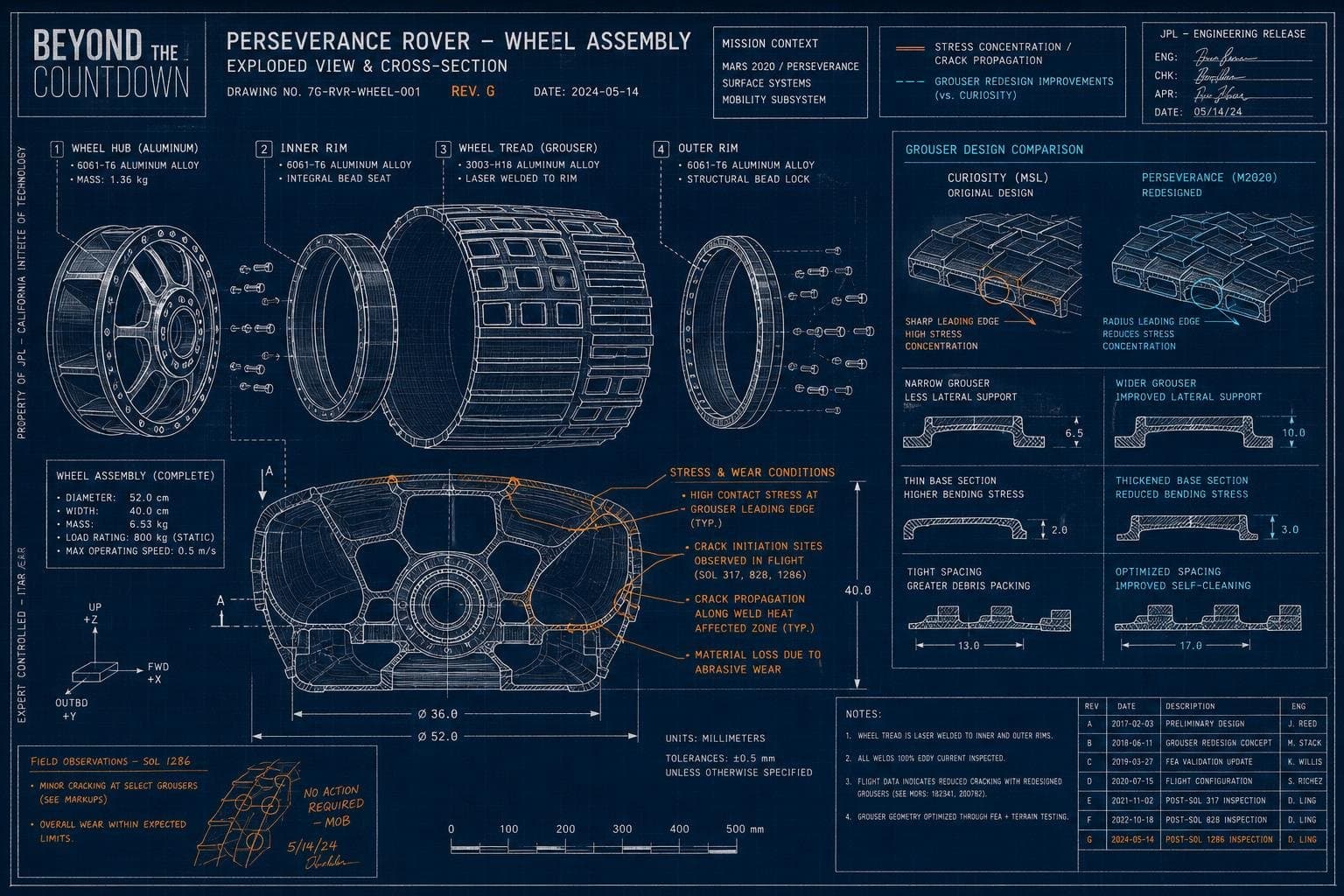
Perseverance's wheels are machined from aluminum — 20.7 inches in diameter, with cleats called grousers that bite into loose regolith and provide traction on rocky surfaces. The design inherited lessons from Curiosity, whose wheels began showing significant punctures and cracks in the sharp, angular basalt of Gale Crater within the first few years of operation. JPL engineers had to develop terrain-assessment algorithms mid-mission to route Curiosity around the worst rock fields, essentially retrofitting a wheel-preservation strategy onto a rover that hadn't been designed with one.
Perseverance's wheels are wider and the grousers are redesigned — the tread pattern changed to reduce the stress concentration that caused Curiosity's characteristic crack propagation. But the aluminum is still aluminum. It dents. It tears. And Perseverance has now logged 26.2 miles on Mars, a marathon distance, in under five years — which means those wheels have absorbed a marathon's worth of Martian terrain.
The question engineers faced wasn't "how do we make wheels that never wear?" It was "how much wear can we accept before mobility is compromised, and how do we stay on the right side of that line?"
Speed Is the Hidden Variable
Here's the counterintuitive part: slower is harder on wheels, not easier.
When a rover crawls over a sharp rock at low speed, the wheel deforms around the obstacle and bears the full load for longer. At higher speed — with better suspension dynamics — the wheel can roll over the same obstacle with less sustained contact stress. This is part of why ERNEST's active suspension system matters for the next generation of rovers. It's not just about covering more ground faster; it's about changing the force profile that terrain imposes on the wheel structure.
Perseverance's top autonomous driving speed is limited partly by its hazard-avoidance processing time — the rover has to see, classify, and respond to obstacles before it reaches them. That constraint keeps speeds low, which keeps contact loads high and sustained. The autonomy software ERNEST tested in the Mojave isn't just a navigation upgrade; it's a wheel-life upgrade in disguise.
JPL principal technologist Issa Nesnas described the ERNEST testing as helping "refine the mobility hardware and autonomy software to navigate extreme distances across a wide range of terrain and lighting conditions" — language that sounds operational but is really about understanding the full system interaction between how fast you move, how well you see, and how long your wheels last.
What Perseverance's Odometer Actually Tells Us
The marathon milestone is worth sitting with for a moment. Reaching 26.2 miles in under five years represents a significant improvement over Curiosity's pace — driven largely by AutoNav, Perseverance's autonomous navigation system that allows it to drive while simultaneously processing terrain data rather than stopping to think between moves.
That speed improvement came from software, not from redesigning the wheels. Which is the deeper engineering lesson here: the wheel design set a floor on acceptable terrain interaction, and then the autonomy stack determined how close to that floor the rover actually operates day-to-day. The two subsystems are coupled in ways that aren't obvious from the outside.
Curiosity's wheel damage forced JPL to treat terrain avoidance as a first-order operational concern mid-mission. Perseverance's wheel redesign bought back some margin. ERNEST's active suspension and faster autonomy are buying back more. Each generation is essentially expanding the envelope of terrain the rover can traverse without consuming that margin faster than the mission can afford.
The wheel that wears predictably, on terrain the software can read accurately, at a speed the suspension can handle — that's the system working as designed. The damage isn't a bug. It's the evidence that the trade-off was correctly calibrated.
Watch for how JPL incorporates ERNEST's desert test data into the wheel geometry and suspension specifications for whatever follows Perseverance. The 16-mile autonomous traverse wasn't just a demonstration — it was a data collection run for the next set of design decisions.