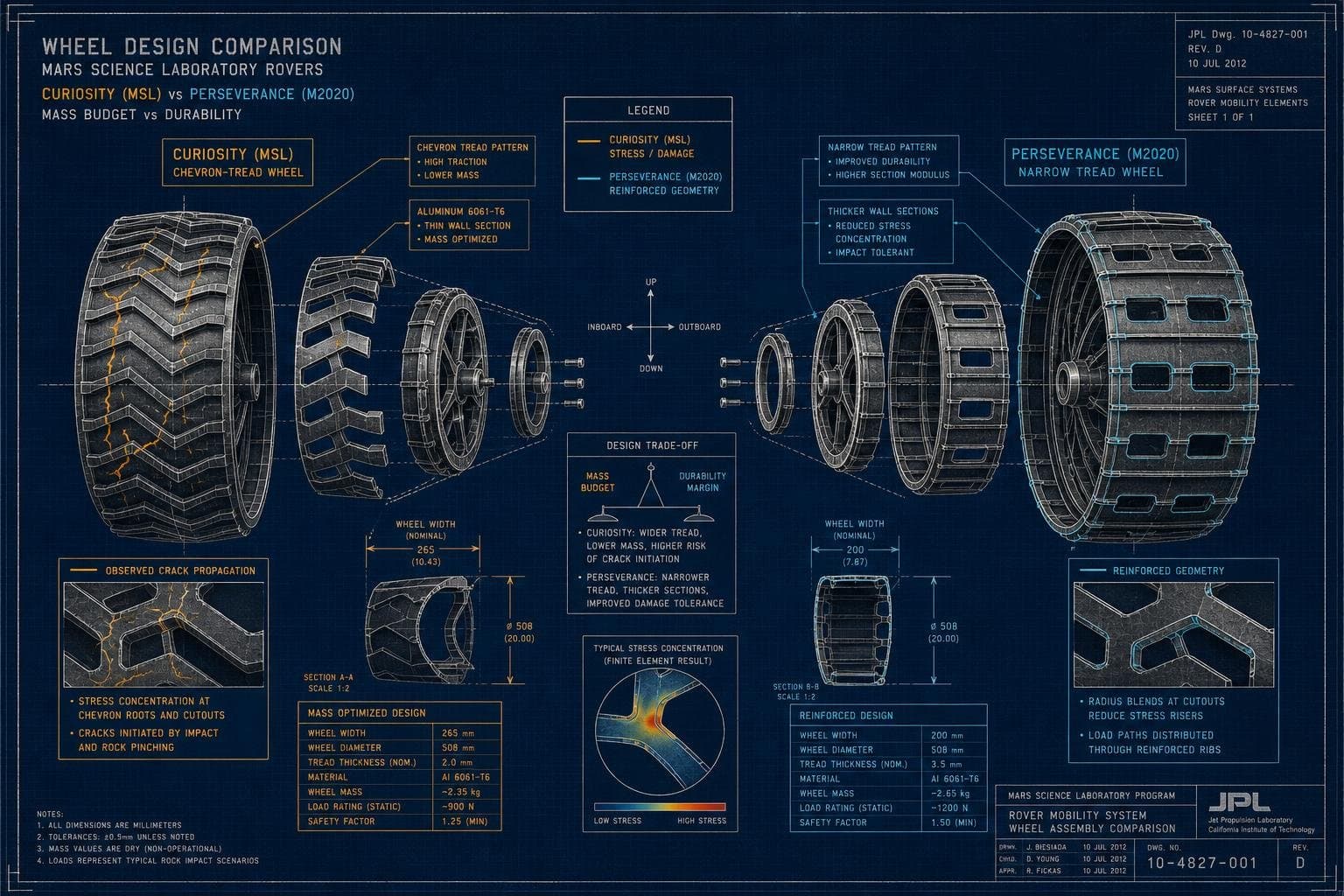

On July 23, 2026, Curiosity's Mars Hand Lens Imager captured something engineers had been watching for years: fresh cracks in the outer material of one of the rover's wheels, worn through by the rugged southern terrain of canyons and extinct volcanoes. The rover is 14 years into a mission that was originally designed for two. Those wheels were never supposed to last this long — and the fact that they have tells you something important about how NASA thinks about wheel design as a constraint problem, not a durability problem.
Perseverance's wheels are a direct response to what Curiosity's taught engineers. Understanding that response means understanding the trade-off that was actually being made.
Curiosity's Wheels Were Optimized for the Wrong Variable
When Curiosity landed in 2012, its aluminum wheels were designed to be lightweight and to distribute load across soft, sandy terrain. They worked. But within about a year, engineers noticed damage — punctures and tears from sharp rocks that the design hadn't adequately anticipated. The Martian surface, it turned out, included far more jagged, angular rock than the pre-landing terrain models had predicted.
The engineering response at the time was operational: slow down, pick better routes, avoid the worst rock fields. That's a legitimate adaptation, but it has a cost. Every route deviation is time the rover isn't doing science. Every cautious traverse is a constraint on where the mission can go.
The deeper lesson was about what the wheel design had implicitly assumed: that the primary threat was compressive load on soft ground, not puncture and shear stress from hard, angular rock. Mars corrected that assumption the hard way.
Perseverance's Wheels Encode That Lesson
Perseverance's wheels are a different geometry — narrower, with a different tread pattern and thicker aluminum. The change in tread pattern from Curiosity's chevron-style grooves to Perseverance's more robust profile was specifically aimed at reducing the stress concentration points where cracks initiate. Thicker material trades some weight for puncture resistance.
That's a classic engineering exchange: mass budget for durability. On a rover, mass is one of the most constrained resources in the entire mission — every kilogram you add to the wheels is a kilogram you're taking from science instruments, batteries, or sample storage. The Perseverance wheel design is an argument that the operational cost of wheel damage — rerouting, slowing, potentially mission-curtailing degradation — outweighs the mass penalty of building wheels that can handle what Mars actually throws at them.
The results so far support that argument. Perseverance completed a full marathon distance on June 14, 2026, covering 42.195 kilometers in five years and four months — compared to the eleven years and two months Opportunity needed to cover the same distance. That gap reflects more than wheel design: Perseverance's AutoNav system, which builds three-dimensional terrain maps from navigation-camera image pairs and selects safe arcs around hazards autonomously, is a major factor. But wheel reliability is a prerequisite for any of that distance to be possible. A rover that has to slow down and pick its way around terrain isn't going to set distance records regardless of how good its navigation software is.
The Durability-Mobility Trade-off Isn't Solved, It's Managed
Here's what's easy to miss: Perseverance's wheels aren't a permanent solution to the durability problem. They're a better-calibrated bet on the same fundamental trade-off. Mars will still wear them down. The question is whether they degrade slowly enough to remain functional across the mission's useful life, and whether the mobility they enable justifies the mass they cost.
Curiosity's current wheel condition — still holding up after 14 years despite significant visible damage, per NASA's own assessment — is actually a strange kind of validation for the original design. The wheels weren't supposed to last this long because the mission wasn't supposed to last this long. They're failing gracefully, which is exactly what you want from a component operating decades past its design life.
NASA's ongoing investment in surface mobility research reflects how seriously the agency treats this problem. A recent NASA Johnson challenge specifically tested competing wheel designs for lunar base mobility, evaluating how different geometries and materials handle regolith — a parallel engineering problem to what Curiosity and Perseverance face on Mars, where terrain unpredictability is the core constraint that no pre-mission model fully captures.
Perseverance's wheels are designed to last longer in a shorter mission window, on terrain that the Jezero Crater sample return objectives require. That's a different optimization target than Curiosity's, and it should produce different results — which is the point.
What Curiosity's cracked wheels are really showing us, fourteen years in, is the full arc of a design decision made in 2004 and 2005. The engineers who spec'd those wheels made reasonable assumptions about Martian terrain. Mars disagreed. Perseverance's wheels are the written response to that disagreement.
Watch for how Perseverance's wheel condition looks at the five-year mark of active driving — that comparison will be the real test of whether the redesign's mass penalty bought what the engineers thought it would.


