


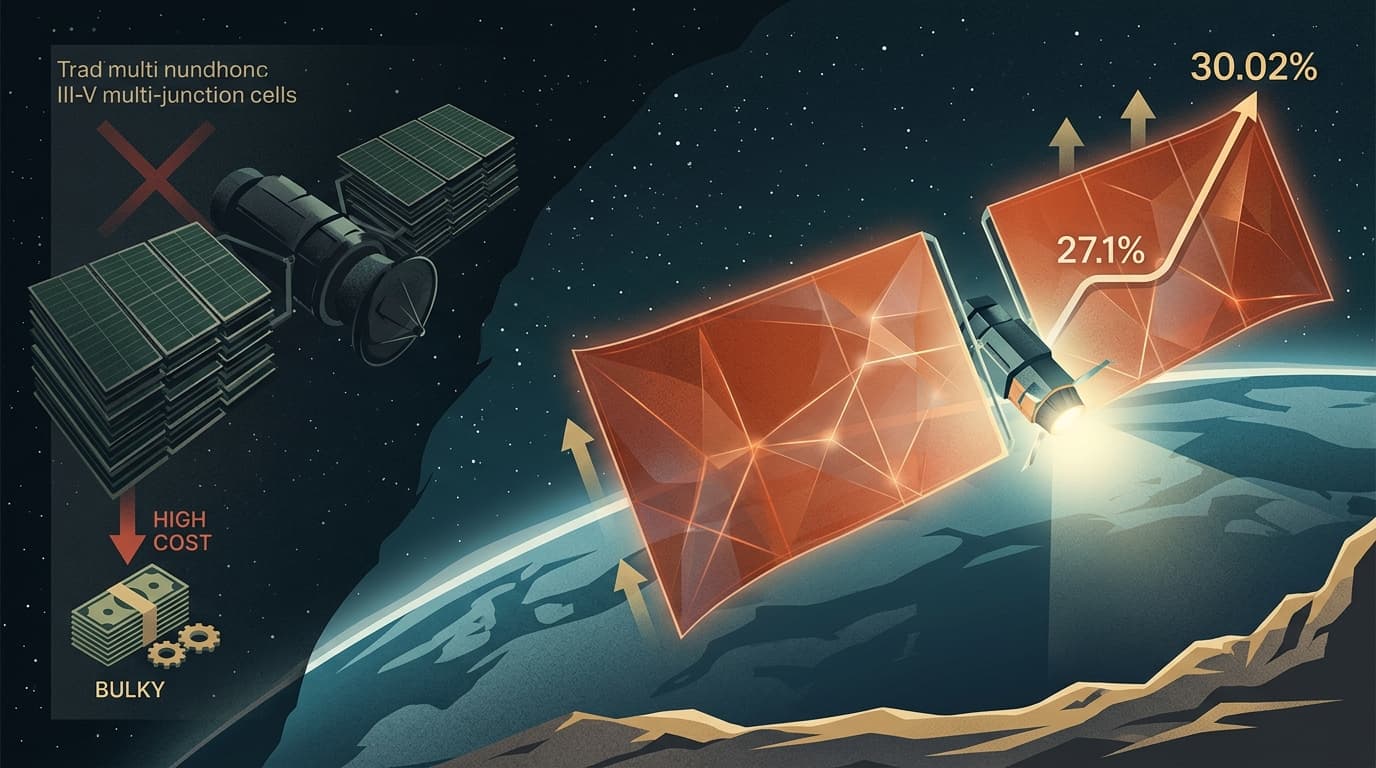

The solar cells powering satellites today cost roughly 1,000 times more per watt than the panels on your roof. That's not a rounding error — it's the fundamental constraint that has kept space power systems expensive, heavy, and limited to missions that can justify the bill. A result published recently in Nature suggests that gap may be closing faster than most engineers expected.
Researchers at EPFL and CSEM have achieved a certified 30.02% efficiency in a triple-junction solar cell that combines a silicon bottom cell with two perovskite thin-film layers on top. The previous certified record stood at 27.1%. That's a meaningful jump — but the more interesting engineering story is how they got there, and what it reveals about the constraint hierarchy driving next-generation space photovoltaics.
The Efficiency Ceiling That Space Has Always Accepted
The cells currently used in space applications are III-V multi-junction devices — semiconductor stacks built from materials like gallium arsenide and indium phosphide. They're extraordinary performers, reaching efficiencies up to 37%, and they're radiation-hardened for the orbital environment. They're also, as EPFL's Kerem Artuk noted, about 1,000 times more expensive per watt than terrestrial cells.
That cost structure made sense when spacecraft were small, launches were infrequent, and the power budget was fixed. It makes less sense as the industry moves toward large constellations, lunar surface power systems, and solar electric propulsion where you're measuring arrays in tens of kilowatts. At that scale, the cost of III-V cells stops being a line item and starts being a mission constraint.
The EPFL result matters because it demonstrates that perovskite-silicon architectures can approach III-V performance levels using materials and processes that are, in principle, manufacturable at scale. The team's first triple-junction demonstration in 2018 achieved 13% efficiency. Crossing 30% in roughly seven years of iteration is a development pace that aerospace engineers should be paying attention to.
Two Problems, Three Fixes
Triple-junction designs have been theoretically attractive for years. The physics is straightforward: stack cells with different bandgaps, and each layer captures a different slice of the solar spectrum. The practical problem has always been voltage losses in the top cell and insufficient current generation in the middle layer — two failure modes that compound each other.
The EPFL team addressed both with targeted material interventions. For the top cell, they introduced a molecule that guides perovskite crystal formation and suppresses defects, pushing the top cell voltage to 1.4 volts under sunlight. For the middle cell, they developed a new three-step fabrication method to improve near-infrared light absorption. A third optical engineering tweak improved how light moves through the full stack.
What's notable from a systems design perspective is that none of these are exotic interventions. They're process refinements and material choices — the kind of engineering that can, in principle, transfer to industrial manufacturing. The team demonstrated the architecture at cell areas of 1, 4, and 54 cm², which is the right way to show that a result isn't purely a lab artifact.
The Space Qualification Gap Is Real, But It's Not the Whole Story
The honest caveat here: efficiency in a terrestrial lab and performance in orbit are different problems. Space solar cells face radiation degradation, thermal cycling across hundreds of degrees, and vacuum conditions that affect material stability differently than atmospheric exposure. Perovskites have known stability challenges that III-V cells don't share, and the space qualification process for any new photovoltaic technology is measured in years, not months.
But the framing of "perovskites aren't ready for space" misses what this result actually represents. The EPFL work isn't a flight-ready product — it's a demonstration that the efficiency ceiling for affordable multi-junction architectures is higher than the field assumed. PV-Lab head Christophe Ballif noted that triple-junction cells have an efficiency potential well above 40%, which means the 30% result is a waypoint, not a destination.
The pattern in aerospace is that terrestrial performance milestones drive investment in radiation hardening and environmental qualification work. Crossing 30% with a manufacturable architecture is the kind of result that gets space agencies and satellite manufacturers to fund the next phase of that work. Watch for whether ESA's photovoltaics research programs or NASA's Space Technology Mission Directorate begin citing perovskite-silicon tandems in upcoming solicitations — that's the signal that the qualification pipeline is actually opening.
The expensive cells will keep flying on missions that need them. But the engineering pressure to find something cheaper that performs comparably just got a significant new data point.