


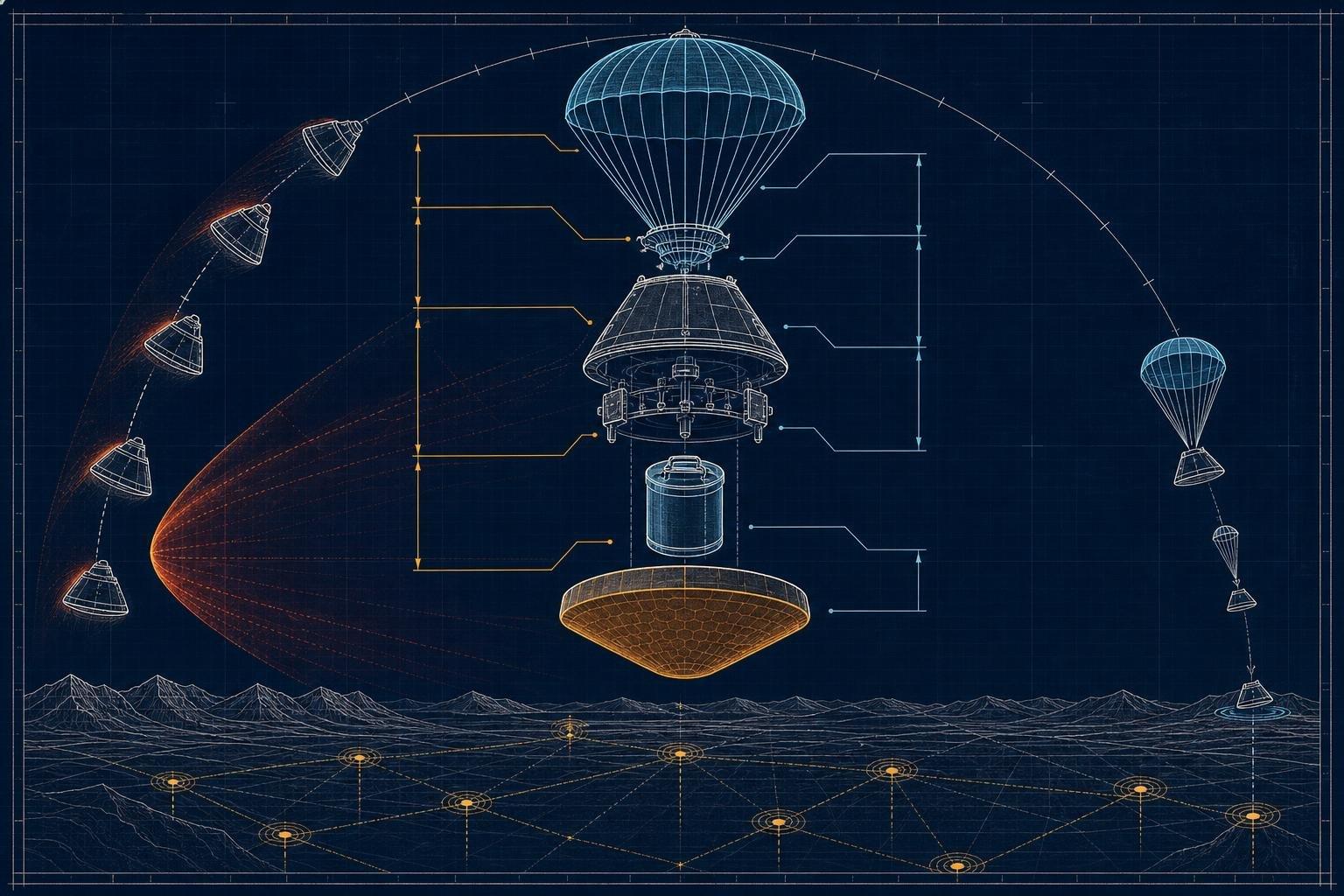

On September 24, 2023, a 100-pound capsule separated from a spacecraft still cruising past Earth, fell through the atmosphere with no engine, no steering surfaces, and no way to correct course, and landed inside a fenced-off patch of Utah desert the Department of Defense had reserved for exactly this purpose — the Utah Test and Training Range. The spacecraft itself never stopped moving; it released the capsule and flew on toward its next target, Apophis, while the capsule alone carried seven years of mission work — launched September 8, 2016, sample collected from asteroid Bennu on October 20, 2020 — down to a landing zone it had no way to aim itself toward once it left the bus.
That's the part of sample-return engineering that doesn't get much airtime next to Mars landings and Starship catches: there's no active guidance loop at all. A parafoil deploys, a parachute slows final descent, and everything that happens between atmospheric interface and touchdown is ballistics, not control theory. The "precision" in precision reentry isn't delivered by the capsule. It's delivered upstream, in how carefully the release geometry and trajectory were set before the capsule ever separated — and it's confirmed downstream, by instruments on the ground watching the thing fall.
The Capsule Doesn't Correct — It Gets Checked
That verification step is where the newest research on OSIRIS-REx is actually interesting. A team led by Elizabeth Silber deployed 16 three-component nodal seismometers near Eureka, Nevada, between 7 and 20 kilometers from the capsule's predicted ground track, specifically to catch the air-to-ground coupled shock signal as the capsule's Mach cone swept overhead during reentry (Silber & Ronac Gianonne, 2026). Every station recorded an impulsive onset consistent with the ballistic shock wave — which is another way of saying the capsule showed up, physically, exactly where the trajectory math said it would.
A companion study compared that effort to a parallel infrasound deployment: four sensors near Eureka Airport, used to confirm the capsule's path through arrival-time differences and back-azimuth estimates (Nishikawa et al., OSTI, 2026). What makes that comparison worth sitting with is the contrast with how Japan's space agency monitored Hayabusa2's reentry over Australia in 2020: 28 portable infrasound sensors spread across seven arrays in Woomera, dense enough to reconstruct the entire three-dimensional trajectory from the acoustic data alone. OSIRIS-REx got by with four sensors and a compact seismic array and still nailed signal coherence and azimuth consistency.
That's not a story about Hayabusa2 over-engineering its observation network. It's a story about how much confidence a well-targeted ballistic entry buys you. When you're not reconstructing an unknown trajectory from scratch — you're confirming a predicted one — a small, well-placed array does the job that used to require a continent-spanning sensor grid.
Confidence Upstream Buys Simplicity Downstream
This is the trade-off that's easy to miss if you're used to thinking about reentry in terms of active control: the engineering investment in a capsule like this goes almost entirely into the release conditions — separation timing, entry angle, velocity — rather than into onboard correction. There's no actuator fighting atmospheric uncertainty mid-fall. The system either arrives inside its predicted corridor or it doesn't, and by the time anyone's watching the shockwave data, the outcome is already locked in.
The flip side is that everything downstream of release has to be unusually forgiving of a landing zone you can't adjust. The Utah Test and Training Range exists precisely because a target area measured in tens of kilometers, not meters, is what an unguided capsule needs — and because the post-landing handling has to assume the thing could come down anywhere in that footprint. Post-flight contamination assessments of the capsule's sample canister, conducted after retrieval, underline how much procedural rigor gets built around the parts of the mission you can't steer: recovery teams treated the entire touchdown and retrieval sequence as a controlled clean-room extension, not an afterthought (Sandford et al., Meteoritics & Planetary Science, 2026).
What to Watch Next
The infrasound and seismic datasets from OSIRIS-REx are now explicitly being used as a reference case for planning observation of future sample-return reentries, including opportunistic monitoring of natural meteoroid events (OSTI, 2026). The open question in that research isn't whether ballistic reentry can be precise — it clearly can be — it's how sparse an observation network can get before trajectory confirmation starts to degrade. That's a genuinely useful number for anyone planning the next sample-return mission's ground segment, because it means the sensor budget, not the capsule's design, is where the next round of cost trade-offs will happen.