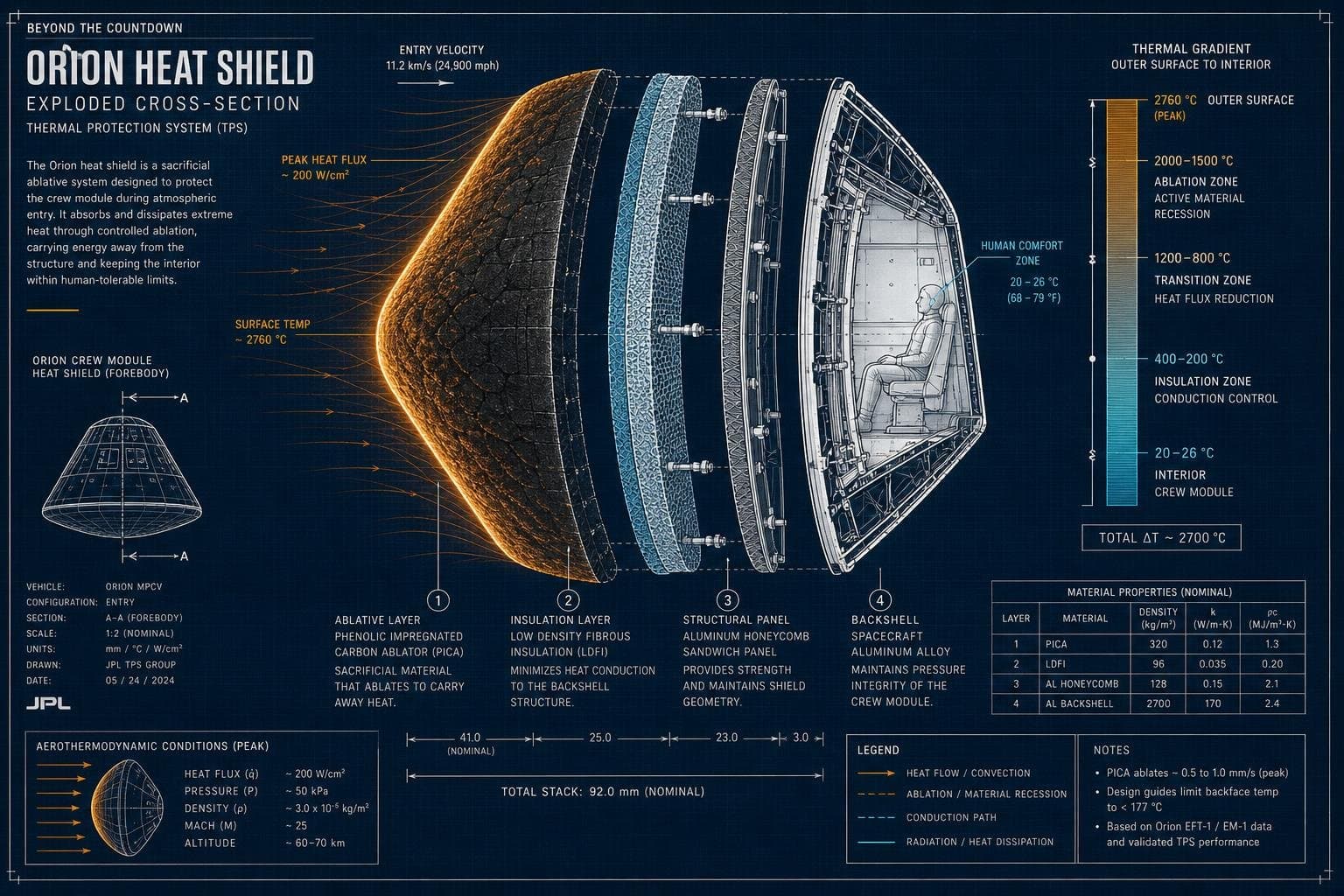

The capsule hit the atmosphere at 24,581 miles per hour — roughly 24 times the speed of a bullet. The heat shield surface climbed to nearly 5,000 degrees Fahrenheit, roughly half the surface temperature of the sun. And inside the crew module, the temperature stayed in the mid-70s Fahrenheit — comfortable enough that you'd forget, for a moment, what was happening on the other side of that shield.
That gap — 5,000 degrees on the outside, shirt-sleeve conditions on the inside — is what an ablative heat shield is designed to maintain. The Artemis 1 mission in December 2022 was the first time Orion had to prove it could do this at lunar return velocities, which run more than 7,000 mph faster than a spacecraft returning from the International Space Station. It passed. Now that capsule is heading to the Smithsonian's National Air and Space Museum, and Artemis III flight hardware is stacking up at Kennedy Space Center.
The engineering question worth sitting with: what exactly did Artemis 1 prove, and what does it leave open for the crewed missions ahead?
The Physics That Makes Lunar Return Uniquely Brutal
The speed difference between ISS return and lunar return isn't a minor footnote — it's a fundamentally different thermal problem. Kinetic energy scales with the square of velocity. That extra 7,000-plus mph doesn't add a proportional increment of heat; it adds a disproportionate one. The plasma sheath that forms around a capsule at lunar return velocities is hotter, and it persists longer through the skip re-entry trajectory Orion uses to manage deceleration loads.
Ablative heat shields work by sacrificing themselves. The material chars, pyrolyzes, and ablates — essentially controlled burning — and that phase-change process absorbs enormous amounts of energy that would otherwise conduct into the structure. The ablated gases also form a boundary layer that partially insulates the surface from the incoming plasma. It's a one-time expenditure: the shield is consumed in the process of protecting the crew.
This is exactly the kind of materials-and-structures problem that NASA Langley's structures and materials research directorate exists to characterize — understanding how thermal protection materials behave under combined mechanical and heating loads, and how well pre-flight models predict post-flight reality. The Artemis 1 capsule going to the Smithsonian is genuinely informative in this respect: engineers can study exactly how the material performed, where it ablated more than predicted, where it held, and what the post-flight inspection reveals about the thermal model's accuracy.
That post-flight analysis matters enormously for Artemis III. The uncrewed test gave engineers real ablation data at actual lunar return conditions. No ground test facility can fully replicate the combination of velocity, plasma chemistry, and trajectory that Orion experiences during re-entry. Arc jet testing can approximate peak heating rates, but the integrated thermal history of a full re-entry is something you can only measure by flying it.
What Artemis III Inherits — and What It Doesn't
The hardware now stacking at Kennedy represents the next iteration of this system, built on what Artemis 1 taught. That's the normal progression of flight test programs: you fly an uncrewed vehicle precisely so the data can inform the crewed one. The heat shield that protected an empty crew module in 2022 has now been examined, modeled, and used to validate — or correct — the thermal analysis tools that will certify the next shield for human occupants.
There's an asymmetry worth noting, though. Artemis 1 flew a specific trajectory with specific entry conditions. Artemis III will carry crew, which introduces constraints on the re-entry corridor — the acceptable range of entry angles and velocities — that are tighter than for an uncrewed mission. A crewed vehicle has to manage not just peak heat flux but also peak deceleration loads, because humans have physiological limits that hardware doesn't. The heat shield design has to satisfy both constraints simultaneously.
This is the kind of systems-level coupling that makes spacecraft design genuinely hard. The thermal protection system doesn't exist in isolation: it's load-bearing structure, it sets the capsule's center-of-mass requirements, and it determines the re-entry corridor the guidance system has to fly. Change one, and you've perturbed all the others. It's worth remembering that the broader context for this work — the push toward sustained human presence beyond low Earth orbit — is reshaping how agencies and industry think about reusable versus expendable protection systems across the commercial space sector, not just for government capsules.
The reusability question is the one that hangs over every ablative shield program. By definition, an ablator that works is an ablator that's been partially destroyed. Orion's heat shield is not reusable — it's replaced between flights. That's an acceptable trade for a capsule flying a handful of crewed lunar missions. It becomes a much harder trade if you're designing for the flight cadences that modern launch programs are now normalizing, where rapid reuse is the economic assumption baked into the entire architecture.
The Test That Still Has to Happen
Artemis 1 answered the most fundamental question: can this shield survive lunar return heating? Yes. What it couldn't answer — because it was uncrewed — is how the system performs when the re-entry corridor is constrained by crew safety margins rather than just hardware limits.
Artemis III is that test. Watch for how NASA characterizes the post-flight heat shield inspection after the first crewed lunar return. The specific ablation pattern, compared against Artemis 1's, will tell


