



The hardest part of returning from the Moon isn't the heat. It's that the thing protecting you from the heat also has to hold the spacecraft together while it's being heated.
That constraint — thermal protection and structural integrity, simultaneously — is what drove NASA engineers to rethink Orion's thermal protection system (TPS) after the spacecraft's first test flight. The answer they landed on is a material that didn't exist in production form when the program started.
The Problem EFT-1 Revealed
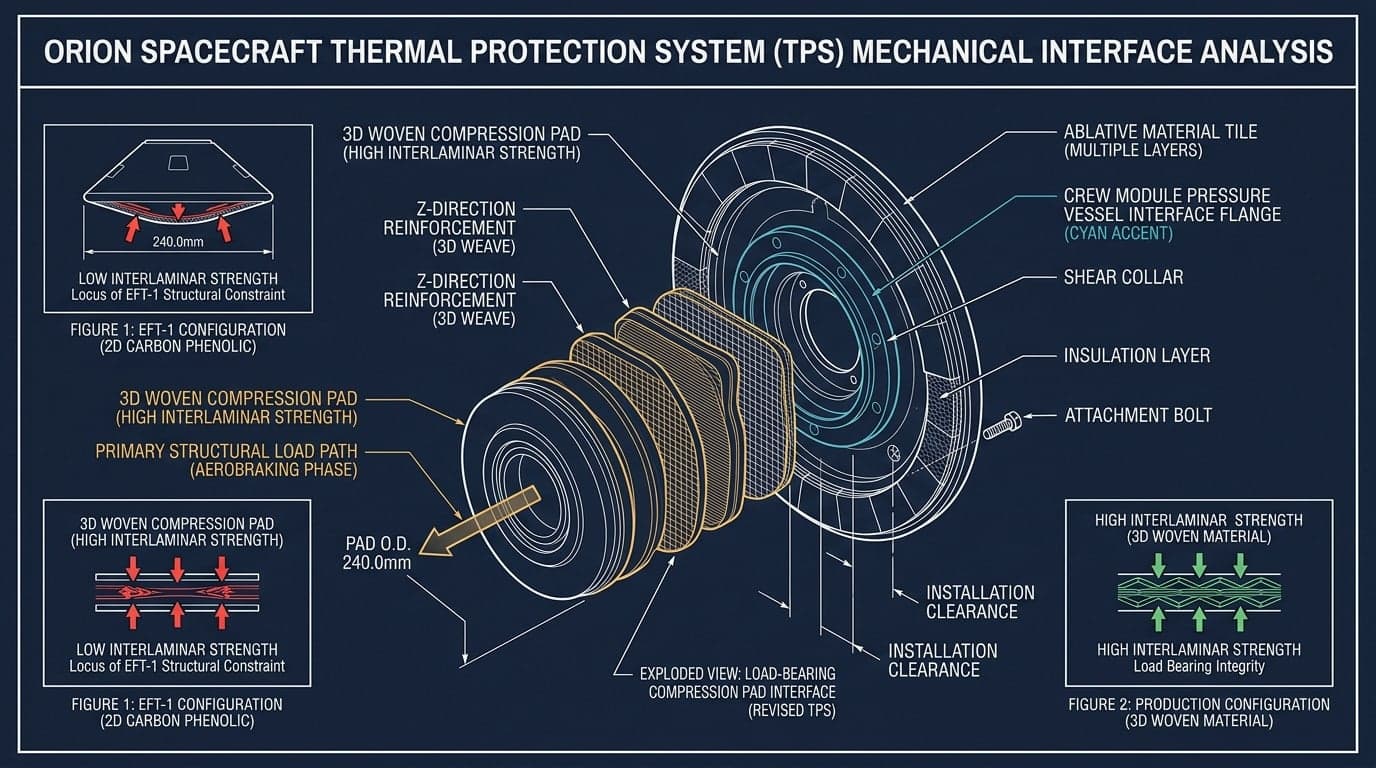
Orion flew its first uncrewed test, Exploration Flight Test-1, in 2014. The heat shield performed well enough to survive reentry, but post-flight analysis exposed a structural problem hiding inside the TPS design. The compression pads — the components that bear the mechanical loads where the heat shield interfaces with the crew module structure — were made from 2-D carbon phenolic material. That material has a fundamental weakness: relatively low interlaminar strength, meaning it resists forces applied across its layers poorly. To compensate, engineers had to embed metallic shear inserts to handle the structural loads the carbon phenolic couldn't manage on its own.
For a low-Earth-orbit mission, that workaround was acceptable. For missions beyond LEO — the lunar trajectories Artemis requires — the reentry velocities are higher, the heating is more severe, and the structural demands on those compression pads increase accordingly. The metallic insert solution wasn't going to scale. Engineers determined the existing materials would not work for future missions beyond low Earth orbit, which meant finding something that could carry structural loads and survive ablative heating without needing a metal crutch.
What 3-D Weaving Actually Solves
The solution came from an unexpected direction: textile manufacturing. NASA's Space Technology Mission Directorate partnered with Bally Ribbon Mills, a Pennsylvania weaving company that had been developing 3-D weaving technology since the early 1990s — originally under an Air Force Research Laboratory contract — to produce a new class of structural ablator.
The physics of why this works is worth pausing on. Traditional composite materials are built up in layers, which means their strength in the through-thickness direction (perpendicular to the layers) is always the weak point. Delamination — layers separating under load or thermal stress — is the failure mode that haunts 2-D composites. 3-D weaving eliminates delamination by interlocking fibers in all three dimensions, creating a structure that resists crack propagation and handles loads in directions that 2-D fabrics simply can't.
For Orion's compression pads, this means the TPS component can now carry the structural loads directly — no metallic shear insert required. The material is simultaneously the thermal insulator and the load-bearing element. That's the elegant solution hiding in what sounds like a manufacturing detail.
Why Ablative Over Metallic in the First Place
The ablative-vs.-metallic question is worth addressing directly, even though the source pool doesn't give me specific NASA trade study documents to cite. The engineering logic is fairly transparent from first principles.
Metallic heat shields — the approach used on some earlier spacecraft concepts — work by radiating heat away from a high-temperature surface. They're reusable and structurally robust. The problem is mass and the physics of lunar return. Coming back from the Moon, Orion hits the atmosphere faster than a vehicle returning from low Earth orbit, generating heat loads that a purely radiative metallic system would struggle to manage without becoming prohibitively heavy. Ablative materials work differently: they absorb heat by pyrolyzing (chemically decomposing), carrying energy away in the outgassing products rather than trying to radiate it all back. The material sacrifices itself to protect what's behind it.
The trade-off is that ablatives are single-use — you can't fly the same heat shield twice. For a human lunar return vehicle where the reentry environment is severe and mass margins are tight, that's a trade NASA has consistently judged worth making, going back to Apollo.
What Comes Next
The 3-D woven TPS work isn't just an Orion story. [NASA's development partners expect the new woven materials to be used for future planetary missions](https://www.fiberjournal.com/3-d-woven-thermal-protection-system-technologies