



Five years and 2.2 billion miles into its journey, NASA's Lucy spacecraft just crossed into Jupiter's L4 Lagrange point, becoming the first spacecraft to reach the swarm of Trojan asteroids that share the gas giant's orbit around the Sun, according to NASA. That's the headline. But the more interesting engineering story is buried in how Lucy spent the years getting there — because the mission team didn't just cruise through the main asteroid belt on the way to the real targets. They used it as a live-fire test range for a navigation system they hadn't yet trusted with the primary mission.
A Detour That Was Actually the Plan
Lucy's actual job is to visit 11 Trojan asteroids over a 12-year tour, according to principal investigator Hal Levison, speaking via EurekAlert. None of those targets were in the main asteroid belt. But in 2022, the mission team noticed Lucy's planned trajectory would carry it near a tiny, then-unnamed object — and rather than ignore it, they added an encounter specifically to exercise the spacecraft's systems ahead of the Trojan encounters, per EurekAlert. That object, later named Dinkinesh, became the first of three asteroids Lucy visited in the belt — not because the science team needed those particular rocks, but because the mission needed a dry run.
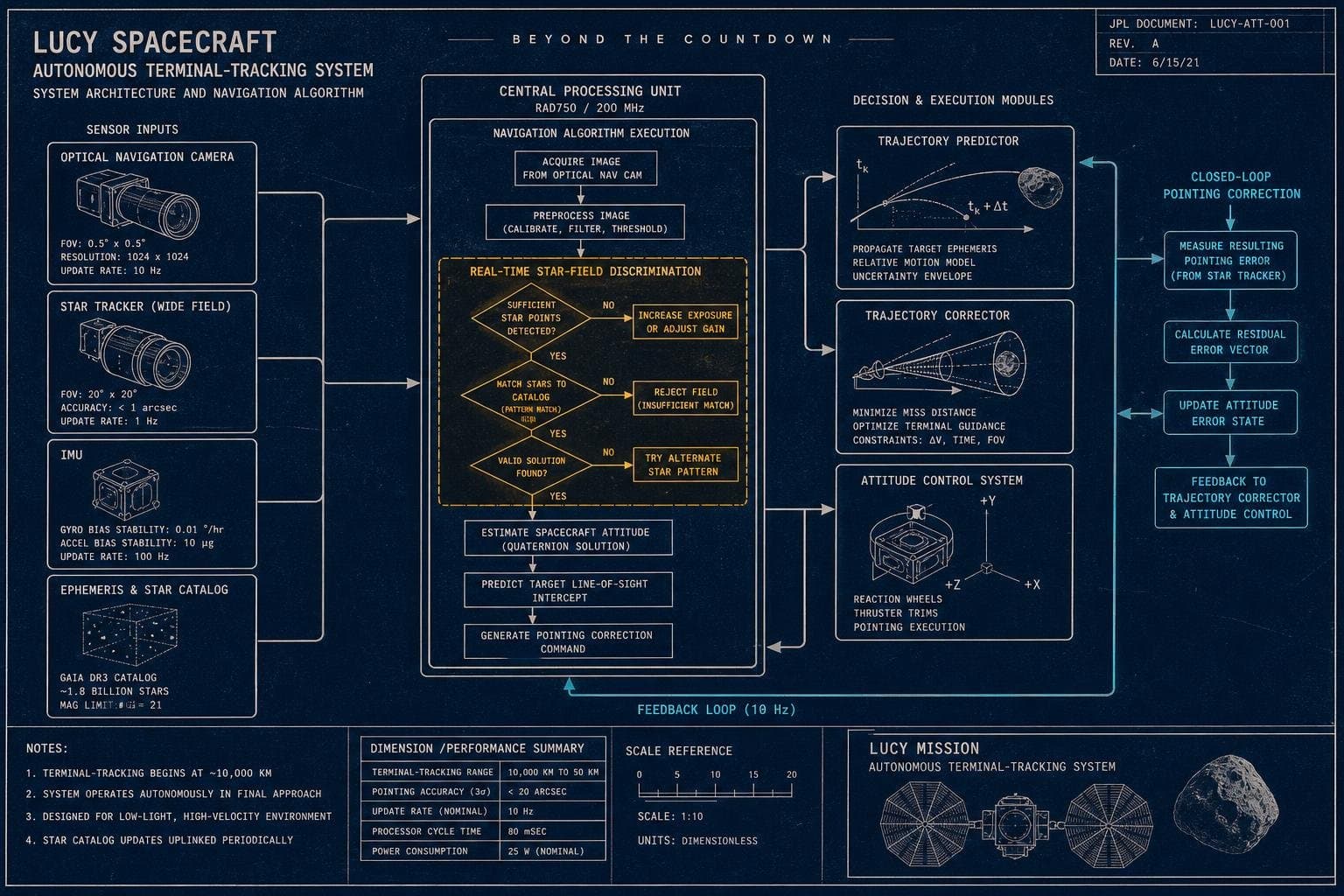
This is the kind of decision that looks almost wasteful on a schedule chart and makes complete sense once you think about what's actually hard here. Lucy's targets are tiny, dim, and separated from each other by more than 6 million miles on average, according to NASA. From the spacecraft's perspective, a Trojan asteroid doesn't look like a target — it looks like a pinprick of light drifting against a static field of stars, indistinguishable from noise until the spacecraft is already bearing down on it. You cannot plan a flyby trajectory around a body you can only resolve in the final hours of approach. You need an autonomous terminal-tracking system that can lock onto that pinprick, distinguish it from background stars, and feed pointing corrections to the spacecraft in near real time, with no help from Earth given the one-way light delay across billions of miles.
That's the system the team chose to validate against real targets instead of trusting it cold on the Trojans. And the belt flybys paid for themselves as science too — the November 2023 Dinkinesh encounter revealed a satellite that turned out to be a contact binary, the first time such a structure had been seen orbiting another asteroid, according to EurekAlert. The April 2025 flyby of Donaldjohanson found a second contact binary, a peanut-shaped body with a smooth connecting neck and an unusual end-over-end wobble, per the same report. Two bonus discoveries, purchased essentially for free, on top of a navigation shakedown the team needed anyway.
Why the Test Mattered More Than the Targets
The alternative design path here is obvious: skip the detours, save the fuel and the operational overhead, and fly straight to the first real Trojan. NASA's own trajectory animation, released in late October, traces exactly that direct-looking arc from the 2021 launch to the L4 arrival, as covered by the Times of India. But a direct approach means your first real test of the terminal-tracking system happens on an asteroid you can't afford to miss — a flyby that's been budgeted, scheduled, and promised to scientists for over a decade. Testing on throwaway targets in the belt means any failure mode shows up early, against stakes you can absorb, instead of against the main mission.
Lucy's first Trojan encounter, with the asteroid Eurybates, is set for August 11, 2027, according to NASA. By the time that flyby happens, the terminal-tracking system will have already proven itself twice, against two asteroids nobody originally planned to visit.
What to Watch
The next real test of this approach comes with Eurybates in August 2027 — the first Trojan the terminal-tracking system will have to lock onto without a prior dress rehearsal on that specific kind of object. Between now and then, the mission team still has to navigate the L4 swarm itself, where EarthSky notes thousands of asteroids drift in a region with no fixed boundaries. The belt flybys weren't the mission. They were the insurance policy that made the mission possible.