


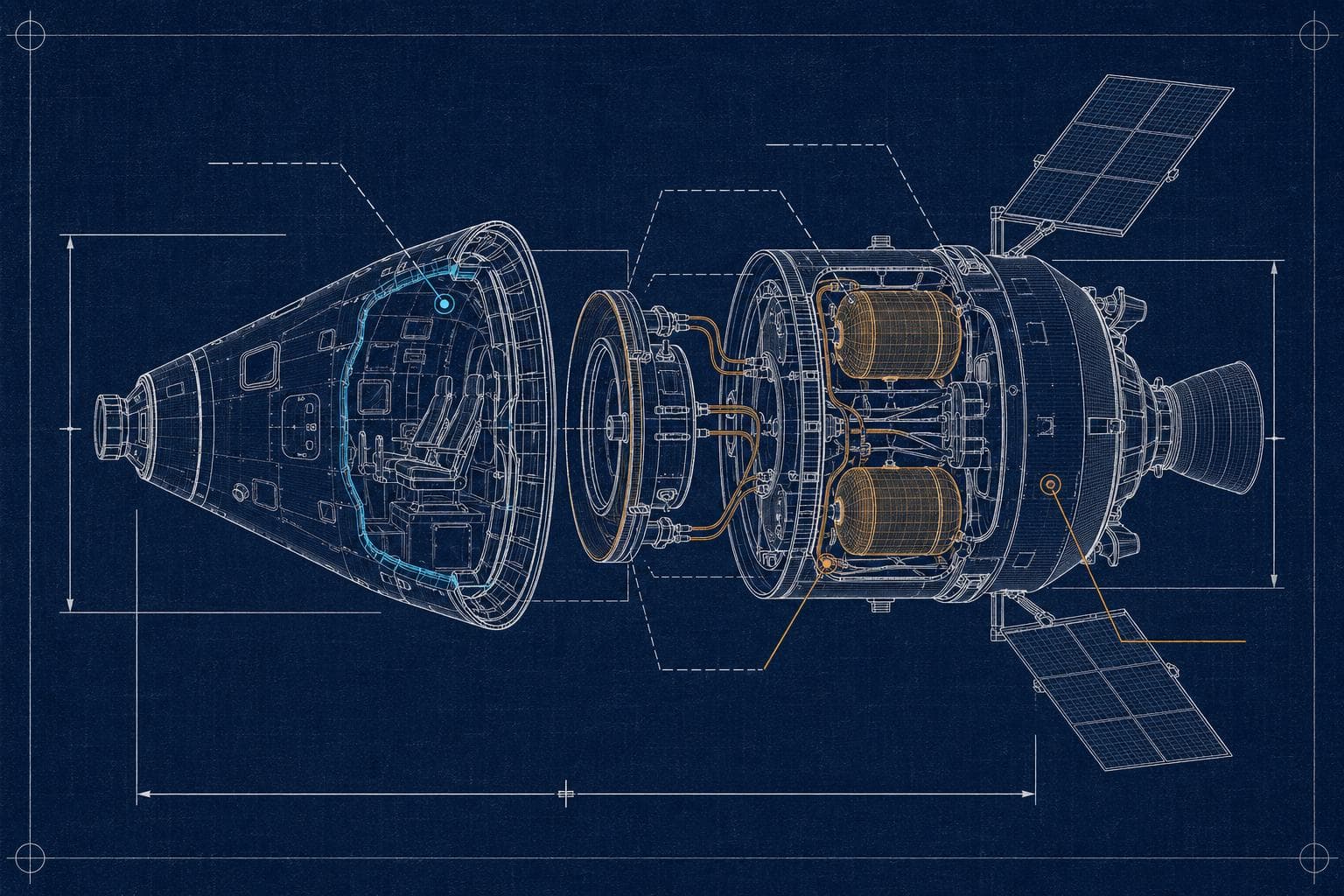

The six-day clock on Artemis II isn't a scheduling choice. It's a hard constraint written in tank volume.
During NASA's pre-mission briefings, officials were direct about it: "those tanks are only so big, and they were sized for that contingency." The 144-hour oxygen limit defines the mission envelope. Not the trajectory. Not the crew schedule. The consumables. That single sentence reveals more about life support engineering than most mission summaries do — because it exposes the fundamental constraint hierarchy that governs every design decision in this domain: mass is finite, and biology is non-negotiable.
The Tank-Sizing Problem Is Harder Than It Looks
Here's the trade-off that doesn't make the press releases: every kilogram of oxygen you add to extend mission duration is a kilogram you can't spend on propellant, shielding, food, or instrumentation. On a lunar flyby, that math is already painful. On a Mars transit measured in months, it becomes the central design problem of the entire mission.
Orion's life support architecture reflects a particular point on that trade-off curve — one optimized for short-duration crewed missions with abort options available. The system carries enough consumables for the planned mission plus a contingency margin, but it doesn't attempt to recycle or regenerate at the level you'd need for truly long-duration deep space operations. That's a deliberate choice, not an oversight. Regenerative life support — systems that close the loop on water, oxygen, and CO₂ — adds complexity, mass, and failure modes. For a 10-day mission with a crew of four, the engineering calculus favors simplicity and reliability over efficiency.
The pressure reduction decision tells the same story from a different angle. NASA confirmed that Orion's cabin pressure will be lowered as part of preparation for future docking missions — a change that was always in the plan. Lower cabin pressure reduces the pressure differential the structure must contain, which matters for docking interfaces and spacesuit operations. But it also changes the partial pressure of oxygen the crew breathes, which requires careful management to avoid hypoxia. Every adjustment to one variable in a closed-loop life support system ripples through the others. That's the systems thinking that makes this domain genuinely hard.
The European Service Module Is Doing More Than Propulsion
What's easy to miss in the Artemis II coverage is how much of the life support burden sits with hardware that isn't labeled "life support." The European Service Module — built by ESA and Airbus — provides not just propulsion and power but life-support consumables to Orion and its four astronauts. The oxygen those tanks hold? That's ESM hardware. The thermal control keeping the cabin habitable? Also ESM.
This distribution of function across modules is itself an engineering compromise. It creates interface dependencies — the crew module relies on the service module for consumables it cannot generate itself — but it also allows each module to be optimized for its primary role. The crew module stays focused on crew protection and reentry survivability. The service module handles the resource logistics. Clean separation of concerns, with the trade-off being that losing the service module early in a mission becomes a life support emergency, not just a propulsion problem.
The Stanford reporting on Artemis II's systems stress-testing frames the mission correctly: this is a validation exercise for the hardware and materials that will eventually need to sustain crews for much longer. The 10-day flyby is the easy version of the problem.
What Artemis II Is Actually Testing
The honest read on Artemis II's life support constraints is that they're acceptable for this mission precisely because this mission is short. The 144-hour oxygen limit doesn't matter much when you're doing a lunar flyby with a return trajectory already planned. It matters enormously when you start asking what a 30-day lunar surface stay requires, or a 900-day Mars transit.
The engineering decisions being validated right now — cabin pressure management, consumable sizing, the ESM interface — are the foundation that longer-duration systems will have to build on or replace. Watch for how NASA characterizes the life support performance data from Artemis II in post-mission technical reviews. The gap between "system performed as designed" and "system performed well enough to extend" is where the next generation of design choices will be made.
The tanks were sized for the contingency. For Mars, the contingency is the whole mission.