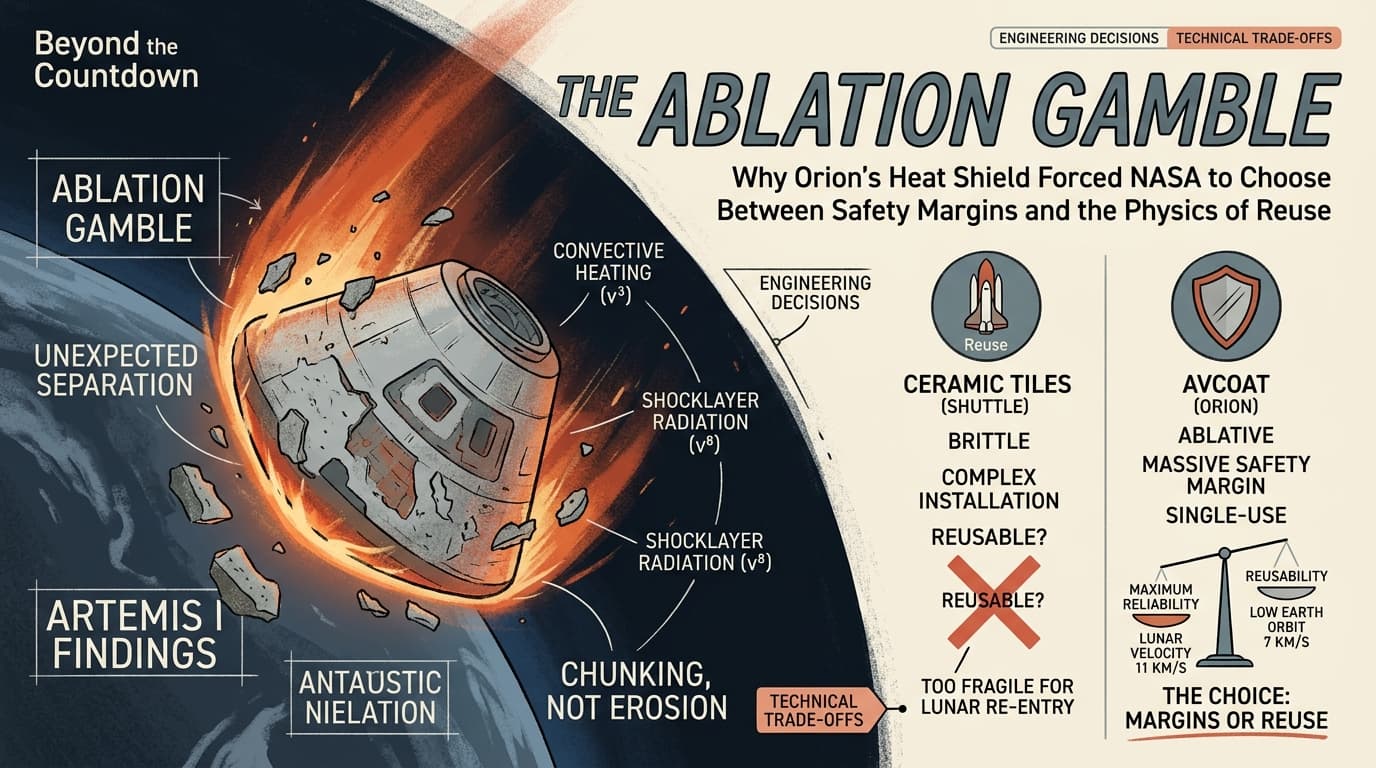

There's a chunk of Orion's heat shield sitting in a NASA lab somewhere that shouldn't exist. After the Artemis I mission returned from lunar distance in December 2022, engineers found that sections of the ablative material at the spacecraft's base had fallen away during reentry — not eroded as designed, but physically separated in chunks. The material had done something unexpected, and for nearly eighteen months, the public didn't know how unexpected.
That gap between event and disclosure became its own story. But the engineering story underneath it — why ablative heat shields behave this way, what the alternatives cost, and what it actually means to design a thermal protection system that balances weight, reusability, and safety margin — is the one that matters for understanding where human spaceflight goes from here.
Thermal protection systems are, in the most fundamental sense, the answer to a physics problem with no elegant solution. As NASA's Johnson Space Center explains it, convective heating scales with velocity cubed, and shock-layer radiation scales with velocity to the eighth power or higher. A spacecraft returning from low Earth orbit hits the atmosphere at roughly 7 km/s. Returning from the Moon, that number climbs to 11 km/s. The heating environment doesn't scale linearly — it explodes. Every design choice in a thermal protection system is a response to that brutal physics, and every choice carries a cost.
Section I: The Three Strategies and What Each Sacrifices
Before getting to Orion specifically, it's worth establishing the design space, because the trade-offs between the three main TPS approaches explain almost every decision that follows.
NASA's own state-of-the-industry assessment organizes thermal protection into three fundamental categories, each representing a different philosophy for managing the same problem.
Reusable TPS — the tile-based systems pioneered by the Space Shuttle — manages heat through insulation and re-radiation. The material stays structurally intact, which is the whole point: fly it again. The Shuttle's silica fiber tiles (LI-900, LI-2200, and their successors) could survive temperatures above 2,000°F and be reflown with minimal refurbishment. The X-37B uses updated versions of this approach today. The cost is that reusable tiles are optimized for the heating environments they were designed for. Push them into a significantly more severe environment — say, lunar return velocities rather than LEO return velocities — and the margins erode fast.
Hot structures take a different approach: build the structure itself from high-temperature materials, typically ceramic matrix composites, so it can absorb and re-radiate heat without separate insulation panels. The advantage is structural efficiency — you're not carrying dedicated TPS mass in addition to your vehicle structure. The disadvantage is that CMC fabrication is expensive, the materials are brittle in ways that require careful design, and reusability depends heavily on protective coatings that degrade.
Ablators are the oldest and, in some ways, most honest approach. You accept that the material will be consumed. The ablative surface decomposes under heating, and the decomposition gases form a protective boundary layer that actually reduces the heat flux reaching the underlying structure. The material recedes, chars, and in doing so, shields everything behind it. Apollo used Avcoat in a honeycomb matrix. Orion uses a modernized version of Avcoat, now cast as discrete blocks bonded to the heat shield carrier structure. SpaceX's Dragon uses PICA — Phenolic Impregnated Carbon Ablator — which NASA also used on the Mars Science Laboratory heat shield.
The ablator's fundamental trade-off is simple: it works extremely well, it handles high-energy environments that would destroy reusable tiles, and it is, by design, consumed in the process. Single-use, or at best, requiring significant refurbishment. For a capsule returning from the Moon at 11 km/s, ablation isn't just an option — it's essentially the only mature technology that provides the required margin.
Which is exactly why what happened to Artemis I's heat shield is so interesting, and so instructive.
Section II: What Orion's Heat Shield Actually Did — and Why It Matters
The Artemis I Orion capsule returned from a 25-day lunar mission in December 2022. During reentry, something happened that the models hadn't fully predicted: sections of the Avcoat ablator didn't just erode smoothly — they liberated as chunks. The char layer, instead of staying in place and doing its insulating job, separated from the underlying virgin material in ways that created localized exposure.
Ars Technica's reporting on the subsequent review process describes the aftermath: NASA was "roundly criticized for its opaque handling of damage to Orion's heat shield," with the seriousness of the problem not publicly disclosed for nearly eighteen months after the mission. NASA's Inspector General eventually published close-up images of the char loss, and an independent review team was convened in April 2024 to assess the agency's investigation.
The engineering question — separate from the transparency question — is what the char loss actually means for the safety margin. Ablative TPS is designed with recession in mind. The models predict how much material will be consumed, and the heat shield is sized to ensure enough material remains at the end of reentry to protect the structure. The question with Artemis I wasn't whether material was consumed — it was whether the mode of consumption (chunking rather than smooth recession) was within the design envelope, and whether the remaining margin was adequate.
By December 2024, NASA formally decided to fly Artemis II with the existing heat shield design. In January 2026, new NASA administrator Jared Isaacman conducted his own review — briefings with senior agency leaders and a half-day session with outside experts — and declared "full confidence in the Orion spacecraft and its heat shield, grounded in rigorous analysis and the work of exceptional engineers who followed the data throughout the process."
That statement is meaningful, but it also illustrates the core tension in TPS safety margin analysis. "Following the data" is exactly what you want engineers to do. The problem is that ablative systems, almost by definition, are consumed during the event you're trying to characterize. You can't inspect the heat shield mid-reentry. You can only examine what's left afterward and reconstruct what happened from that evidence plus whatever instrumentation you had running. The models that predicted the heating environment and the material response are validated against that post-flight evidence — but if the material behaved in an unexpected mode, the validation is necessarily incomplete.
This is the safety margin problem in its sharpest form: you're not just managing uncertainty about the environment, you're managing uncertainty about the material's failure modes. And the two interact.
Section III: The Weight-Reusability Axis and Where TUFROC Sits
The Orion situation represents one end of a design spectrum — a high-energy, single-use ablative system where the priority is surviving an extreme environment with adequate margin, and reusability is essentially off the table. But the broader TPS engineering challenge, especially as the industry moves toward more frequent and more economical access to space, is how to move along the weight-reusability axis without sacrificing the safety margins that ablators provide.
This is where NASA Ames Research Center's work on TUFROC — Toughened Unipiece Fibrous Reinforced Oxidation-Resistant Composite — becomes relevant. TUFROC is a tile-based system designed specifically for space plane applications: vehicles that need to survive high heating rates on leading edges and other high-temperature zones, but also need to be reflown without significant refurbishment.
The TUFROC design addresses a specific gap in the reusable TPS portfolio. Standard silica fiber tiles handle the broad acreage of a vehicle's lower surface reasonably well, but leading edges — wing leading edges, nose caps, control surface edges — see dramatically higher heating rates and require materials with higher temperature capability. The Shuttle used Reinforced Carbon-Carbon (RCC) for these areas, which worked but was heavy, expensive to manufacture, and vulnerable to impact damage (as Columbia demonstrated catastrophically in 2003).
TUFROC's approach is to use a carbon-based cap material bonded to a fibrous insulating substrate. The carbon cap handles the high surface temperatures through re-radiation — it gets extremely hot but stays intact — while the fibrous substrate provides the insulation that keeps the underlying structure cool. The "toughened" and "unipiece" aspects of the design address the impact vulnerability and manufacturing complexity that plagued RCC.
The weight implications are significant. NASA's TPS state-of-the-industry assessment frames the selection process as a multi-variable optimization:


