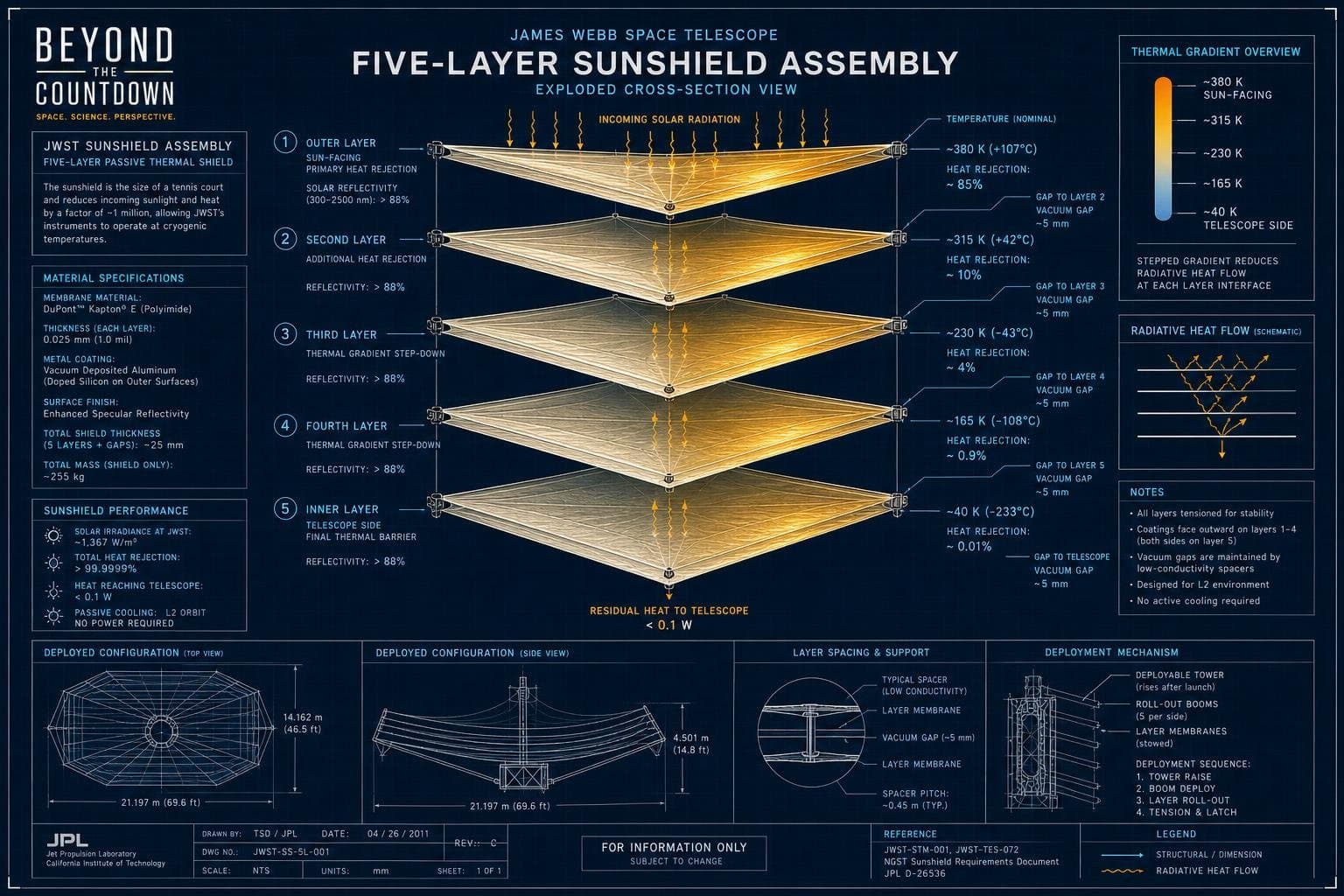

The number that keeps engineers up at night isn't the 344 single-point failures Webb carried into space — though that's alarming enough. It's the temperature differential the sunshield has to maintain: roughly 585 degrees Fahrenheit between the sun-facing side and the cold side where the instruments live. According to NASA's own documentation via spacewar.com, the warm side reaches temperatures close to 400°F while the cold side sits at 185°F below zero. That gap isn't a side effect of the design. It is the design. Without it, Webb's infrared instruments would be blinded by the telescope's own thermal noise.
Getting there required five layers of Kapton film, each as thin as a human hair, unfolding in sequence a million miles from Earth with no possibility of a service call. The engineering decisions embedded in that system reveal a lot about how you solve a problem when "good enough" isn't survivable.
Why Five Layers Instead of One Thick One
The intuitive solution to thermal protection is mass — more material, more insulation. Webb's engineers went the opposite direction. The Northrop Grumman test documentation describes five separate membrane layers, each coated with reflective metal, stacked with precise gaps between them. Each layer intercepts and re-radiates heat from the layer above it, so by the time you reach the fifth layer, the thermal load has been stepped down dramatically rather than absorbed all at once.
This is a fundamentally different thermal strategy than bulk insulation. A single thick barrier would absorb heat and conduct it — slowly, but inevitably. The multi-layer approach turns the sunshield into a series of radiating surfaces, each one cooler than the last, with the vacuum gaps between layers doing the actual insulating work. Vacuum is a near-perfect insulator. The layers exploit that fact rather than fighting it.
The result, as Northrop Grumman's sunshield manager Jim Flynn noted in NASA's test documentation, is an effective sun protection factor of one million — the SPF number that gets cited in press releases, but whose engineering logic is rarely explained. Each layer reduces the thermal load by roughly an order of magnitude. Five layers, five orders of magnitude. The math is elegant; the execution is not.
Kapton Was the Only Material That Could Do This
The membrane choice wasn't obvious. You need something that survives cryogenic temperatures on one face and near-400°F on the other, stays dimensionally stable through the deployment sequence, doesn't outgas in vacuum (which would contaminate the optics), and can be manufactured thin enough to fold compactly inside a rocket fairing.
Kapton polyimide film hits all of those constraints simultaneously. Its molecular structure — built around a five-membered imide ring — gives it a continuous service ceiling of 400°C and cryogenic performance down to −269°C without the progressive softening that limits other engineering polymers. That 669-degree service window, in a single material, is essentially the reason Webb's sunshield is physically possible. The outgassing numbers matter too: Kapton HN returns total mass loss values typically below 1.0% per ASTM E595, meeting the thresholds that protect Webb's optical surfaces on orbit.
The reflective metal coating on each layer handles the radiative side of the equation — bouncing incoming solar energy rather than absorbing it. The Kapton substrate handles the structural and thermal stability side. Neither alone would be sufficient.
The Deployment Problem Nobody Talks About
Here's the constraint that shapes everything else: all five layers had to fold compactly enough to fit inside the Ariane 5 fairing, then unfurl reliably in sequence in microgravity, without tangling, tearing, or failing to separate. Webb's deployment sequence included more than 50 major deployment steps and 178 release mechanisms that all had to work correctly. The sunshield's 295 deployable single-point failures were the largest single category.
Ground testing was genuinely difficult. As Flynn explained in the Northrop Grumman test documentation, gravity makes ground testing of a tennis-court-sized membrane deeply misleading — the layers sag and interact in ways they never would in microgravity. The test team's solution was to rest the layers on a structure of metal beams covered in plastic, simulating the zero-g separation behavior as closely as possible. It took seven engineers and six technicians about 20 hours to complete a single three-day test cycle. On orbit, the same sequence took several days to execute autonomously.
That asymmetry — weeks of ground testing per day of flight operation — is the hidden cost of deployable systems. You can't test the real thing in the real environment. You build confidence through analogy and modeling, then commit.
What the Sunshield Actually Proves
Webb's thermal architecture is a case study in constraint-driven elegance. The five-layer Kapton design didn't emerge from a preference for complexity — it emerged from a set of requirements that ruled out every simpler alternative. One thick layer conducts. Fewer thin layers don't step down the temperature enough. A different material either outgasses, softens, or fails at cryogenic temperatures. The solution space was narrow, and the engineers found the path through it.
The next time you see a Webb image — a galaxy cluster, a stellar nursery, an exoplanet atmosphere — the science is real, but so is the folded membrane that made it possible, sitting a million miles away, doing its job one layer at a time.


