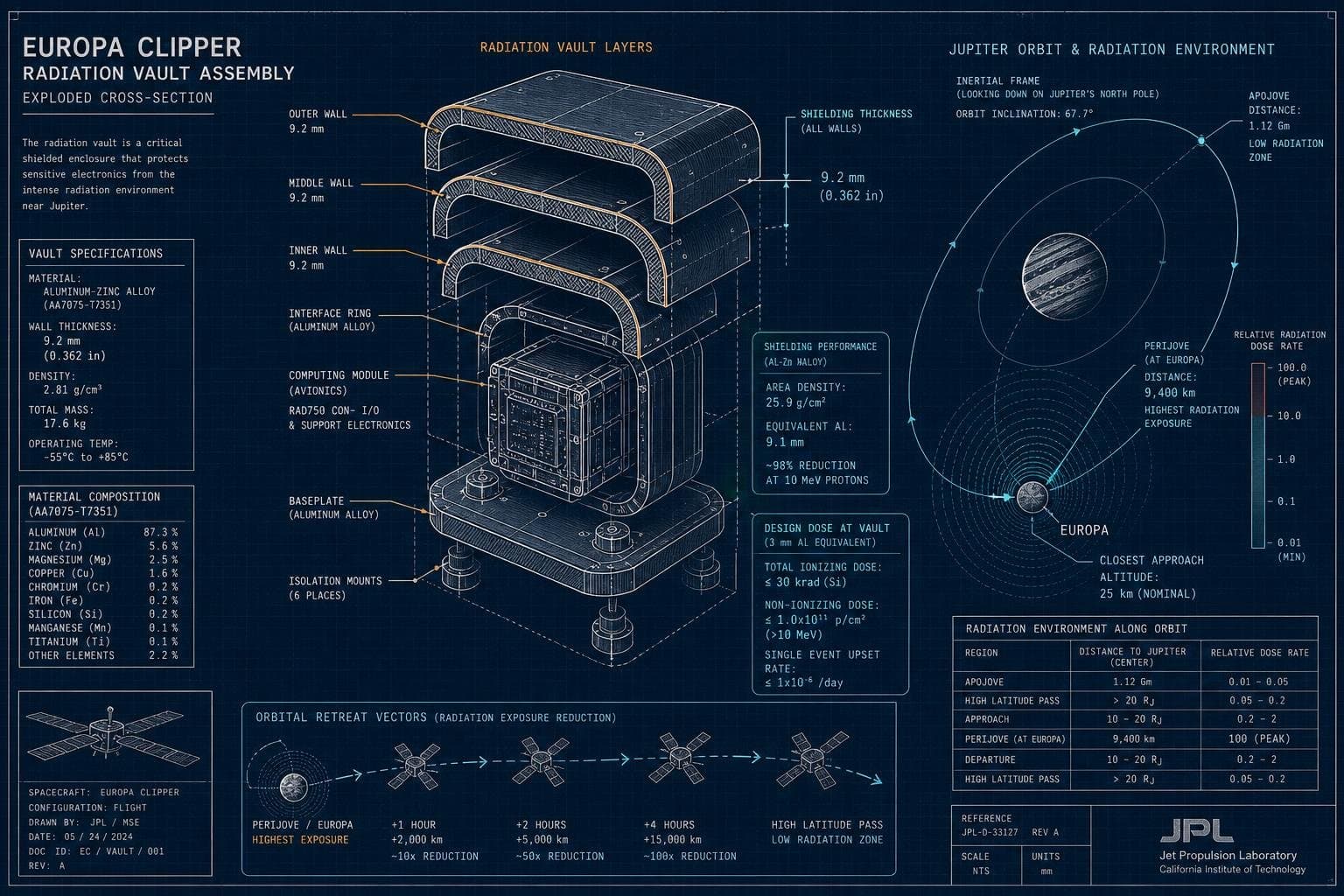

Nine millimeters of aluminum-zinc alloy doesn't sound like much. But that's the thickness of the walls protecting Europa Clipper's most critical electronics from one of the most radioactive environments in the solar system — a vault with 9.2 mm walls built specifically to keep the spacecraft's onboard computers alive long enough to do their job.
What's interesting isn't the vault itself. It's that the vault is the second layer of a two-part strategy, not the whole plan. Jupiter's radiation problem is bad enough that shielding alone was never going to be sufficient. Engineers had to design the mission's orbit around the physics of the threat before they ever got to material science.
The Radiation Problem Starts With the Orbit, Not the Metal
Jupiter's magnetic field traps charged particles into what Europa Clipper's chief engineer in operations, Tracy Drain, has described as a "giant donut of radiation" surrounding the planet — a band of high-energy particles intense enough to fry unprotected electronics fast, as she laid out in her May 2025 Watson Lecture, recapped by Caltech Magazine. Europa itself sits deep inside that band, which creates an unavoidable exposure problem: the moon the mission needs to study is parked in the worst part of the neighborhood.
The response wasn't just thicker walls. It was trajectory design. Rather than settling into orbit around Europa the way a lunar orbiter circles the Moon, Clipper flies an elliptical path around Jupiter itself, diving in for close flybys of Europa and then retreating to lower-radiation regions of the Jovian system to downlink data before the next pass. According to the mission's science overview, the spacecraft is planned to execute 49 such flybys after Jupiter orbit insertion, at closest-approach distances as tight as 25 to 100 kilometers — brief, targeted exposure instead of sustained bombardment, per the peer-reviewed mission overview. The vault matters enormously, but it's shielding against a dose that the orbit design already cut down dramatically. Skip the orbital strategy and no amount of aluminum-zinc alloy saves you.
Radiation Hardening Isn't One Spec — It's a Stack of Them
The vault protects the spacecraft's central computing, but individual instruments still need their own defenses, because not every sensor can live inside the vault and still do its job. Redwire's Digital Sun Sensor system, which supplies Clipper's attitude-determination data, had to be radiation-hardened on its own terms: every component in the sensor's electronics processor is rated to withstand a minimum of 300 krad, which Redwire calls the most radiation-hardened sun sensor processor the company has built, according to its engineering writeup.
That number is the kind of spec that looks arbitrary until you ask what it's actually solving for. Jupiter's radiation environment isn't the only design pressure on the sun sensor — it also has to function correctly across a wildly different signal range than most sun sensors ever see. Clipper launched via gravity assists past Mars and Earth before heading outward, meaning the same sensor has to read a strong solar signal near Earth and a signal roughly 1/25th as intense once it arrives at Jupiter's distance, a gap Drain has framed as the reason the mission needed the largest solar arrays ever flown on a planetary spacecraft — wide enough to hang off the edges of a basketball court, per the Caltech lecture recap. Redwire's fix was multiple gain settings inside the sensor's amplifiers, letting the same hardware handle both extremes without swapping components mid-mission, as the company explains.
That's the pattern worth sitting with: radiation hardening isn't a single switch you flip. It's a stack of decisions — orbit geometry to limit total exposure, a shielded vault to protect the computing core, component-level hardening for the sensors that can't be tucked inside the vault, and adaptive electronics to handle the operating range those sensors will actually see across the whole trip. Pull out any one layer and the others have to absorb more than they were designed for.
What to Watch as Clipper Closes In
Europa Clipper launched in October 2024 and is expected to enter Jupiter orbit in 2030, per the mission's science overview — which means the vault, the sensors, and the orbit-design bet are all still years from their real test. The interesting engineering data won't show up at arrival. It'll show up flyby by flyby, as mission teams track how much dose the vault's electronics actually absorb against pre-launch models, and whether the elliptical retreat-and-return orbit performs the way the radiation math predicted. That comparison — modeled exposure versus measured exposure — is where this design either earns its reputation or reveals what got underestimated.


