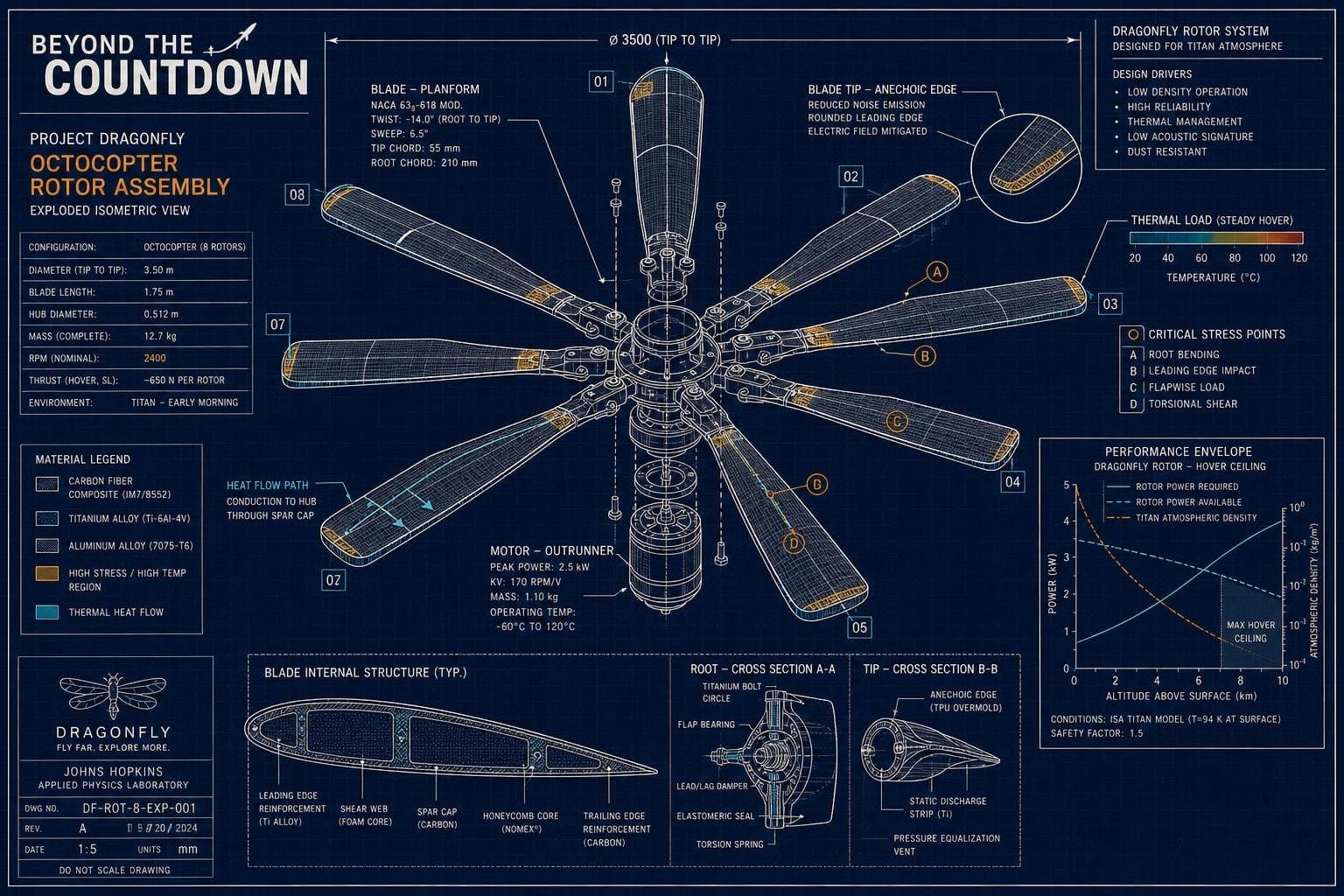

The headline event isn't a liftoff. It's a simulation that ran on a rack of flight-like avionics in Laurel, Maryland, where engineers watched a virtual Dragonfly separate from its backshell, scan Titan's dunes for a safe spot, circle back, and touch down — all without a human in the loop (NASA Science). No atmosphere, no plutonium generator, no real moon. Just code deciding, in real time, whether an octocopter the size of a small car can land itself on an alien world eight years from now. That gap — between a convincing simulation and the actual physics of Titan's air — is where the rotor engineering lives.
Why Titan Is the One Place in the Solar System Where This Works at All
Dragonfly is a dual-quadcopter: eight rotors, no wheels, built to hop across Titan rather than crawl (Tech Briefs). That architecture only makes sense because of what Titan offers that nowhere else does: a dense atmosphere paired with low gravity, a combination that lets a roughly 450 kg vehicle generate lift with comparatively modest power, covering hops of up to 8 km at a time (Space Group). That's the trade nobody gets on Mars, and it's worth sitting with for a second, because it inverts the usual intuition about flying on other worlds.
Everywhere else in the solar system, thin air is the enemy. On Titan, the air is the ally — the problem shifts somewhere else entirely.
The Mars Comparison Shows Where the Hard Part Actually Is
NASA's own work on Mars helicopter blade design makes the contrast useful. Engineers there are chasing longer flights on a world where the atmosphere is so thin that rotor blades have to spin extremely fast just to generate meaningful lift, pushing blade tip speeds and structural limits hard (NASA). That's the Ingenuity-class problem: not enough air, so you compensate with speed and you pay for it in stress on the blade and reduced flight time.
Dragonfly's rotors don't have to fight that battle. With a thicker atmosphere doing more of the lifting work, the blades can turn slower for the same lift — which matters for power budgets, for acoustic and vibration loads on a fragile science payload, and for the kind of lift-to-power margin that lets a vehicle survive repeated touch-and-go landings on sand dunes nobody has ever seen up close. It's a reminder that rotor trade-offs aren't a space-only problem — terrestrial and defense programs wrestle with the same compromises between lift efficiency, speed, and structural load, which is part of why Airbus is pursuing a compound rotorcraft approach for a NATO helicopter requirement rather than a conventional design (Aviation Week). Different mission, same underlying arithmetic: lift, power, and structure always have to be negotiated together.
The engineering question for Dragonfly isn't "how do we generate enough lift in almost nothing." It's "how do we manage a vehicle, a generator, and a science payload across years of autonomous hops in an environment where temperatures sit far below anything terrestrial hardware was designed for." The atmosphere stopped being the obstacle. Everything downstream of it — power, autonomy, structural endurance over a three-year surface mission — became the obstacle instead.
That's the quiet reframe hiding in this mission. People hear "flying robot on Saturn's moon" and picture the hard part as aerodynamics. The sourced reality points somewhere else: toward a Pu-238-powered generator sized to survive a six-year cruise and three years of surface operations, and toward an autonomy stack that has to make landing-site decisions with no real-time human oversight possible across that distance (Space Group). The rotors are arguably the part of this mission that's least likely to surprise anyone, because Titan's atmosphere hands them a better deal than any other rotorcraft in history has gotten.
What the Simulated Flight Actually De-Risked
The October test matters because it exercised most of the systems and maneuvers Dragonfly will need at Titan, on the actual flight-like computer hardware that will fly, not a generic desktop model (NASA Science). That's a meaningful distinction for anyone who's shipped embedded systems: testing your control logic on the target silicon, with the timing constraints and latency of the real flight computer, catches a different class of bug than testing it on a workstation. It doesn't prove the rotors will perform as modeled in Titan's actual atmosphere — nobody gets that confirmation until arrival at Titan, following a launch no earlier than 2028 (Tech Briefs). What it proves is that the decision-making loop — sensing, path planning, landing-site selection — can run end to end on the hardware that has to make those calls a billion kilometers from the nearest human, piloted by a mission team led by Elizabeth "Zibi" Turtle at Johns Hopkins Applied Physics Laboratory (Space Group).
Watch for how APL sequences the next round of testbed runs as the mission closes in on its 2028 launch window — each one is another chance to find out what the simulation didn't catch before Titan's atmosphere gets the final word.


