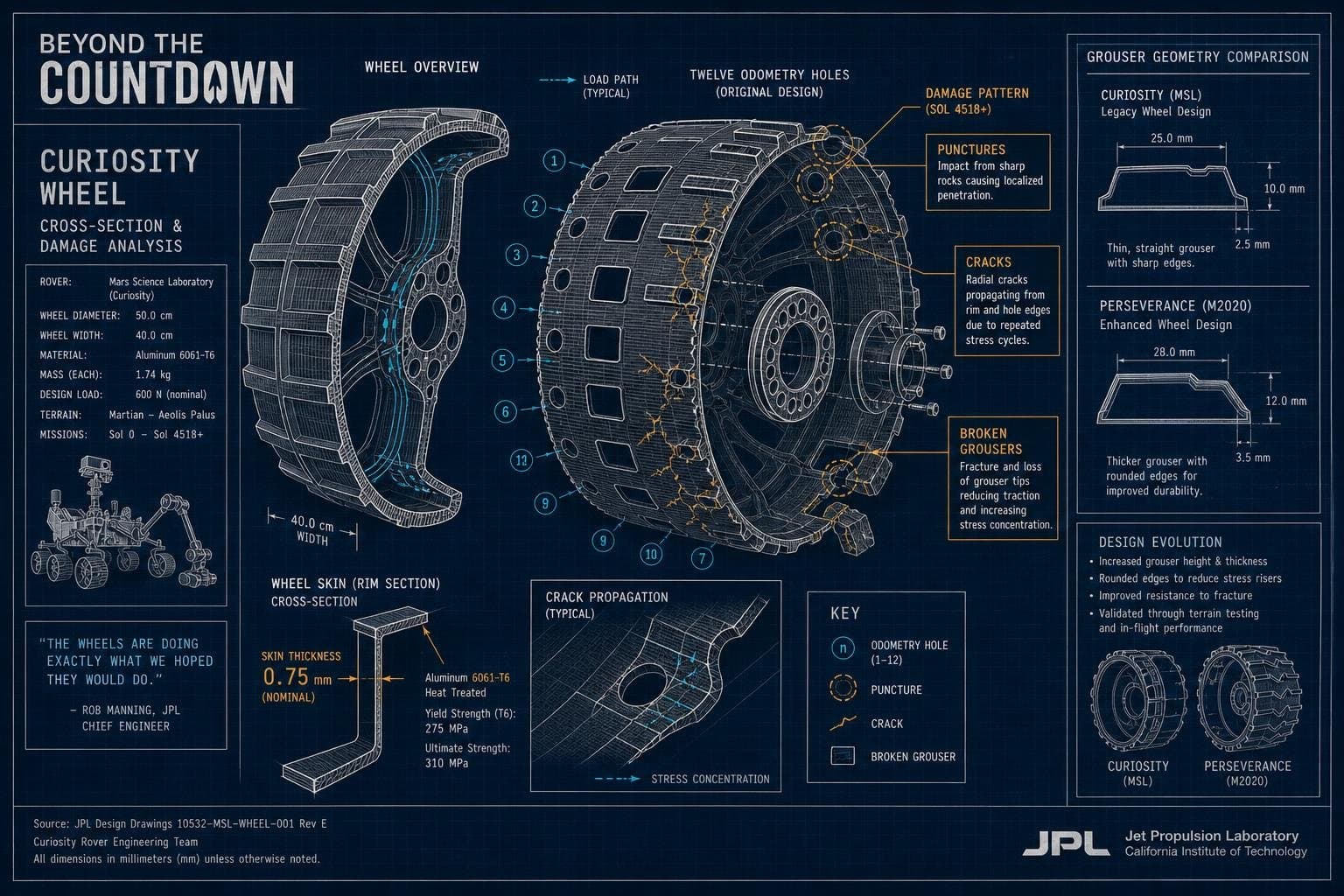

The original twelve holes in each of Curiosity's wheels were deliberate. Drilled at the factory, spaced precisely, they were odometry markers — a way to count rotations and track distance traveled. Everything that came after was unplanned.
By 2026, those wheels are riddled with damage: holes punched through the skin, cracks propagating along the rims, broken grousers — the raised ridges that provide traction. What happened to Curiosity's wheels is one of the most instructive engineering failure modes in the history of planetary exploration, and it directly shaped how Perseverance was built.
The Design That Made Sense Until Mars Disagreed
Curiosity's wheels were machined from solid aluminium blocks — each about 50 centimeters across, with a skin only 0.75 millimeters thick, roughly half the thickness of a US dime. That thinness wasn't carelessness — it was the minimum the machining process could reliably produce while keeping mass down. Nineteen grousers ran around each rim to grip the surface.
The logic was sound. The testing was not. Engineers began seeing damage accumulate faster than expected around 2013, about fourteen months into the mission. Mission engineer Matt Heverly later described the culprit: exposed bedrock sharpened by millions of years of wind erosion — ventifacts, in geological terms. The ground tests on Earth had never reproduced this specific hazard. Heverly was direct about it: the team "did not test in a relevant way," and while some wear was expected, "the rate of damage accumulation was much faster than we expected."
The first two grousers broke in early 2017, after roughly 16 kilometers of driving. By 2021, four had broken. The structural concern isn't cosmetic — grousers are load-bearing. Lose enough of them and the wheel loses its ability to grip and distribute load, which on a rover that cannot be serviced means mission end.
What Perseverance Changed — and What It Didn't
Perseverance launched in 2020 with a different wheel geometry. The team widened the wheels, reduced the number of grousers, and curved them — a curved grouser deflects point loads rather than absorbing them directly, distributing stress across a larger arc. The skin thickness increased. The result is a wheel that's heavier but substantially more resistant to the puncture-and-crack failure mode that plagued Curiosity.
This is the classic constraint negotiation in rover design: mass budget versus durability. Every gram on a rover is a gram that had to survive launch loads, transit, and entry. Curiosity's thin wheels were a reasonable mass optimization given what engineers knew at the time. Perseverance's heavier wheels represent the updated prior — the cost of not knowing what Martian ventifacts would do to aluminium.
The ongoing Curiosity wheel monitoring — still active as of late July 2026, with the rover approaching its 14th year on Mars — continues to generate data on long-duration wear patterns that no Earth test can replicate. In that sense, Curiosity's damaged wheels are still doing science. That same spirit of extracting value from wear data is visible in how the current Curiosity team operates: carefully sequencing every arm placement and drive across challenging terrain in Gale Crater, treating each sol as a precision exercise in working within the vehicle's remaining margins.
The Deeper Problem: You Can't Steer Around What You Can't See in Time
Wheel design is only half the equation. The other half is path planning, and here the constraint is physics rather than materials.
Because of the signal delay between Earth and Mars, there is no real-time joystick control — a hazard spotted on camera cannot be avoided by a driver reacting to it. Every drive is scripted in advance, planned in centimeters by a team working on Mars time. The rover's onboard hazard avoidance system provides a last line of defense, but it operates on limited sensor data and cannot identify the specific rock sharpness that tears aluminium.
This is why the wheel damage problem is fundamentally unsolvable through design alone. You can make the wheels tougher — Perseverance did — but you cannot eliminate the gap between what ground tests reveal and what Mars actually delivers. The terrain is the variable you cannot fully characterize until you're on it. It's a constraint that applies equally to future crewed surface systems, where the stakes of under-characterized terrain go well beyond a broken grouser.
What you can do is build in margin, monitor obsessively, and update the design for the next mission. That's the engineering discipline Curiosity demonstrated, even while being damaged by it. Perseverance's wheels will wear too. The question Artemis-era surface missions will have to answer is whether the lesson generalizes further — to human-rated vehicles operating on terrain we've characterized even less than Gale Crater. Curiosity's odometry holes were the only deliberate damage. Everything that followed was Mars writing its own specifications.


