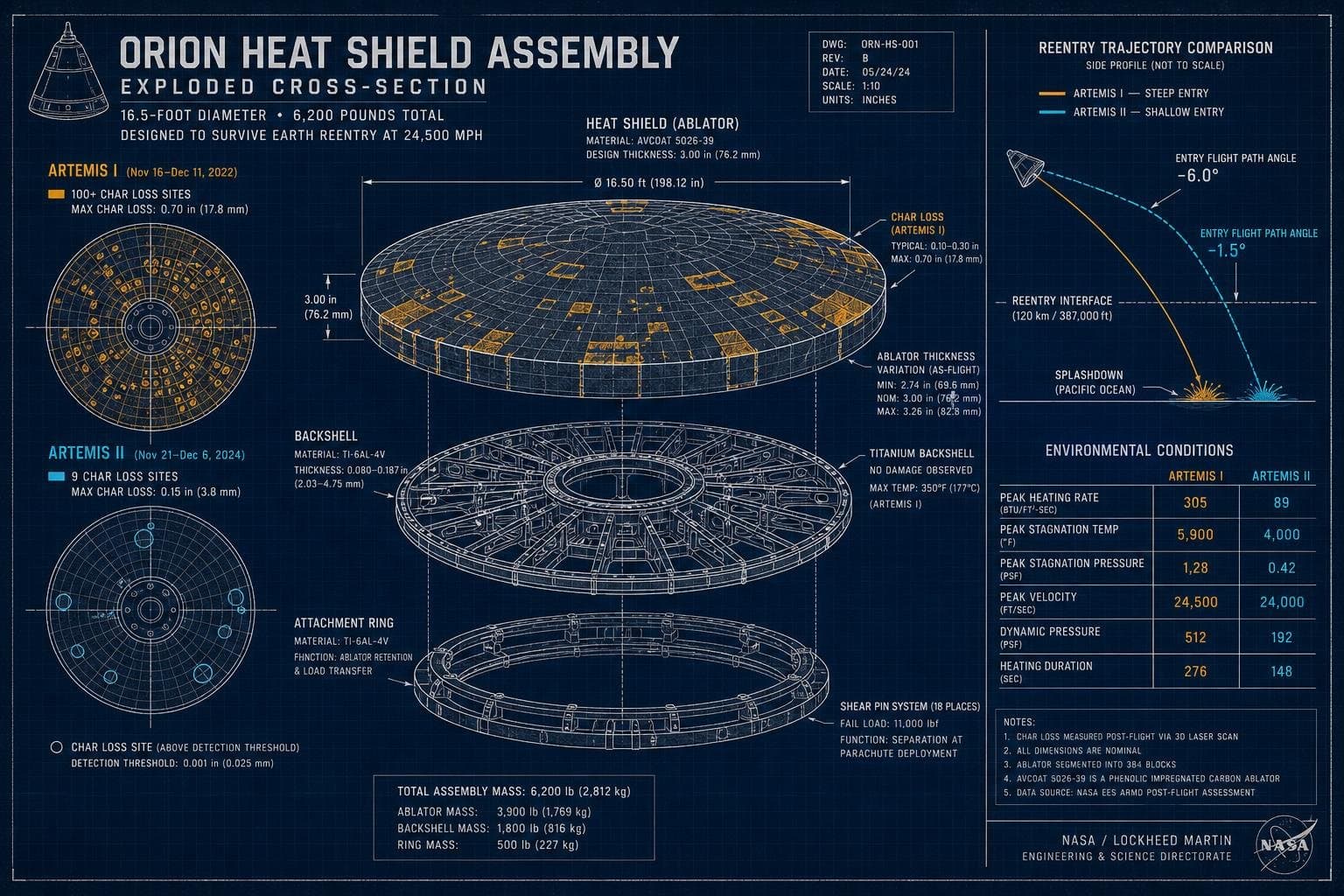

The number that matters most from Artemis II's return isn't the splashdown time or the crew's heart rates. It's the difference between 100 and 9.
After Artemis I's December 2022 reentry, inspectors found more than 100 char loss sites across Orion's heat shield, some deeper than an inch. After Artemis II splashed down in the Pacific this spring, that number had dropped to approximately nine. Paul Hill, former director of Mission Operations at NASA and a member of the Aerospace Safety Advisory Panel, called the condition of the shield "highly satisfying" following a review at Ames Research Center. That's not just a better result — it's a data point that reshapes how NASA thinks about flying humans to the Moon and back.
But here's the engineering wrinkle worth sitting with: NASA didn't fix the heat shield. They changed the trajectory.
The Material Didn't Change — The Conditions Did
At the base of Orion sits a 16.5-foot ablative heat shield made from 186 individually bonded blocks of Avcoat — a reformulated version of the material Apollo capsules used. Avcoat works by charring and ablating during reentry, carrying heat away from the vehicle rather than conducting it inward. The blocks are bonded to a titanium skeleton and composite skin that also carry structural loads after service module separation.
The Artemis I failure mode was specific and instructive. Post-flight analysis found that the Avcoat material was effectively "impermeable" — it couldn't breathe. During reentry, gases generated by the ablation process became trapped inside the material, building pressure until the char layer cracked and shed chunks. The skip-entry trajectory Artemis I used created a prolonged heating environment that gave those trapped gases time and energy to cause damage. NASA's Aerospace Safety Advisory Panel review confirmed that this outgassing mechanism was the root cause.
NASA faced a classic constraint-optimization fork: redesign the material, or redesign the conditions. Redesigning the material meant qualifying a new Avcoat formulation — time, cost, and the risk of introducing new unknowns before a crewed flight. So they chose the trajectory. For Artemis II, engineers modified the reentry profile to a steeper angle, spending fewer minutes in the outgassing-prone heating regime that caused Artemis I's problems.
The trade was explicit and quantified. The steeper profile reduced Orion's downrange capability — the distance the capsule can travel relative to Earth's surface from the point of atmospheric entry — from 4,800 nautical miles to 1,775 nautical miles. That's a significant reduction in landing zone flexibility. If weather closes a primary splashdown site, you want options. The new trajectory narrows them considerably.
What the Reentry Environment Actually Demands
To understand why this trade-off is so consequential, the numbers need to be concrete. Orion returns from lunar distance at roughly 25,000 miles per hour, and the bottom of the capsule must survive temperatures approaching 5,000 degrees Fahrenheit. The heat shield is oriented to absorb all of that heat load the moment the service module separates — a separation that happens just 44 minutes before splashdown, exposing the shield for the first time in flight.
Flight director Jeff Radigan put the precision requirement plainly before Artemis II's return: "We have to hit that angle correctly." The heat shield has no margin for error and no second attempt. It's a single-use component by design — ablation is the mechanism, not a side effect. That's the fundamental tension with any reusability ambition: the material works by destroying itself.
Artemis II's mission objectives included evaluating a range of technologies critical to future lunar expeditions, and the heat shield reentry was among the highest-stakes of those evaluations — the one that had to work, with crew aboard, after the Artemis I anomaly had raised serious questions about the design.
The Forward Problem: Trajectory as a Workaround Has Limits
The Artemis II result is genuinely good news, and the safety panel's confidence in future missions is warranted on the data. But the trajectory fix is a workaround, not a solution. For Artemis III and beyond — missions that will carry crew to lunar orbit and eventually to the surface — mission planners will want that downrange flexibility back. A crewed lunar landing mission has enough variables without also accepting a constrained splashdown window.
That points toward the material question eventually reasserting itself. NASA has been exploring next-generation thermal protection approaches, including 3D woven composite TPS materials that could offer different permeability and structural characteristics than block-bonded Avcoat. Whether any of those paths reaches Orion's heat shield before Artemis III is the engineering decision worth watching.
For now, the nine-versus-one-hundred comparison is the headline. But the more interesting number is 1,775 — the nautical miles of downrange capability NASA traded to get there. Every future mission planning discussion starts from that constraint.


