


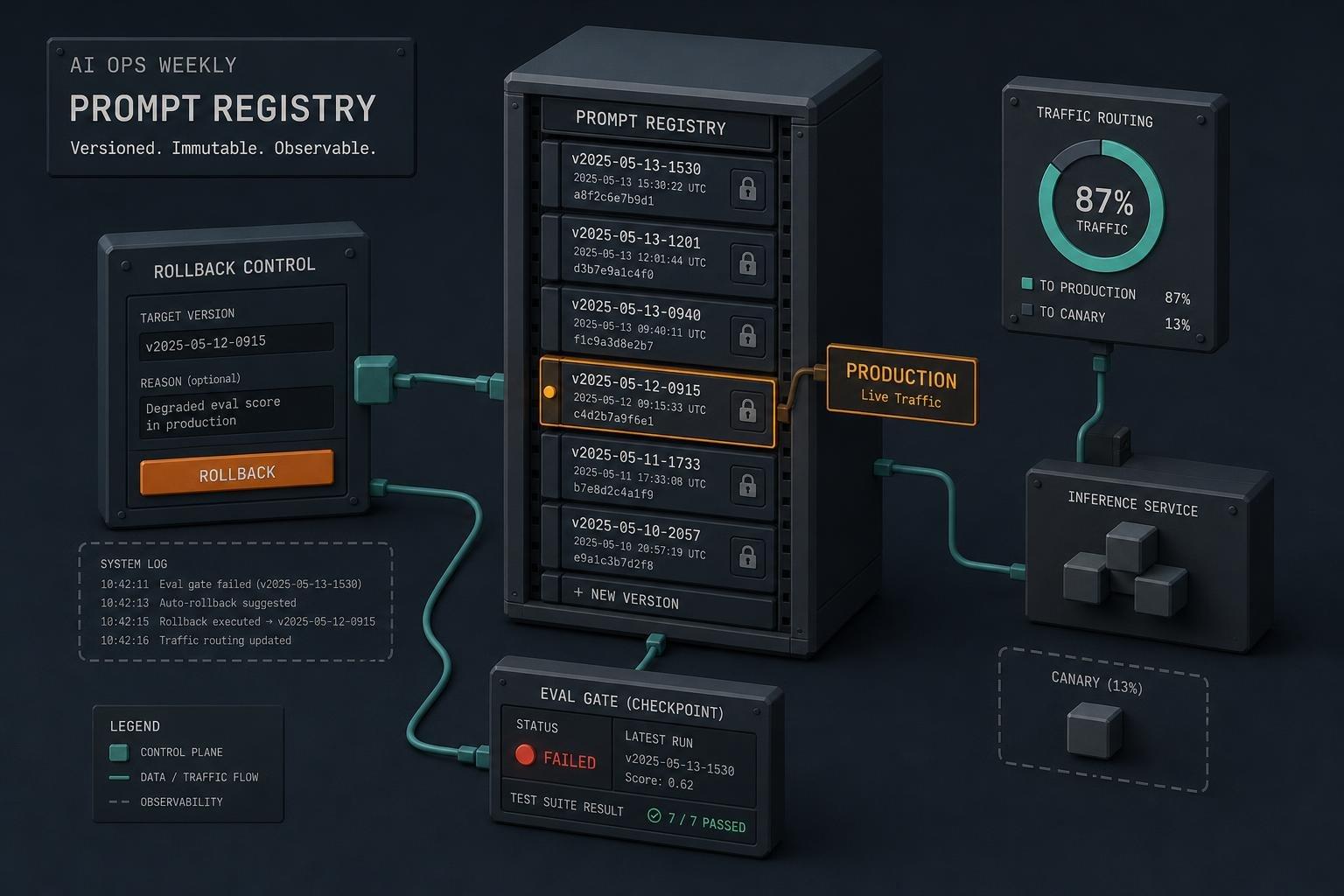

A support bot starts approving refunds it was never supposed to touch. Git shows nothing unusual — no merge, no deploy marker, no red build. The thing that changed was a sentence in a system prompt, and nobody can say when, why, or by whom, because the prompt was never treated as a release artifact in the first place (excellentwebworld.com).
I wrote about treating prompt changes like code changes back in June. The part I underweighted then is the part that actually bites teams in an incident: not whether you version prompts, but whether you can roll one back in the same amount of time it takes to revert a bad deploy. Most teams can revert a Kubernetes rollout in one command (qovery.com). Far fewer can tell you, at 2am, which prompt version is currently serving traffic, let alone flip it back.
The gap isn't storage, it's "what's live right now"
Storing prompts in files is the easy 80%. Teams that skip versioning entirely usually graduate to dumping prompt text into a YAML file in the repo, which solves diffing but not the harder question: which version is actually running in production this second? Prompt management tooling exists specifically to answer that query in one shot rather than an hour of grepping logs and Slack threads (langwatch.ai).
The pattern that actually works borrows directly from release engineering: every save creates an immutable, uniquely identified version — never an in-place edit — and a separate, movable label (production, staging) points at whichever version should be live (mlflow.org). Code should never request "the latest prompt." It should request a pinned version number, or a label that someone deliberately reassigned (opusjake.ai). That distinction is the whole ballgame. Pinned versions suit a small team shipping through Git normally. Labels suit teams where a PM needs a wording fix live same-day without waiting on a deploy. Either way, every output gets logged against the exact version that produced it, so "which prompt wrote this" stops being archaeology.
Rollback is a label flip, not a redeploy — if you built it that way
Here's the part that actually determines your incident response time. If your prompt lives embedded in application code, rolling back a bad prompt means rolling back a binary — full redeploy, full blast radius, whatever else happened to be in that commit along for the ride. If your prompt lives in a registry with a movable production label, rollback is reassigning that label to the last known-good version, no redeploy required (langwatch.ai). Done right, that's a sub-minute operation, not an on-call engineer waiting on a CI pipeline (opusjake.ai).
Checklists for moving agents into production now list versioning, logs, and rollback as co-equal requirements alongside cost controls and access controls — not nice-to-haves bolted on after launch (sim.ai). That's the right instinct, but it only pays off if rollback was designed in from day one. Bolting a rollback path onto a prompt-in-code setup after the first incident is exactly the kind of "complete rewrite under pressure" that production checklists warn against.
Review has to gate the label flip, not just the merge
Branching and pull-request review for prompts is table stakes now — most teams I talk to have that part. The part that's still missing is the gate between "reviewed" and "live." A code review approves a diff; it doesn't tell you the new prompt still passes your eval set against a golden dataset, and drift in answer quality doesn't throw an error the way a failed test does (excellentwebworld.com). The teams getting this right wire a smoke eval set into every PR and a full eval set before any label reassignment, treating a two-word prompt edit with the same CI gate as a model swap (futureagi.com). Without that gate, you've built a very fast way to ship a regression with full confidence it's reviewed.
The discipline that matters isn't picking a registry tool. It's making sure three things are true simultaneously: every version is immutable and traceable to an output, the thing pointing at "production" is a label you can move in seconds, and nothing moves that label without clearing an eval gate first. If any one of those three is missing, you don't have prompt versioning — you have prompt storage, and storage doesn't help you at 2am when the refund bot needs to stop approving things it shouldn't.