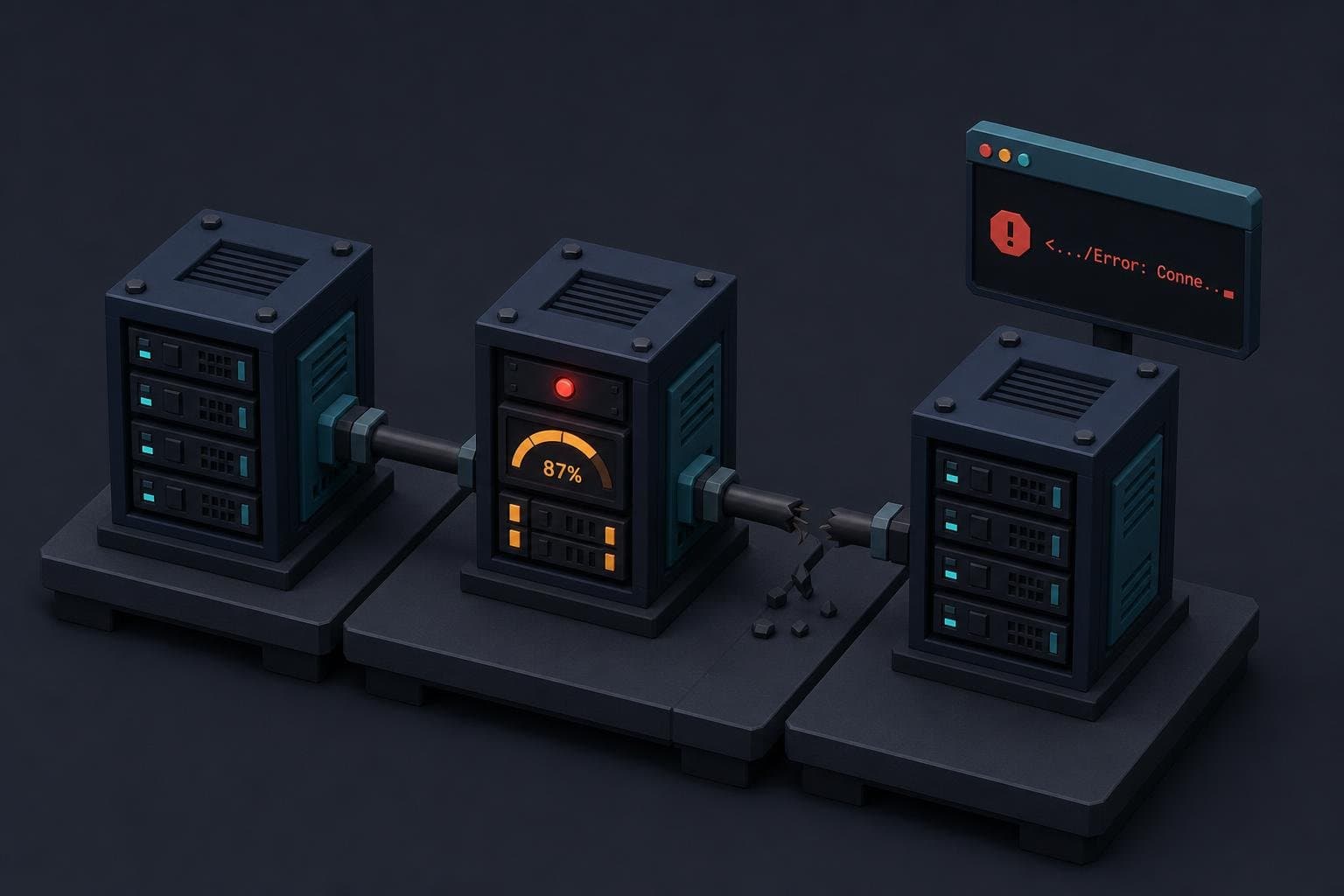

Most teams discover their LLM fallback strategy is broken at the worst possible moment: not during a 503 from a provider, but three steps later, when a downstream service starts behaving strangely and nobody can explain why the dashboard stayed green the whole time.
The failure mode is more subtle than an outage. Outages are easy. You get an error, you page someone, you fix it. The dangerous failure is the one that reports 100% completion while dropping schema integrity to 0%.
That's the real problem with naive fallback chains.
The Payload Problem Nobody Talks About
Here's what actually happens when you hit a rate limit mid-pipeline and your retry loop swaps to a backup model: you hand that backup model a payload formatted for a different engine. The request shape may be similar — almost every major provider now speaks OpenAI's chat API dialect, so the call succeeds — but "compatible" quietly stops meaning "identical" the moment you're dealing with structured JSON outputs, tool schemas, or tightly coupled agent steps.
A practitioner building a three-agent pipeline — Planner, Executor, Validator running sequentially — hit this exactly. The Executor hit a 429 mid-run. The retry loop swapped models. The pipeline reported success. But the confidence key was missing from the output, and the result field contained "incomplete – schema mismatch during swap". The Validator received structurally broken input and had no way to know it. The data went into the database anyway.
A crash would have been better. A crash forces an immediate fix. Silent data corruption slips through unnoticed.
The fix requires three things the basic retry loop doesn't do: catch the error before passing data downstream, rebuild the payload for the backup model's expectations, and save the agent's progress state before the swap so you can resume rather than restart. That's not a fallback — it's a recovery layer. The distinction matters operationally.
Provider Outages Are More Common Than Your Incident Count Suggests
If you haven't built this yet, the urgency is real. Anthropic experienced major outages on March 2, June 2, and June 18, 2026, with disruptions hitting the web interface, developer console, and the Claude Code platform simultaneously. These weren't brief blips — they were prolonged enough that development cycles stalled and customer-facing bots went silent.
The pattern is predictable: a model gains adoption, becomes load-bearing for production workflows, and then its own popularity triggers instability during traffic surges. Deployflow describes this as the "success tax" — the tool becomes so essential that its sudden popularity triggers its own collapse. Single-vendor dependency turns their downtime into your operational crisis.
The abstraction layer tools like LiteLLM offer are genuinely useful here — unified routing across providers, automatic failover, cost tracking per model. But the supply chain risk is real too. In March 2026, LiteLLM versions 1.82.7 and 1.82.8 were compromised in a PyPI supply chain attack, with attackers slipping a credential-stealing payload into official releases. The malicious versions were live for roughly two hours before detection. If you're using LiteLLM as your routing layer — and many teams are — your dependency management and version pinning strategy is now part of your fallback chain's threat model.
What a Production-Grade Fallback Chain Actually Requires
Routing traffic to a backup provider when the primary throws a 503 is table stakes. The harder engineering is everything around it:
Schema-aware payload translation. Before handing off to a backup model, your recovery layer needs to know what the backup model expects and transform the request accordingly. This is especially critical for tool-use schemas — LiteLLM 1.89.0 shipped a fix for Anthropic and Fireworks tool schema compatibility specifically because inline $ref definitions were causing 400 errors on schema validation. That's a silent failure waiting to happen in a fallback scenario.
State preservation before the swap. In multi-step pipelines, the swap point matters as much as the swap target. If you lose the agent's progress state during a model switch, you're not failing over — you're restarting, which compounds the latency hit from the original failure.
Monitoring schema integrity, not just uptime. Your dashboards tracking API response codes and thread completion are measuring the wrong thing for AI pipelines. A green dashboard with corrupted downstream data is worse than a red one, because at least the red one tells you something is wrong. Add schema validation checks at each pipeline stage as a separate signal from process completion.
Dependency hygiene as operational practice. Pin your LiteLLM version. Verify image signatures if you're running the proxy container. The supply chain attack vector is now documented and real — treat your AI routing library with the same scrutiny you'd apply to any dependency sitting in front of your credentials.
The teams getting this right aren't the ones with the most sophisticated routing logic. They're the ones who started from the failure case — what breaks when the swap happens mid-pipeline — and built backward from there.


